Just a very quick one today, but spring’s here and that means the buds on the hedgerows are starting to burst with the vivid green leaves again. And that Saturn yellow vest you’ve been wearing all winter? It’s now acting more like camouflage than a conspicuity aid.
———————– Find out more about the Science Of Being Seen #SOBS on the FREE www.scienceofbeingseen.org website An in-depth look at the facts behind conspicuity! ———————–
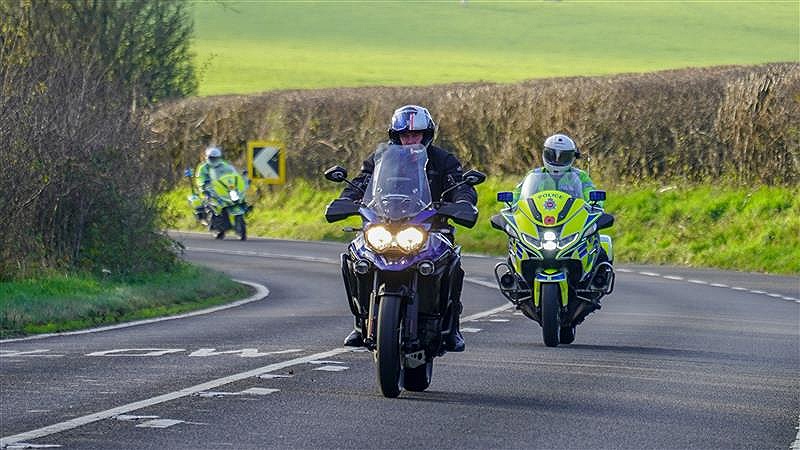
Check out the photo, clipped from a BikeSafe page. Spot the bikes. Does one rider and machine stand out rather better than the other two? Is one bike harder to spot than the other two? It’s thanks to the grass bank, and the effect of contrast. And just wait till the hedgerow in the background comes into leaf!
My personal recommendation for rural riding at this time of the year is always pink but I can understand if you don’t fancy that colour. Try orange instead!
——————————— IF YOU THINK THIS POST HIT THE SPOT please pay it forward to other bikers! Like ✔ Comment ✔ Share ✔ Follow ✔
ANSWERING QUESTIONS NO-ONE ELSE ASKS FIND OUT how you can get Survival Skills! visit us at www.survivalskills.co.uk
There’s a rather well-written post on LinkedIn called ‘Looked but failed to see – the hidden danger lurking in plain sight’ by Steven Gibb, a ‘driver training specialist’.
“Have you ever heard a driver say, “I looked, but I never saw them”? This common phrase is at the heart of one of the most dangerous cognitive failures on the road: Cognitive Perception Failure (CPF).”
He continues: “CPF is responsible for a significant number of collisions involving motorcycles, pedestrians, cyclists, and even emergency vehicles. Drivers often check their surroundings yet fail to perceive critical hazards—resulting in potentially fatal consequences.”
Steven says that there is “science behind cognitive perception failure” and that “CPF is not about poor eyesight—it’s about how the brain processes visual information. Research highlights several key reasons why drivers miss hazards, even when looking directly at them”.
Steven correctly says that amongst the real-world consequences are motorcycle and bicycle accidents including “the infamous “Sorry Mate, I Didn’t See You” (SMIDSY)” which results when drivers “fail to register their presence”.
And he goes on to talk about:
inattentional blindness
saccadic masking
expectation bias
cognitive load and distractions
If you’re a regular here, you’ll almost certainly have realised that everything in Stephen’s LI post are topics covered in ‘Science Of Being Seen’, the presentation I created as long ago as early 2012 when SOBS debuted as the third module for the pilot Biker Down courses.
SOBS also talks about some other very important perceptual issues, including motion camouflage and our remarkable inability to firstly see what we’re not expecting and secondly guess what we might not be seeing (both exploited by magicians).
SOBS also talks about the ‘looked but COULD NOT see’ and ‘looked, saw and MISCALCULATED speed and distance’ issues that cause a significant chunk of the collisions at junction.
And of course, SOBS also debunked the simplistic “put your lights on and wear hi-vis and you’ll be seen” road safety advice by examining the effect of contrast camouflage, then pointed out the absolute requirement for riders to understand the importance of pro-active evasion and avoidance techniques to escape the moment we’re NOT seen.
================================= WHAT IS SCIENCE OF BEING SEEN? (SOBS) SOBS is my in-depth investigation into the ‘Sorry Mate, I Didn’t See You (SMIDSY) collision between motorcycles and other vehicles. Created for the fire services ‘Biker Down’ course, it’s based on science, not speculation. I aim to quash some persistent myths about how and why junction collisions happen, and show how motorcyclists can employ simple techniques to stay out of trouble!
Personally, I’d been talking about many of the issues since at least the mid-90s on my website blogs, as well as on bike forums and from the first SOBS presentation in early 2012 and right up to 2025, the SOBS presentation has been put together as a research-based explanation for the SMIDSY collision, and one which doesn’t rely on the time-worn trope that collisions at junctions happen “because drivers don’t look properly for motorcycles”.
What made SOBS unique at the time was not just that it was the very first time anyone had made a serious attempt to explain to motorcyclists (and anyone else who would care to listen) just how easy it was for drivers to ‘look but fail to see’ a motorcycle at a junction and why we need to look after ourselves, but – second unique point – everything was being covered TOGETHER to create a straightforward and cohesive explanation for the SMIDSY.
Having said all that, and whilst it would be nice to get a credit, the fact is I’m happy to see more articles covering the visual perception issues like this starting to appear for a very simple reason; the more articles like this that cover the science in a readable way, the more chance there is that ordinary riders will read them then actually start to believe there’s more to not being seen than drivers ‘not looking properly’.
And if we can convince enough riders to believe that, those individuals might start making pro-active efforts to protect themselves, and then we might actually begin to see a reduction in the proportion of ‘looked but failed to see’ collisions happening at junctions.
We still have a long way to go though. One of the very first comments on the LinkedIn article was to dismiss it:
“Drivers don’t look properly for motorcycles.”
I’m still fighting that response myself. Sometimes you really can lead the horse to water but it’s still hard to convince it that it needs to take a drink.
——————————— IF YOU THINK THIS POST HIT THE SPOT please pay it forward to other bikers! Like ✔ Comment ✔ Share ✔ Follow ✔
ANSWERING QUESTIONS NO-ONE ELSE ASKS FIND OUT how you can get Survival Skills! 👉 visit us at www.survivalskills.co.uk
On 23 January 2018 a helicopter and a fixed wing plane crashed after a mid-air collision near Philippsburg, Baden-Wurttemberg, in south west Germany. Four people, two from each aircraft, died. Both crews were conducting training flights under what the aviation world terms ‘Visual Flight Rules’ where the principle of “see and avoid” applies. The tragedy happened despite what was described as a dramatic last moment evasive movement by the fixed wing plane.
It should, since the roads also operate under our own version of Visual Flight Rules and the principle of ‘see and avoid’ also applies to us.
The key point of Visual Flight Rules is that BOTH crews should be looking out for each other.
Yet what do we do on the roads?
The driver who doesn’t have priority has to look out for, then avoid the driver who does. Rather than set up the rules so that BOTH road users have equal responsibility to avoid a potential collision, the notions of ‘priority’ and ‘culpability’ creates a situation in which one of the collision partners firmly believes that it wasn’t THEIR job to look out for a potential crash.
“The driver didn’t look properly.”
“The driver should have looked harder.”
I’ve lost count I’ve heard riders saying just those things after a near-miss or an actual collision.
So does this reliance on ‘the other fellow’ work? Does it, heck!
You, me and everyone else on the roads is human. Humans frequently make mistakes, often misjudge the threat level, and occasionally take extreme risks.
So WHY would we believe those statements of error?
Because we are routinely told this is the problem. Just do a google on ’cause of collisions driver failed to look’ and you’ll see what I mean. I’ll just give you a single example and leave you to find your own.
“‘Failed to look’ is number one contributory factor”
That’s the Road SafetyGB website, dated July 6 2015. The text continues:
“The IAM says a Freedom of Information request to the DfT confirmed ‘failure to look properly’ as the most common contributory factor which is included in more than 30,000 collisions annually.”
Sarah Sillars, then the IAM’s chief executive officer, said:
“These figures show conclusively that simple human errors continue to cause the majority of accidents. Drivers cannot blame something or someone else for a collision happening… the message is clear that drivers must apply their full attention to driving…”
‘Drivers cannot blame something or someone else’… but isn’t that EXACTLY what we do when we claim a driver didn’t look properly? “It’s not my fault, mate, I wasn’t supposed to be looking.”
================================= WHAT IS SCIENCE OF BEING SEEN? (SOBS)
SOBS is my in-depth investigation into the ‘Sorry Mate, I Didn’t See You (SMIDSY) collision between motorcycles and other vehicles. Created in 2012 for Kent Fire & Rescue as the third module of the pilot Biker Down courses, our team was awarded a Prince Michael of Kent International Road Safety Award later that year. SOBS has gone international and features in New Zealand, the US and at home with RoadSafetyGB in 2021.
NOW WATCH SCIENCE OF BEING SEEN ONLINE
WATCH OUT FOR SOCIAL MEDIA ANNOUCEMENTS =================================
Each year, there are calls for more training, more penalties, yet if the IAM repeated the exercise today, nine years later, they’d discover the ubiquitous ‘failure to look properly’ is still top of the list. Yet, the fact is that when a ‘looked but failed to see’ collision happens, it’s often the case that the vehicle that caused the collision was VISIBLE to the other driver in the run-up to the crash. Two to Tangle.
But most riders and drivers believe that the OTHER driver should be keeping them safe. Just think about all the “be safe, be seen” campaigns there have been over the years.
The trouble is, taking that to be our ‘system of road rules’ effectively means that half the road users at any one moment are ‘flying blind’ and NOT looking out to see why they may need to avoid another vehicle.
Ask yourselves, how many of us put any REAL effort in to ‘flying’ our bike to the equivalent of aviation’s Visual Flight Rules? How many of us are actually ready to ‘see and avoid’?
When will road safety stop telling us that collisions are the ‘fault’ of the person who made the initial error? Isn’t it time that we changed our thinking and took some responsibility for staying out of crashes like this? When will we all be encouraged to take some personal responsibility for searching out the drivers about to make an error?
Junction collisions are ‘Two to Tangle’ incidents – one road user’s error sets up the collision, but there are no rules that say we have to ride into it. Let’s apply our own ‘Visual Riding Rules’ by looking out for ANYONE who could pose a threat…
…and stop putting ourselves in the line of fire simply because the Highway Code says it’s someone else to keep us out of trouble?
——————————— IF YOU THINK THIS POST HIT THE SPOT Like Comment Share Follow
ANSWERING THE QUESTIONS NO-ONE ELSE ASKS FIND OUT how you can get Survival Skills! visit the website at www.survivalskills.co.uk ———————————
There’s not much I can do to influence what FB shares but I’m sure you ALL know by now that just how the platform chooses to share posts and videos is pretty unfathomable. Right now, I’ve noticed that hits on my pages are down despite an all-time high of followers / subscribers.
2) LIKE, COMMENT & SHARE posts – it’s an effective way of increasing exposure and takes just a second or two of your time
3) FOLLOW ME ON FB… but also FOLLOW ME ELSEWHERE
This is why I encourage people to sign up to my Ko-Fi page (it’s free and you get email alerts every time a new post goes up) or to subscribe to my Substack newsletter which goes out with a weekly digest of the previous 7 days posts delivered to your inbox.
That way you WON’T MISS A POST and you can pick and choose what to ride WHEN YOU WANT TO READ THEM.
BONUS BUY – DON’T FORGET that all orders above £5.00 unlock the Ko-Fi FACEBOOK ARCHIVE – get access to all supporter-only content for a month!
DETAILS: We’re incessantly told to wear, and freely sold a vast range of clothing based on claims that particular clothing enhances are ‘conspicuity’ when riding, and that this makes us safer.
But DOES IT? Is there any evidence it works? And how is it designed?
A better approach to understanding the concept of conspicuity is to start from the opposite side. What makes camouflage effective? If we start from that direction, it’s easier to understand just what stands out in the field, rather than in photos or in laboratory trials. Find out in this presentation:
JANUARY’S ONLINE TALK EVENT – SOBS in-depth – understanding how camouflage works and the implications for clothing: Monday January 15 at 8pm
LEARN ABOUT BIKING FROM THE COMFORT OF YOUR OWN HOME
TICKETS – tickets for all talks cost £6 (Income from tickets & book sales is ploughed back into funding my further research and writing and to cover expenses including website hosting)
I’ve put a new twist on the SCIENCE OF BEING SEEN (SOBS) presentations!
As you’ll know if you’re a regular here, my project is an in-depth investigation into the ‘Sorry Mate, I Didn’t See You (SMIDSY) incident between motorcycles and other vehicles where a vehicle turns into the path of a motorcycle. Whilst some of these ‘right-of- way violations’ (ROWV) result in an actual collision, rather more are near-misses, and there are plenty of incidents where the driver starts to move then spots the bike at the last second and stops again, causing a heart-pumping moment for both.
The project started as the background research for a 30-odd minute presentation originally created for Kent Fire and Rescue Service’s (KFRS) ‘BIKER DOWN’ courses, a three-module intervention with sections on accident scene management, relevant first aid aimed at likely injuries in a bike crash, and of course my section – the ‘accident prevention’ module.
SOBS looked at the kind of errors drivers made that caused them to miss a motorcycle in the landscape, why hi-vis clothing and day-riding lights have proven less effective in preventing the collision than was hoped, and offered some strategies the rider could use to stay out of trouble if possible, and the importance of effective evasive action if staying out of trouble didn’t work.
The KFRS team ran the first pilot course with SOBS as the third module in early 2012 and we were soon nominated for – and won – a Prince Michael of Kent International Road Safety Award later that year. I continued to deliver SOBS every course for KFRS, and Biker Down itself went national with most FRS across the UK picking it up, and many of those ran a version of SOBS as their own third module.
The effectiveness of SOBS has been shown by the number of people who’ve openly started to talk about some of the drivers’ visual perception problems – blind spots created by the vehicle itself, motion camouflage, saccadic masking, workload issues etc.
Although uncredited, I also provided Biker Down Canada with the background material they used to create the new ‘Thinking Biker’ video that’s replaced SOBS as the third module of Biker Down here in the UK.
So, I’m now developing SOBS further on my own. There’s the website of course, at http://www.scienceofbeingseen.org, the work of many years of collating and cross-referencing scientific papers. There’s also the SOBS paperback. And I take the talk directly to bike groups across the country in person.
Though the talk has in the past been given from the perspective of the motorcyclist, I’ve also had some drivers attending them – and the feedback was they they also found the insights into driver error very interesting.
A key point in engaging with drivers is the fact that there’s no ‘didn’t look properly’ blame going on during my talk.
In fact, I make the point that the vast majority of drivers DO look, and in the vast majority of case DO look perfectly well – after all, with 1.4 million bikes on the road covering around 3 billion miles with 40 million drivers around them, the result is just 100 fatal collisions plus around 1000 injury crashes occuring every year.
I don’t think anyone has ever tried to estimate the number of times drivers and riders meet each other at junctions, but it’s quite obvious that compared with the number of opportunities for things to go wrong, the actual number of serious errors is actually tiny. Nearly every driver spots nearly every bike!
And that makes it as hard for DRIVERS to understand the cause of a ‘looked but failed to see’ LBFTS incident as it is for the RIDER to understand why a bike, apparently in plain sight, can go missing.
Thus the SOBS talk has now got an offshoot – SOBS for DRIVERS.
The science remains the same, of course. But the emphasis of the talk has been shifted – to explain why drivers miss bikes of course, but also to try to explain some rider behaviour which can contribute to the problem – activities such as filtering, how a rider’s lack of awareness of just how ‘Vision Blockers’ interrupt lines-of-sight plus a tendency to overrate a driver’s chances of seeing a bike in mirrors can lead to them riding in blind spots where they can’t be seen, plus a trusting tendency to leave it all for the driver to sort out.
Once again, there’s no blame aimed at the RIDER – but I do aim to explain that whilst most riders are aware of the issues of the SMIDSY, few have any real insight into the driver’s issues because when the riders themselves are driving, they too nearly always spot other bikes!
And finally, I suggest some strategies – such as slowing down the side-to-side scan we all make at junctions to reduce the risk of saccadic masking, a pause when making the check to the right to let a bike ‘uncloak’, and ‘bobbing the head’ in the car to look around the blind spots created by the vehicle itself.
So, if you belong to a DRIVER group and you’re reading this, why not drop me a line and we’ll see if I can’t arrange for a presentation to your own group, either in person or via Zoom?
*** SOBS *** “Plus ca change” – from the archives The full expression in French is, as I recall from O Level days: “the more it changes, the more it’s the same thing”. And I was reminded of that as I was looking through some old editorials that featured in my ‘blog before blogs were invented’ back in 2001.
Think Once, Think Twice, THINK BIKE – screen grab from the very first ‘Think Bike’ video ca. 1975
What was I writing about? It was an article written in the weekly paper Motorcycle News which suggested that:
“…the reason that car drivers did not see motorcycles was because they were looking in the wrong place. It seems that some research into the way that drivers look for hazards had revealed that experienced drivers looked too far away and failed to spot bikes close by, whilst inexperienced drivers didn’t look far enough down the road and failed to see bikes travelling at speed.”
That particular piece of research threw some light on one of the complex sequence of visual perception issuess that can result in the ‘looked but failed to see’ LBFTS error – that is, what happens when the driver DID look but failed to spot a motorcycle that WAS visible.
Right now in 2023 you probably won’t be surprised to know that the LBFTS issue is now examined in depth in my ‘Science Of Being Seen’ (#SOBS) project, as one of the three types of error that result in drivers failing to react correctly towards powered two wheelers approaching an intersection:
:: looked and COULD NOT see
:: looked but FAILED to see
:: looked, saw but MISJUDGED speed and distance
SOBS was researched over the winter of 2011 and launched with Kent Fire and Rescue’s pilot ‘Biker Down’ courses in early 2012 and was used by many Biker Down teams until 2020 when the course was absorbed into the fire service generally during a COVID reorganisation.
But long before I put it all into a coherent body of thought to create SOBS, I’ve always attempted to make sense of the findings of research into car / motorcycle collisions.
It really kicked off in 1995 when I made the switch from courier to rider trainer, and was told that I had to tell CBT trainees that using hi-vis clothing and riding with their lights on in daytime would help protect them from the LBFTS collision.
My courier experience said that that was a dangerous strategy, and what was actually needed was a far more proactive approach which involved not being where a car driver’s error would put me at risk. And thanks to the internet, I was able to start reading scientific papers online and discover the findings of research into the collision issue.
But of course, the needs of journalism have never let reality stand in the way of a good story. As I wrote back in 2001:
“In best MCN style, instead of making something constructive from this research, it was instead used to justify the claim that because car drivers were going to knock us off anyway, we might as well not bother with Hi-Vis clothing or daytime lights.”
If that sounds a totally bonkers conclusion, it was, and actually still is.
Talking about the need to understand why these LBFTS errors happen and then do something about them, I continued:
“…it doesn’t absolve us from taking some responsibility for the situation.”
The sad fact is that this kind of article offers riders an excuse to offload all the responsibility for ‘two to tangle’ collisions persist and live on in biking folklore. Riders ‘know’ that it’s the driver who causes the crash because magazines like MCN told them twenty-plus years ago, and continue to state as fact that “drivers don’t look properly”.
But claims like this continue to be made, and continue to allow riders to duck the fact; whilst it may be driver error that sets up the crash, the biker still has to RIDE INTO IT to make it happen. For every driver that makes the LBFTS error, there’s a rider who failed to predict ‘what happens next’.
I continued:
“It’s true many riders rely on lights and bright clothing and assume they will be seen. Big mistake. Many riders still don’t understand how position of the bike and other traffic / road layout etc. influences how much drivers can see and what they are looking for, so they don’t take active steps to put themselves into a position where they can be seen, nor make allowances for the car driver’s problems: for instance busy junctions mean the driver is looking for the smallest gaps to get out into the traffic, looking for traffic coming from several different directions and may well have pedestrians wandering around too. The amount of attention he has to spot YOU and decide what to do is limited.”
I also noted the consequences of speed in confusing drivers looking at an approaching motorcycle:
“Whilst general awareness of bikes has increased, for every car driver who thinks I am further away than I am and does pull out, there seems to be another who waits for 5 minutes for me to reach the junction and won’t pull out till I’m past. Many drivers (and bikers – I’ve had them pull out on me) are hopeless at judging distance, but more particularly it’s SPEED that confuses them. Again it’s something that riders rarely consider. Not only does approaching junctions at high speed make it very difficult for you to get out of trouble, but it also relies on the driver to make the right judgement.”
And I concluded:
“Contrary to what MCN appears to believe, just because the research tells us what we knew already, there is no excuse for not doing something about it, and it’s pretty irresponsible of them to feed the natural tendency we all all have to blame someone else for our own lack of awareness.”
So that’s where we were getting on for a quarter of a century ago. And despite writing on the topic for even longer, I still encounter plenty of riders stating as fact that “drivers don’t look”.
I met one the other week who claimed I had no evidence for my analysis of crashes – I do, and it’s all documented in SOBS.
And the fact is it’s pretty easy to prove the ‘drivers don’t look’ claim is nonsense by playing a simple numbers game.
There are 1.3 million bikes on the road, and around 40 million drivers. If all those drivers never looked ‘properly’ and thus never saw any of those 1.3 million bikes, NONE OF US would get much further than the end of our own road. In fact, there are around 100 fatalities that result from collisions between motorcycles and cars at junctions, and around 1000 serious injuries. It’s still far too many, but that means 1,298,900 riders DON’T have a serious incident. Even if there were 10,000 minor injuries, that would still be 39,988,900 drivers who don’t take out a motorcycle.
The only conclusion is that vast majority of drivers clearly [sic] DO see the vast majority of bikes.
I continue to build new research into SOBS, with the aim of helping riders and drivers alike understand WHY these visual perception failures continue to happen, and to give both groups of road users some help in avoiding the vision errors on the one hand, and staying out of trouble on the other.
That’s the claim being put forward by press reports of a new study published in the journal Transportation Research Part F: Traffic Psychology and Behaviour earlier this month. The press release from Rice University’s News and Media Relations department was headlined:
“New motorcycle lighting design could save lives… Alternative to one-headlight setup helps other motorists see bikes almost a second sooner.”
Not surprisingly, it’s already been republished in several locations where motorcyclists are likely to read it.
The press release refers to a new research paper, entitled ‘Effect of Motorcycle Lighting Configurations on Drivers’ Perceptions of Closing’ and authored by Bradley W. Weaver and Patricia R. DeLucia from Rice University, Houston, in Texas is based on Weaver’s PhD dissertation.
The study looked at motorcycles at night. Weaver said in a press release:
“Because motorcycles are smaller than many other vehicles, it is more difficult for other drivers to accurately judge their motion on the roadway. It is particularly difficult at night when a motorcycle has only a single headlight because other drivers can’t see the motorcycle’s full height or width.”
The aim of the study was: “to better understand how drivers perceive an approaching set of motorcycle headlights during nighttime driving and to determine whether alternative motorcycle headlight configurations improve drivers’ perceptual judgments of closing for an oncoming motorcycle”.
In other words, the scenario they were investigating was the one where a vehicle is planning to turn across the path of one coming the other way, rather than the classic ‘SMIDSY’ collision where a vehicle pulls out from a side road.
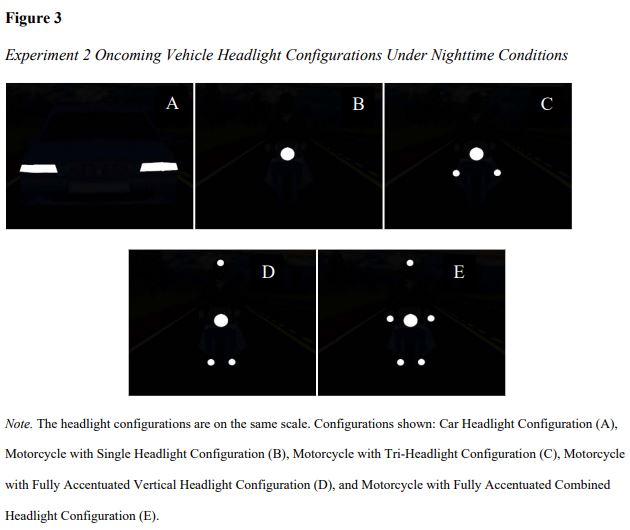
And to do this, they set up a simulator study in which a ‘driver’ saw approaching lights in various configurations of lights including a standard car light configuration, plus a variety of arrangements of lights representing motorcycles. The participants – all drivers, and most with no experience of riding motorcycles – had to press a key on the keyboard when they detected that the light was actually moving towards them.
Illustration from ‘Effect of motorcycle lighting configurations on drivers’ perceptions of closing during nighttime driving’ Bradley W.Weaver, Patricia R.DeLucia Transportation Research Part F: Traffic Psychology and Behaviour Volume 90, October 2022, Pages 333-346
I managed to get hold of the PDF of the paper, and I’ve now had a chance to read it.
There are some interesting conclusions.
Firstly, the standard car headlight configuration was most rapidly detected as moving towards the participant. None of the motorcycle lighting configurations were detected as moving as rapidly.
Secondly, drivers find it easier to detect this ‘looming’ movement when a single motorcycle headlight is ‘big’ rather than ‘small’. As far as I remember, this is consistent with a study done here in the UK back in the 1960s.
Thirdly, they also looked at the popular ‘tri-light’ configuration where the single headlight is supplemented with two additional lights. I’ve previously reported studies have suggested positive benefits for the tri-light arrangement at night, and their results also suggest this light configuration that helps accentuate both a motorcycle’s height and width is superior to a single headlight when it comes to detecting movement towards a driver.
Four, they also looked at ‘fully accentuated’ lighting systems that were either:
:: horizontal – a flat row of lights going right across the front of the machine :: vertical – a row of lights from the bottom of the bike to the top of the rider’s helmet :: combined – both horizontal and vertical lights
They compared these arrangements against a standard single headlight, a motorcycle with a tri-headlight configuration, and a car’s headlights.
Their results indicated that the headlight configuration that accentuated BOTH a motorcycle’s height and width, or the configuration that accentuated ONLY the motorcycle’s HEIGHT were better than the single headlight or the motorcycle with a tri-headlight configuration.
Of the two, the vertical light arrangement was detected as moving toward the observer sooner.
And so the authors concluded:
“…the fully accentuated vertical motorcycle headlight configuration may be better in terms of practicality because it requires fewer headlights and therefore costs less.”
And they also pointed out that “…motorcyclists would need to wear a helmet-mounted headlight” admitting that it wasn’t a “very common practice” and that “buy-in from motorcyclists would be needed”.
The paper also flagged up a potential problem, although they didn’t identify the real issue. The authors said that “motorcyclists turning their head would change how the oncoming motorcycle appears”, but that’s not actually the problem.
Although the lights in the diagram of the experimental configuration are smaller, there’s no information on BRIGHTNESS – or if there is, I missed it.
If these additional lights actually produce as much light output as the bike’s standard headlight from a smaller lens – as do many of the auxiliary lights currently used by motorcyclists – then a rider with a helmet mounted light turning his or her head to look directly AT a vehicle will actually dazzle the driver. We have low-beam lights for a reason.
I’ve had precisely this problem with cyclists, using powerful helmet-mounted lights. One blinded me completely in the middle of a left-hand bend on a narrow road – I could neither see the cyclist, nor the hedge on the inside of the bend. This is not a trivial problem, and in my opinion precludes the use of bright lights on the helmet.
SURVIVAL SKILLS delivering science, not speculation GOT A QUESTION about riding bikes? Drop me a line and I’ll give you a research and evidence-based ACCURATE ANSWER!
Of course, the biggest question of the lot is how much ‘time’ does the vertical light configuration buy the rider?
The answer is that the study found that other motorists were able to see motorcycles “up to 0.8 seconds sooner”.
“Just under a second might not seem like a lot, but reducing a driver’s response time to a potential collision can make a difference between life and death” said DeLucia.
Well, it depends on how far away the bike is, and whether or not the lighting configuration actually stops drivers initiating a turn.
So let’s put the 0.8 second gain in context. The simulation had the motorcycle travelling at 30 mph. That’s 13.4 metres per second. So the maximum extra distance was just 10.7 metres. And you’ll note that the study said ‘up to’ 0.8 seconds.
The study says “when the scene started, the oncoming motorcycle was 750 to 850 ft (228.60 to 259.08 m) from the participant”, but the important point is where was the bike when the driver actually detected the moving motorcycle?
IF I’ve read the results correctly – and to be honest I’m not entirely sure that I have so I’m happy to be corrected – the ‘bumper to bumper’ distances at the moment the lighting configurations were detected as moving ranged from an average of 209 feet for the car lights configuration, to an average of 185 feet for the single motorcycle headlight configuration.
But remember where the bike first became visible – well over 200 metres away.
If my interpretation is correct, and assuming the worst case scenario where the bike first appeared 750 ft or 228.6 metres away, the bike had moved 56 metres before it was spotted. That means it was detected as moving when over 170 metres away.
To put that in perspective, that’s still well over TWELVE SECONDS from the time the bike would reach the observer’s position. And crucially, the study did NOT look at whether the driver would have actually initiated a turn across the motorcycle’s path. The fact is that at that distance, there’s no threat to the rider anyway – the car would clear the rider’s path with time to spare.
And so I’m not sure what the practical benefit of being seen 0.8 seconds – or eleven metres – sooner actually is.
There are also several practical problems which weren’t considered. As I’ve previously stated when helmet-mounted lights have been proposed, there are the problems of:
:: attaching them to a helmet :: powering them :: ensuring that the lights, plus any batteries, do not compromise the primary role of the helmet, which is to protect the head in a crash – you’ll probably remember that the latest ECE helmet standard requires that a helmet be tested with options like cameras and radios already attached
Finally, it’s worth pointing out that this was a simulator study. More importantly, the description of the method says “participants downloaded the needed experimental files” and that participants were required to “measure the width of their screens, which the experimenter would then use to calculate the correct viewing distance”. This implies that the study wasn’t run on standardised equipment in a controlled environment, but run on participants’ own computers and screens in their own home. There seems to have been no test to confirm that the various participants got comparable results with each other. The weakness of the study should be obvious.
My conclusion is that it’s an interesting study, but I’m far from convinced that the proposed vertical lights actually create any significant benefit to the rider, that claims that the ‘design could save lives’ are unproven and exaggerated, and compared with conventional lights, there’s little consideration of the practical issues, including the potential for significant inconvenience to other road users being dazzled by a helmet-mounted light.
If you want to make yourself more visible in night-time traffic I’m still of the belief that different-coloured lights are a sound choice.
===================================== CAN YOU SUPPORT SCIENCE OF BEING SEEN?
Each investigation of a research article like this one takes hours of my time. I give that time freely to the SOBS project because I believe it can make a difference by helping riders achieve a better understanding of the SMIDSY collision.
Your one-off donations or regular subscriptions help me keep the project updated with the very latest research into motorcycle crashes.
Unfortunately, I went down with a thumping headache on Wednesday afternoon last week, so the SOBS In-Depth webcast that was due to go live at 8pm that evening had to be cancelled – I could barely focus on the screen, so rather than push on with a second-rate performance, I decided to put it back a week to Wednesday 8 June.
So if you hadn’t booked for the original event, you have a SECOND CHANCE!
The ‘SCIENCE OF BEING SEEN’ (SOBS) presentation is an in-depth investigation of the most common motorcycle crash of all – the ‘Sorry Mate I Didn’t See You’ or ‘SMIDSY’ collision at junctions.
In this SCIENCE OF BEING SEEN – IN-DEPTH – which alternate with the FULL version of SOBS – I’ll be taking a look at how we scan the scene around us and explain that we don’t capture camera-like images of the world around us – discover the role played by fixations and saccades as we attempt to gain situational awareness, and explaining why lateral motion may be important in helping a driver see us. .
Even if you have already seen the full version of SOBS, the additional detail will help you understand why drivers occasionally don’t see bikes… and why riders often fail to realise there’s a threat!
Use the booking link here for information about how the webcast runs.


 Comment


 Science Of Being Seen