Moving beyond ‘Think Bike’ – evidence of change?

It’s almost thirty years since I trained up as a CBT instructor. As part of the second ‘classroom’ session – officially known as ‘Element D: on-road preparation’ – we had to attempt to prepare our novice riders to cope with the on-road element…

…all in about 30 to 40 minutes.

One issue we had to cover was to explain that motorcyclists run a significant risk of not being seen by other road users. The ‘looked but failed to see’ error is so common it has its own abbreviation in research literature (LBFTS). I’m sure it’s old hat to regular readers of my pages, but for a new riders it can be hard to comprehend.
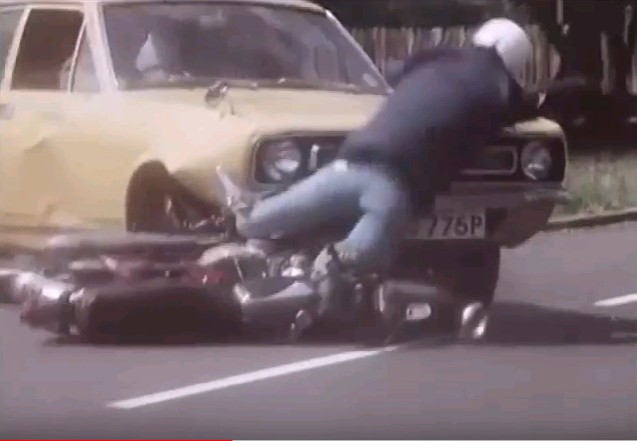
The original ‘Think Bike’ film

So what was the DVSA’s guidance to us instructors? ? Essentially, we were supposed to tell trainees that they were to make themselves easier to be seen; we had to explain the use of conspicuity aids, the differences between daytime fluorescent clothing and night-time reflective kit, and why they should use dipped (low beam) headlights in day time (day-riding lights).

It all began with the first ‘Ride Bright’ campaigns in London in the mid-70s. Many riders voluntarily adopted hi-vis clothing – I was one. Most turned their lights on too – me included when I graduated to a bike with a decent alternator. In fact, motorcycles have had their headlights wired permanently on for over fifteen years.

Just one problem. There is no evidence of positive results.

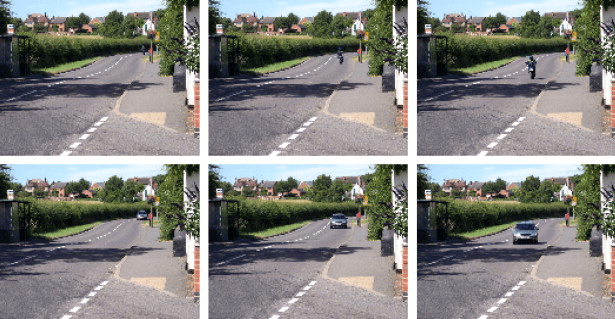
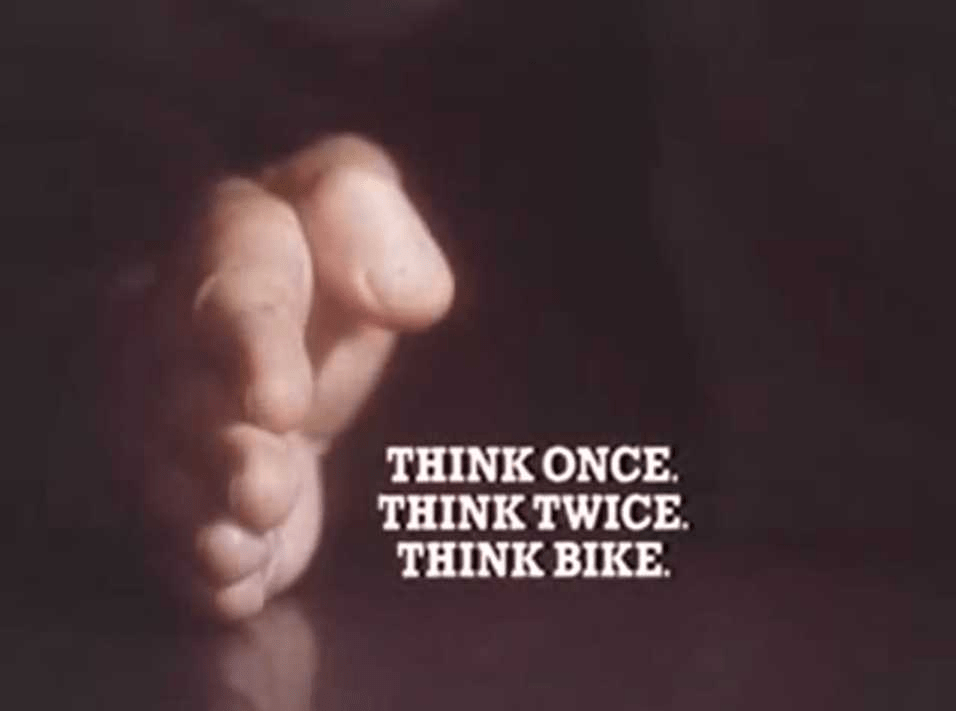
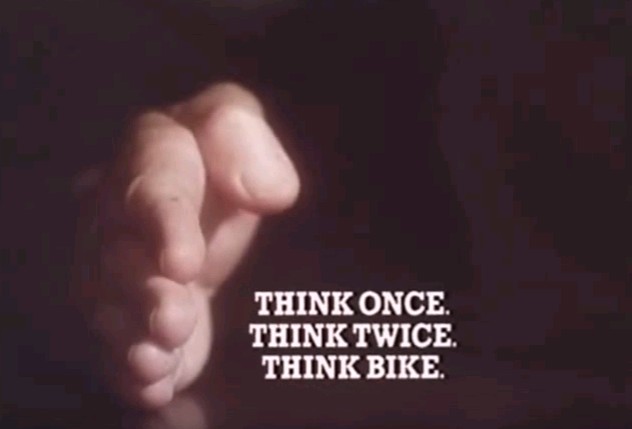
Drivers turning at junctions still look, then fail to spot an approaching motorcycle. And the ‘Sorry Mate I Didn’t See You’ collision with another vehicle at an intersection remains the most common crash involving a motorcyclist. The photo is clipped from the mid-70s ‘Think Once, Think Twice, Think BIKE!’ public information film, incidentally.
Why?

Here’s my guess. There’s an unintentional subtext to all the ‘Think Bike’ campaigns that we have been having since the mid 1970s. In telling new riders to “make yourself easier to see”, the subtext is this – when we encounter another vehicle at a junction ‘the other fellow’ is RESPONSIBLE for LOOKING FOR US.

And if they don’t see us and a collision occurs?

Then they ARE NOT DOING THEIR job – they must be incompetent or inattentive.

Worse, thanks to the ‘make yourself conspicuous’ messaging, riders come to believe that if they use conspicuity aids, they WILL be seen. Believing that, they don’t pay attention to the potential crash that’s being set up for them. Then when a driver commits the ‘looked but failed to see’ error and turns into the path of the approaching motorcycle, the rider sees what’s happening too late and is caught by SURPRISE! And thus riders fail to get out of collisions that could have been avoidable if only the rider had sounded the horn, then braked or swerved, promptly.

“The driver should have seen me” is all too common as a post-crash refrain.

As I’ve been saying for more than two decades – based on my own decade and a half of dodging vans and taxis in London – telling the driver to look out for bikers is only one-half of the story; far more often than not, the rider sees the turning vehicle – or at least the point at which it will appear – well BEFORE the collision becomes inevitable.

It’s this awareness of the need to search out the potential for a SMIDSY collision before it happens, and to understand what to do to stay out of trouble is what underpins the ‘No Surprise? No Accident!’ concept.

That’s why back in 2012 I delivered the very first Science Of Being Seen (SOBS) presentation at the pilot Biker Down course in Kent. Rather than say “wear hi-vis and ride with your lights on so drivers see you”, SOBS took a rather different look at conspicuity aids – explaining why sometimes they DON’T work:

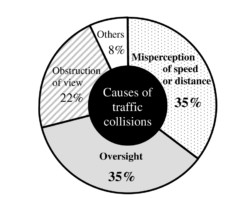
:: looked but COULD NOT see – the bike wasn’t where the driver was able to see it (accounts for around 1 in 5 collisions)
:: looked but FAILED TO see – the bike was visible but due to issues such as motion camouflage, saccadic masking and ineffective conspicuity strategies, the driver failed to detect it (the cause of around 1 in 3 collisions)
:: looked, SAW AND MISJUDGED – the bike was visible but drivers find it hard to accurately calculate ‘time to collision’ particularly on quicker roads (setting up another 1 in 3 collisions)

When we know WHY the collisions happen (and incidentally, distracted driving accounts for less than one in ten of the total, using a mobile at the wheel is about as likely to cause a SMIDSY as a medical emergency at the wheel), we can suggest some defensive measures.
The first is simple enough – ride where we can be seen, and be alert to moments we CANNOT be seen. We need to be aware of the effect of ‘Vision Blockers’ between our position and someone looking for us and to understand the driver blind spot issues caused by the vehicle structure itself. If we can’t be seen, no conspicuity aid will work.

Then and only then should we consider improved conspicuity strategies – I have suggested swapping Saturn yellow (the most common shade of hi-vis but a colour that’s a poor contrast with foliage in rural areas) with Pink for rural daytime use.

And finally I promote the use of proactive responses to a POTENTIAL threat from a vehicle that COULD be about to turn across the rider’s path including sounding the horn, slowing down, changing position and setting up the brakes. It’s not difficult – after all, there are only two things that a vehicle intending to turn into our path can do – wait till we’ve passed by. Or pull out.

So has this ‘protect yourself’ approach filtered down to other road safety campaigns?

Well, there are finally signs that just possibly it has. Back at the beginning of the month, Warwickshire Police announced their usual enforcement campaign, but also mention a new ‘Ride Craft Hub’ which:

“…will help riders identify a SMIDSY situation and protect themselves”.

And last week whilst searching for something else, I found that a couple of years back I’d reported on a story from Tasmania that shows another small but significant indication that the official attitude to rider training is slowly beginning to change.

Stating that the rate of motorcycle accidents in Tasmania had become too high, Infrastructure minister Rene Hidding said that initially the state rolled out more mandatory training “just as had been done in so many other places”.

But Ms Hidding continued:

”It became obvious that people in the industry knew [the process] was wrong.”

A Victoria-based trainer, Duncan McRae, was called in to create a new curriculum which he said was “built around educating riders about those five common crash types that we see most often”.

Does that sound like something you might have heard here?

So, small beginnings, but I believe we’re seeing indications of a shift towards the ‘No Surprise’ approach to riding.

I’m not saying we should stop telling drivers to ‘Think Bike’ as some seem to have assumed, but we should certainly start encouraging a ‘Biker THINK!’ mindset.

I do apologise if I seem to be banging the same drum, but until riders really do accept that SMIDSYs aren’t an automatic consequence of riding a bike, someone has to. And I’ll see what I can dig up on the background to the Tasmanian curriculum change. Watch out for that soon.

http://www.ridecrafthub.org/
http://www.scienceofbeingseen.org
http://www.nosurprise.org
Motorcycle Safety: Moving Beyond ‘Think Bike’

*** SCIENCE OF BEING SEEN *** Moving from ‘Think Bike’ to ‘Biker THINK!’
Ten days ago on my Facebook page http://www.facebook.com/survivalskills, I posted an article about the lack of imagination in Police Scotland’s response to motorcycle crashes – basically, it was more enforcement. At the same time, what caught my eye was the goal that the Scottish ‘Road Safety Framework’ is aiming for is a 30% reduction in motorcyclist KSIs by 2030.

Suggesting that some new ideas were needed, I promptly got a response from an accident claims firm in Scotland telling me about their campaign aimed at drivers called ‘Take Another Look’:

“We are calling for a new campaign to ‘#takeanotherlook’ at junctions…”

On the face of it, that seems like a good idea. Nationwide data from the Department for Transport shows that in 2021, intersections – whether they are T, Y or staggered junctions – are the most common locations of motorcyclist casualties. Collisions at junctions represent no less than 34.7% of combined fatalities and injuries – one-in-three.

The ‘Take Another Look’ people offer an answer as they say their ‘new’ campaign is “…echoing the ‘Think Bike’ initiative of the 1970s that was aimed at increasing motorists’ awareness of motorcycles and reducing accidents caused by failure to spot them in time.”

Just one problem. Whilst calling for a 30% drop in motorcycle casualties by 2030, that same Scottish Road Safety Framework document made this telling statement:

“With regards to longer-term trend of motorcycle fatalities since 1994, there have been many peaks and troughs, and we are still in the same position we were in thirty years ago.”

On the one hand, we have a freshly-minted safety campaign simply repeating what we have been trying for the last fifty.

On the other, we have a statement of fact telling us that thirty years of Scottish motorcycle safety campaigns haven’t changed anything in thirty years.

Shouldn’t that be telling us something? Why are we expecting something that hasn’t worked for half a century to suddenly start working now?

Even if the people putting these campaigns together can’t see it, can’t we motorcyclists see that it’s time to move on from expecting drivers to keep us safe by ‘Thinking Bike’? Isn’t it time to adopt a fresh approach where we learn more about just why drivers don’t see motorcycles, to adopt a proactive approach where we stop relying on others, and crucially to learn to look for ways to avoid being caught up in what needn’t actually be a collision?

Biker, THINK!

=================================
WHAT IS SCIENCE OF BEING SEEN? (SOBS)
SOBS is my in-depth investigation into the
‘Sorry Mate, I Didn’t See You (SMIDSY) collision
between motorcycles and other vehicles.
Created for the fire services ‘Biker Down’
course, it’s based on science, not speculation.
I aim to quash some persistent myths about
how and why junction collisions happen, and
show how motorcyclists can employ simple
techniques to stay out of trouble!
FIND OUT MORE – http://www.scienceofbeingseen.org
BUY THE SOBS e-book – https://ko-fi.com/s/88fbc15a82
WATCH OUT FOR LIVE ONLINE TALKS

SUPPORT SOBS at http://www.ko-fi.com/survivalskills

‘Pigeon vision’ – why it’s not a thing

Does the way pigeons see the world explain some motorcycle crashes?

Ryan over at FortNine recently put up a video entitled ‘how pigeons explain a common motorcycle crash. The presentation says that pigeons “suck at assessing how fast a particular vehicle is closing on them”. And he points to some research that shows that in a particular speed zone, they take off at the same distance from a car no matter what the speed the car approaches at. He says that the pigeons learn the typical speed of cars in their zone. Ryan then says this is because pigeons lack ‘binocular disparity’ and the ability to judge approach speed.

What’s binocular disparity? Because we have two eyes which both offer a view of a particular object, each eye gets a slightly different flat 2-D image from the light that falls on to each retina.

Imagine a tree behind a car. The view of eye is at a slightly different angle, which means each eye will show the tree at a slightly different position relative to the car. The brain can uses these different images to extract depth information. This is binocular disparity.

Ryan then says that we can use binocular disparity “to judge how fast an object is closing on us”, and explains that this is known as ‘stereopsis’ and that “within thirty metres it’s the main method of gauging the speed of other vehicles”.

“Unless” he adds…

…”you’re a pigeon” because pigeons have their eyes on either side of their head.

And he then explains that as we’re sitting at a junction, we only have one eye turned towards the junction:

“Same handicap, see? Only one eye is looking because the other is blocked by my nose”.

He then says that this isn’t so much of a problem when tracking cars because “one eye can still track using the apparent change in size to gauge closing speed”. The problem with motorcycles is that because they are “skinny”, they “don’t show much enlargement” until the bike’s on top of the observer.

Same angle, same distances… the car appears to ‘grow’ more than the bike

This is actually the phenomenon known as looming, and it’s well-known that it is easier to judge speed and distance for cars than bikes – for some reason, our brain measures the lateral growth of a car better than the vertical growth of a bike.

OK, so that’s the basis for the video. It’s plausible-sounding, particularly as it’s well-known that the brain ‘edits out’ the fact that our nose is actually visible in both eyes but I’d say there are significant flaws in the reasoning.

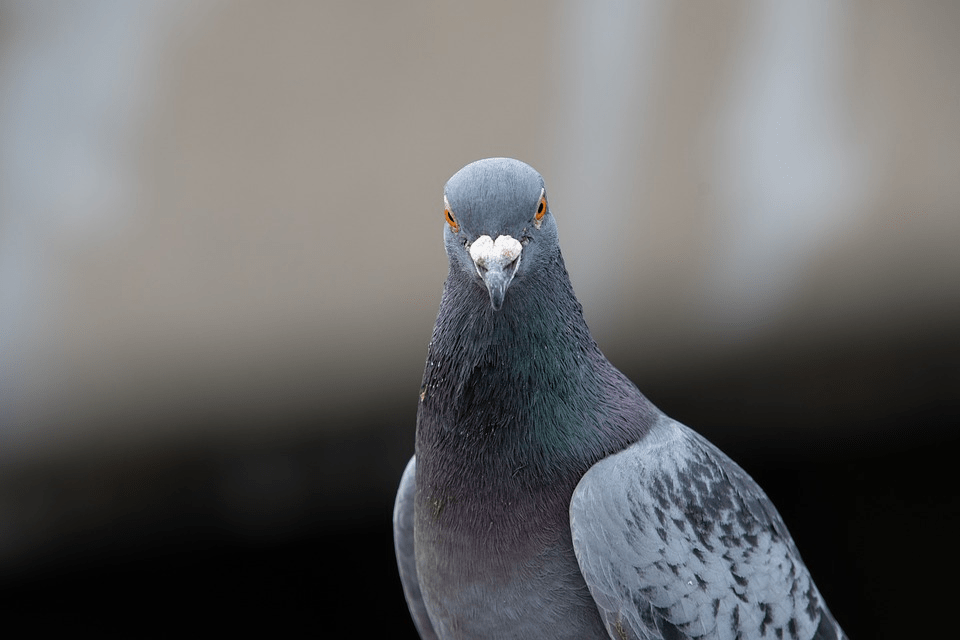
PIGEONS DO HAVE BINOCULAR VISION – Despite having eyes on either side of their head, and though they may turn their heads to scan you with one eye, even for pigeons the fields of view of their two eyes do overlap. Not by much, but pigeons WILL look straight at you and when they do that they are seeing you with both eyes. See the photo.

And although I have no proof, I’d suggest they DO need good depth perception – if they didn’t, they’d never manage to land on a narrow branch. They look directly ahead of them when landing.

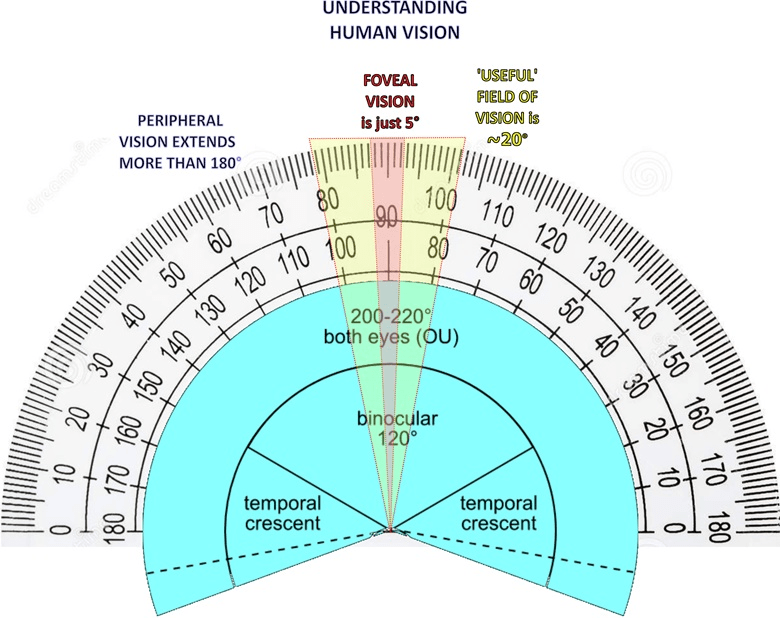
HUMANS HAVE A WIDE FIELD OF BINOCULAR VISION – For human vision, the overlap is around 120° – that means we have monocular vision ONLY for around 40° at each side of our field of view. Yes, the bridge of the nose occludes part of each eye’s visual field, but nothing like the extent of a pigeon.

PERIPHERAL VISION DETECTS MOVEMENT AND LIGHT – The pigeon’s eyes are on either side of its head because it’s a prey animal. The eyes give a ‘wrap-around’ field of view with only a very small blind spot directly behind its head. Humans do have a bigger blind spot, but even staring directly ahead, our eyes are sensitive to movement and lights at 90 degrees since that angle falls within our peripheral vision. And once something is detected, our instinct is to turn our head to look straight at it.

The nose restricts around 40° of our total vision either side, but when we want to ‘look’ at something
we turn our heads to focus both eyes…

‘USEFUL’ AND FOCUSED VISION IS MORE RESTRICTED – Within that binocular field, the so-called ‘useful’ field of vision – the visual area from which information can be extracted in a single glance without eye or head movements – is restricted to around 10° either side of our line of sight.

Even more crucially, if we want to extract detail information, then we have to aim our gaze and use ‘foveal’ vision. This is where we get the clear, colour and focused image of the world. The bad news is that it’s a tiny cone, just 5° across at the point our gaze is focused. This is down to the construction of the human eye.

TO SEE DETAIL WE TURN OUR HEADS – It’s simply not possible to gain full situational awareness by relying entirely on the peripheral vision. If we want to look at something in detail, we have to bring it into the centre of our visual field, into our gaze. Mostly, this is a function of the anatomy of the eye; the fovea, the central portion of the retina, has the highest density of photo receptors. It’s also connected to a much larger part of the visual cortex in the brain, where the visual data is processed.

Whilst peripheral vision can provide useful information to fill out situation awareness, for a detailed study of a particular object we need to turn our eyes onto it.

So when we want to see something in detail – including the involuntary response that happens when we detect movement or light in peripheral vision – we do the same ‘eyes front’ thing that the pigeon does when it needs to land. At junctions we don’t stare straight out of the windscreen, trying to work out what’s coming from each direction via peripheral vision from both eyes simultaneously; we turn our heads to search in each direction in turn, in order to point these foveal cones of vision towards the specific area we’re searching.

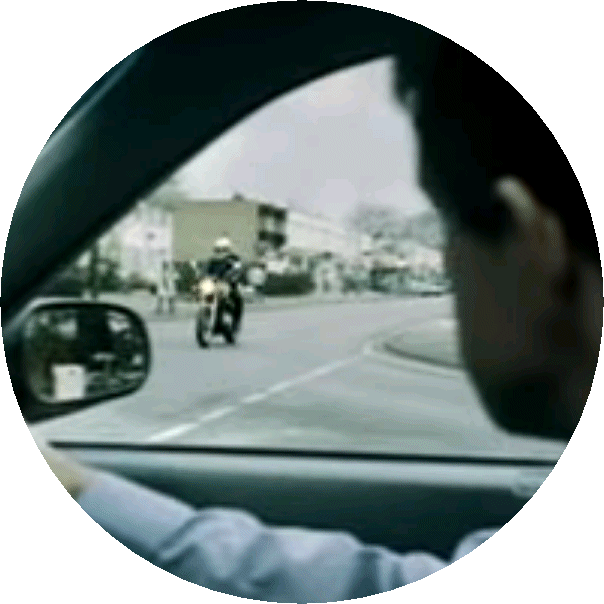
Tracking, we’re keeping the bike firmly in the middle of our visual field…
Image taken from ‘Look harder for bikes’ road safety video

Ryan talks about the issue of ‘tracking’ vehicles. The fact is we achieve this by looking directly at them. That implies we’ve already seen them and we’re not attempting to detect them. The difficulty of judging speed and distance occurs when we’re already looking at them.

DRIVERS TURNING INTO SIDE ROADS MISS BIKES TOO – If the pigeon vision issue really was a thing, how can we explain the fact that there are TWO collision types at junctions?

Whilst the collision with the driver who emerges from the turning on the nearside is the more common, a significant number of crashes involve an oncoming driver turning INTO the side road and across the driver’s path.

If the ‘looked but failed to see’ issue was really down to a chunk of the visual field being viewed only through one eye, these collisions shouldn’t happen – they’d be ideal circumstances for full binocular vision to detect the bike, then judge its speed to a nicety.

FAILED TO SEE ERRORS HAPPEN CLOSE UP – Ryan says that stereopsis is “the main method of gauging the speed of other vehicles… within thirty metres. I’ve no reason to argue with that, but let’s actually think about the collision dynamics.

30 mph is 13.4 metres per second. So thirty metres is something over two seconds away. Research into collisions suggests that the safe ‘cut-off’ when a rider is almost certain to avoid a collision is three seconds out from the crash – so something under fifty metres away at 30 mph. But at 60 mph, it’s getting on for one hundred metres away.

If Ryan’s figures are right, at rural road speeds the error happens well outside the limits of stereopsis. Even at urban speeds, the error in spotting the bike could happen right at the limits.

But even if the error did happen within the zone covered by stereopsis, there’s a second consideration. Even a rider who’s taken by SURPRISE! should be able to stop fairly comfortably within twenty five metres. I can – and have – stopped in about ten metres from 30 mph.

The three main reasons for collisions and junctions; the driver looked but COULD NOT see… the driver looked but FAILED to see… the driver looked, saw but MISJUDGED speed or distance…

So if the bike actually HITS the car, the error MUST have happened closer. A LOT closer. If a driver somehow fails to detect a motorcycle less than twenty five metres away, I don’t think it’s a speed / distance misjudgement (with one exception – see below). It’s far more likely the driver simply didn’t SEE the bike.

And that can happen because either the bike wasn’t VISIBLE when the driver looked (one in five of collisions) or the perception error was caused by one of the many PERCEPTUAL issues that fall under the ‘looked but failed to see’ umbrella (one in three collisions).

The bulk of ‘looked, saw but misjudged speed and distance’ errors (one in three collisions) seem to happen on faster roads where the bike is beyond the range of stereopsis, and we use the rate of change in size to judge approach speed – and now the difficulty in judging the lateral growth of a motorcycle most likely becomes crucial. The size of the machine only grows by a quarter, despite the distance halving.

(And dismiss the ‘driver didn’t look’ theory too – the proportion of collisions where the driver was distracted is tiny. If drivers genuinely ‘didn’t look’, they’d be bouncing off pedestrians, bikes, and buses – as well as other cars – every few seconds.)

OR THE RIDER WAS SPEEDING – Oddly enough, that researcher who found the pigeons scattered at the same distance from the car no matter what speed he approached at found something in common with drivers. We too gain a sense of how much time we have to turn at junctions based on the TYPICAL speed of vehicles.

So if ANY vehicle – not just a motorcycle – is travelling significantly quicker than average, that vehicle is far more likely to have a collision. It’s not the speed that caused it per se, although more speed means more difficulty stopping and a bigger impact if the rider hits something, other road users simply aren’t expecting the vehicle to be travelling at the excess speed, so don’t detect the anomaly easily and thus are more likely to turn across the rider’s path.

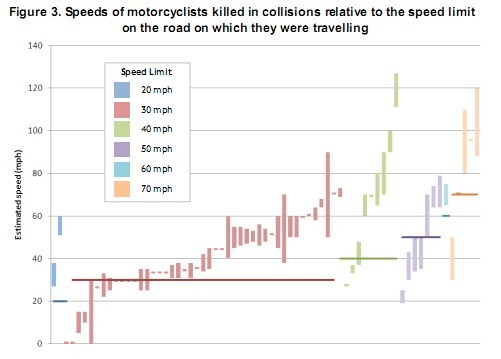
The horizontal line represents the speed limit, the vertical bars of the same colour
represents the speed of the rider estimated by police

I don’t think it’s any coincidence that in a study of fatal bike crashes in the London area a few years ago, the majority of the deaths in the lower speed limits involved riders who were exceeding the limit. The horizontal lines in the chart represent the speed limit. The vertical bars are the estimated speeds of the riders who died.

AND DRIVERS COLLIDE WITH CARS TOO – Research from the Netherlands a few years ago looked at car-motorcycle and car-car detection errors, and adjusted the rates for EXPOSURE – that it, how many bikes and how many cars a driver would encounter in the same time frame. And what they found was that far from picking out bikes to collide with, drivers actually made the ‘looked but failed to see’ error in front of another car just as often as they made the error in front of a two-wheeler.

We always have to be a little careful about taking data from one country and exporting it to ‘fit’ our own roads and in this case the Netherlands has many more mopeds on the roads than the UK so there’s the possibility that drivers were more ‘bike-aware’. But there’s other evidence that hints that in countries where most vehicles are two-wheelers, bikers crash into bikers at much the same rate as car drivers.

We also have to remember that our own PERSONAL stories are looking through the opposite end of the lens. We may think that drivers are more likely to make a mistake in front of us on our bike than other riders, but the fact is we’ll encounter many more cars than bikes on a ride.

AND A FINAL NAIL – I didn’t even mention the fact that a substantial minority of the population have various eye issues which makes stereopsis impossible, yet manage to drive successfully.

CONCLUSION – The FortNine videos that Ryan fronts are often informative as well as entertaining to watch. But in this particular instance, I think the reasoning he uses is flawed. And hopefully I’ve explained this clearly enough that you can follow my own arguments. I’d be interested in your comments too, of course.

BUT HERE’S WHERE I DO AGREE – If there’s one bit of the video that I absolutely concur with, it’s Ryan’s comment after showing the old mid-70s ‘Think ONCE, think TWICE, think BIKE’ TV advert. I wonder where he found that?

Made in the mid-1970s, it’s still one of the best ‘think bike’ ads

He says about ‘think bike’, “he’s not wrong, but it’s not useful either. If we’re dealing with a sensory problem then imploring drivers to see better is like imploring a deaf person to listen up. I’d rather take my own responsibility…”

Spot on. Be proactive. Don’t wait to be seen. Assume you won’t be detected and ride with that in mind.

You can watch the FortNine video here:

You can find out more about the Science Of Being Seen project here:

www.scienceofbeingseen.org.uk

BOOK YOUR OWN PRESENTATION

I’m available to deliver the Science Of Being Seen (SOBS) presentation to clubs and groups around the UK IN PERSON, or anywhere in the WORLD via a WEBCAST, and at reasonable cost too.

SEND ME A MESSAGE AND I’LL GET BACK TO YOU.

The Startle Effect – SOBS, meet No Surprise!

Over on the Survival Skills Facebook page I’ve spent the last few Fridays looking at an unusual court case where a judge withdrew the case from the jury, after rejecting the prosecution’s case that a rider involved in a fatal collision with a pedestrian had to time react when the pedestrian stopped unexpectedly.

The incident reminded me of the words of Chesley Sullenberger – the Miracle on the Hudson pilot – “the startle factor is real, and it’s huge”. He was talking to a US Congressional hearing into the two aviation accidents involving Boeing’s 737 Max, and refuting claims that an alert and properly trained pilot could have dealt with the issues the plane was throwing at them.

Sound familiar?

Think bike? Think again!

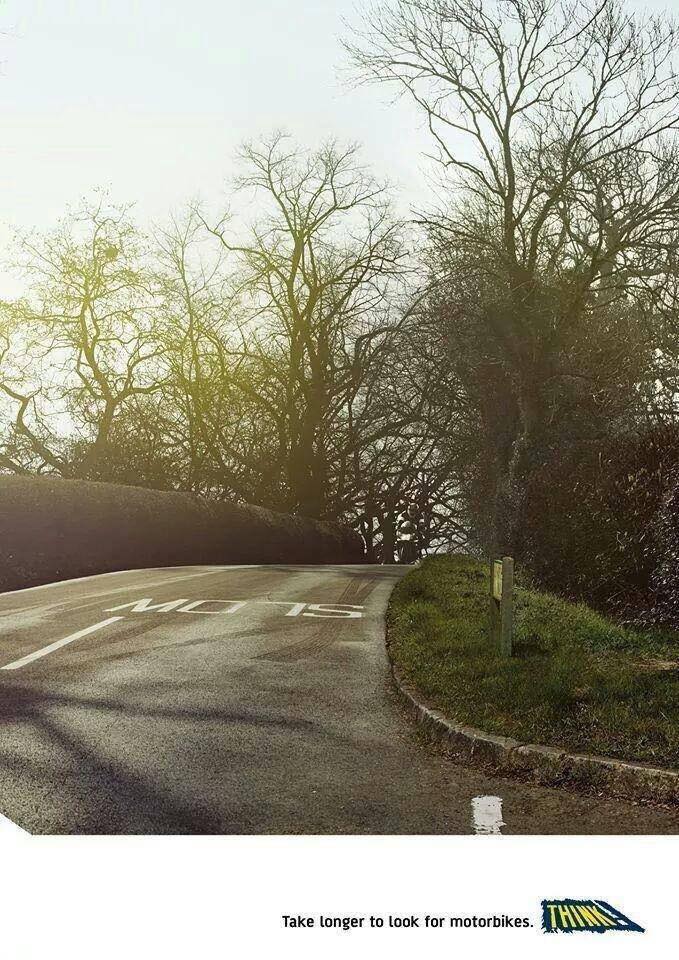
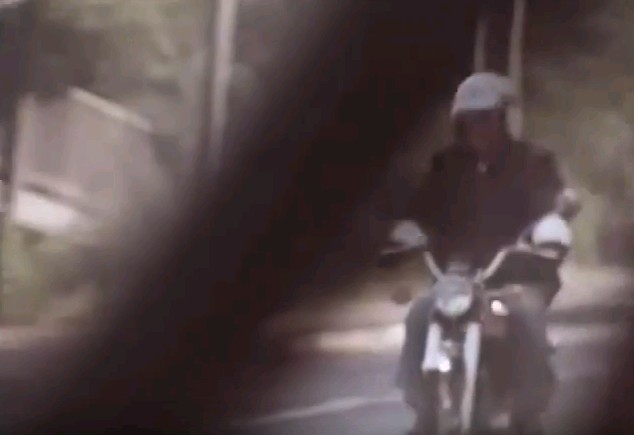
Now, take a look at the photo. You may remember it as one of the long-running series of ‘Think Bike’ products, aimed at the driver.

The idea is, given the target, to try to make a driver aware of just how hard a bike can be to spot.

As soon as I saw it, my thought was that the message should be ‘Biker, Think’. And that’s because it’s a perfect illustration of the point that I regularly make when discussing the Science Of Being Seen (#SOBS); the effect of any CONSPICUITY AID – in this case, the bike’s headlight – depends entirely on WHAT’S BEHIND the rider.

It’s not the lightness of clothing, or – as in this case – the brightness of the headlight, it’s the CONTRAST against the BACKGROUND.

And that’s the message that is so difficult to get over to riders, despite my best efforts and the inclusion of SOBS as a module of the Biker Down courses that have been run by so many fire services in the years since this campaign. When the photo reappeared the other day, the riders’ responses were predictable:

:: drivers don’t look hard enough for bikes

:: the rider should be wearing hi-vis clothing

They both miss the point.


EXTRAORDINARY TIMES…
…EXTRAORDINARY TRAINING
Now OPEN for SOCIALLY-DISTANCED
Survival Skills has adapted! Have you?
Ride2Work & Ride4Fun courses!
Online video coaching AVAILABLE!
www.survivalskills.co.uk

Drivers fail to spot motorcycles for well-documented reasons – in this case, it’s the camouflage effect of the bike lights against the wintery background behind the rider.

And the belief that conspicuity aids stop ‘looked but failed to see’ incidents is mistaken. There’s little compelling evidence from crash statistics – junction collisions are as common as they ever were. It’s easy to check.

So we end up with a double whammy…

a driver who either never sees the bike before pulling out – or possibly spots it halfway through pulling out and SURPRISED! stops dead, blocking the rider’s path…

and a rider who expects to be seen (“because I had my lights on and drivers are more likely to see bikes with lights”) and caught by SURPRISE! only reacts at the very last second when he / she realises the car’s pulling into the bike’s path.

Only by understanding BOTH the Science Of Being Seen AND the No Surprise? No Accident! approach to riding do we get a full understanding of the issues thrown up by this simple photograph of a bike blending into the background.

And we’ll only begin to reduce junction collisions by understanding BOTH sides of the collision – why the driver makes the error that puts the biker at risk, and why the biker fails to predict a highly predictable error. This is what’s known as ‘INSIGHT’ – seeking to offer understanding of the relationship between a specific cause and effect within a particular context.

It’s a type of learning that revolves around problem-solving through understanding the relationships between our own abilities (self-awareness) and the ‘system’ in which we’re operating. Insight is the basis for all my training, incidentally.

If we focus on simplistic and reductionist explanations alone, we may know WHAT went wrong, but without looking for embracing, holistic explanations we’ll never know WHY it went wrong.

——————————–
NOW AVAILABLE – LIVE SOBS PRESENTATIONS
CHECK OUT SURVIVAL SKILLS ONLINE TALK SERIES – NEW!
https://survivalskills.tidyhq.com/schedule/events
——————————–

For more information on both projects: