The Startle Effect – SOBS, meet No Surprise!

Over on the Survival Skills Facebook page I’ve spent the last few Fridays looking at an unusual court case where a judge withdrew the case from the jury, after rejecting the prosecution’s case that a rider involved in a fatal collision with a pedestrian had to time react when the pedestrian stopped unexpectedly.

The incident reminded me of the words of Chesley Sullenberger – the Miracle on the Hudson pilot – “the startle factor is real, and it’s huge”. He was talking to a US Congressional hearing into the two aviation accidents involving Boeing’s 737 Max, and refuting claims that an alert and properly trained pilot could have dealt with the issues the plane was throwing at them.

Sound familiar?
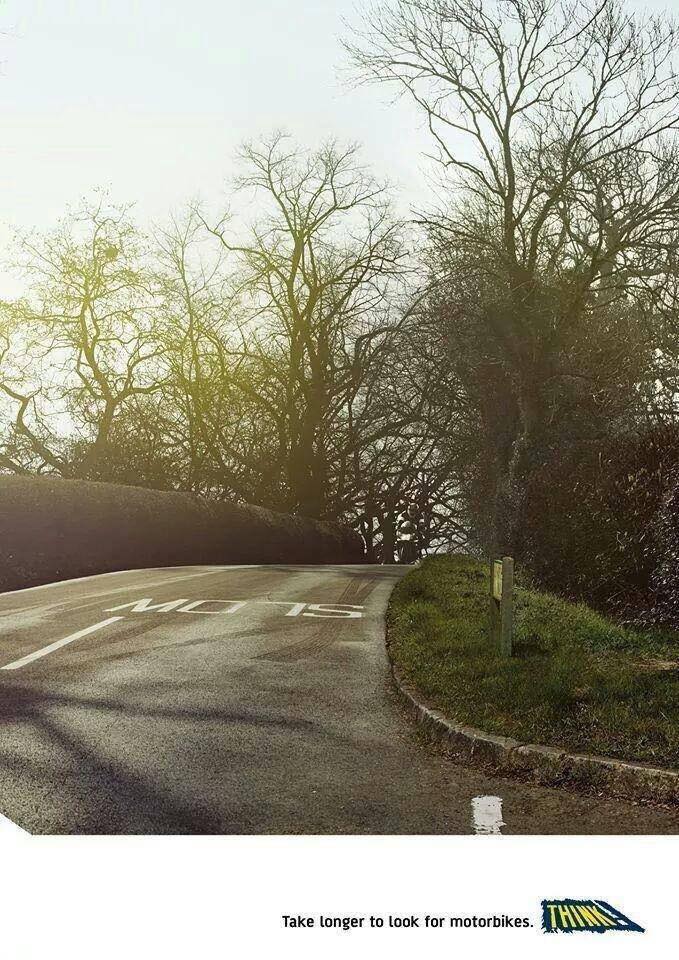
Think bike? Think again!

Now, take a look at the photo. You may remember it as one of the long-running series of ‘Think Bike’ products, aimed at the driver.

The idea is, given the target, to try to make a driver aware of just how hard a bike can be to spot.

As soon as I saw it, my thought was that the message should be ‘Biker, Think’. And that’s because it’s a perfect illustration of the point that I regularly make when discussing the Science Of Being Seen (#SOBS); the effect of any CONSPICUITY AID – in this case, the bike’s headlight – depends entirely on WHAT’S BEHIND the rider.

It’s not the lightness of clothing, or – as in this case – the brightness of the headlight, it’s the CONTRAST against the BACKGROUND.

And that’s the message that is so difficult to get over to riders, despite my best efforts and the inclusion of SOBS as a module of the Biker Down courses that have been run by so many fire services in the years since this campaign. When the photo reappeared the other day, the riders’ responses were predictable:

:: drivers don’t look hard enough for bikes

:: the rider should be wearing hi-vis clothing

They both miss the point.


EXTRAORDINARY TIMES…
…EXTRAORDINARY TRAINING
Now OPEN for SOCIALLY-DISTANCED
Survival Skills has adapted! Have you?
Ride2Work & Ride4Fun courses!
Online video coaching AVAILABLE!
www.survivalskills.co.uk

Drivers fail to spot motorcycles for well-documented reasons – in this case, it’s the camouflage effect of the bike lights against the wintery background behind the rider.

And the belief that conspicuity aids stop ‘looked but failed to see’ incidents is mistaken. There’s little compelling evidence from crash statistics – junction collisions are as common as they ever were. It’s easy to check.

So we end up with a double whammy…

a driver who either never sees the bike before pulling out – or possibly spots it halfway through pulling out and SURPRISED! stops dead, blocking the rider’s path…

and a rider who expects to be seen (“because I had my lights on and drivers are more likely to see bikes with lights”) and caught by SURPRISE! only reacts at the very last second when he / she realises the car’s pulling into the bike’s path.

Only by understanding BOTH the Science Of Being Seen AND the No Surprise? No Accident! approach to riding do we get a full understanding of the issues thrown up by this simple photograph of a bike blending into the background.

And we’ll only begin to reduce junction collisions by understanding BOTH sides of the collision – why the driver makes the error that puts the biker at risk, and why the biker fails to predict a highly predictable error. This is what’s known as ‘INSIGHT’ – seeking to offer understanding of the relationship between a specific cause and effect within a particular context.

It’s a type of learning that revolves around problem-solving through understanding the relationships between our own abilities (self-awareness) and the ‘system’ in which we’re operating. Insight is the basis for all my training, incidentally.

If we focus on simplistic and reductionist explanations alone, we may know WHAT went wrong, but without looking for embracing, holistic explanations we’ll never know WHY it went wrong.

——————————–
NOW AVAILABLE – LIVE SOBS PRESENTATIONS
CHECK OUT SURVIVAL SKILLS ONLINE TALK SERIES – NEW!
https://survivalskills.tidyhq.com/schedule/events
——————————–

For more information on both projects:
SOBS – Imitation is a sincere form of flattery

A buddy of mine pinged me a GoogleFind at the weekend, saying I might want to take a look. It was a link to an advanced group’s newsletter from late 2013. I looked and read:

“Meeting Report – Understanding the causes of SMIDSY collisions”

The article went on to explain that the only aim of the talk was to ensure that the listeners got an unbiased insight into the causes of the ‘Sorry Mate I Didn’t See You’ crash, and some suggestions on how to prevent them in the future.

I read on to discover “motion camouflage”, “looming”, “the central sharp focus” of vision, “door pillars” and vehicles on “converging paths” all getting a mention.

Sound familiar?

I thought so, and the more I read, the more familiar it got.

There’s a word about using colours that create “contrast” and although the final message about hi-vis and day riding lights seems to have been somewhat scrambled, there was also one final suggestion to “move the motorcycle laterally”.

As you may well have realised, it’s much the same content as I deliver on my ‘Science Of Being Seen’ presentation.

SOBS was originally created for Kent Fire and Rescue Service as the third module of the ‘Biker Down’ courses. From Kent, Biker Down was was rapidly picked up by other FRS services and has spread across the UK (and further afield too – I’ve recently been talking to the organiser of Biker Down North America!).

Personally, I took an interest in SMIDY collisions as soon as I trained as a bike instructor in 1995. I had to tell CBT trainees that they were supposed to follow the standard advice to wear hi-vis clothing and use day-riding lights (DRLs), but in my personal experience as a courier both were ineffective, something confirmed by taking a look at ‘before and after’ historical accident statistics.

So the contrasting message “don’t rely on conspicuity aids” was a topic included in my very first advanced course run in 1997 and I’ve been writing about the issue on bike forums since at least 2001. On my website, you can still find the free riding tip originally penned in 2002 that looked at the likely causes of SMIDSYs and the problems riders create for themselves by over-relying on hi-vis and DRLs. It’s been regularly updated and formed the basis for SOBS when I created the presentation over the winter of 2011/12.

I spotted the newsletter date – almost two years after I first delivered SOBS in early 2012. And almost a year after the Kent Biker Down team – myself included – were honoured with an award at 2012 Prince Michael of Kent International Road Safety awards.

During those two years – 2012 and 2013 – we were inundated with people wanting to take the course. We were running Biker Down every couple of weeks.

And as word got around about the course, particularly after the Road Safety Award, we also had numerous visits from rider groups, some based well outside the Kent area.

Of course, it’s not impossible that the author came up with a very similar presentation – after all, all the information is in the public domain. For example, there’s a very well-constructed video from FortNine on the topic on YouTube.

=================================
DO YOU ORGANISE CLUB or GROUP TALKS?
Science Of Being Seen (SOBS) was originally
created in 2012 for Kent Fire and Rescue as
Module 3 of the pilot Biker Down course. As a
team we were awarded a Prince Michael of Kent
International Road Safety Award at the end of
2012. Most of the Biker Down teams in the UK
use a ‘slimmed down’ version of SOBS.

WHY NOT BOOK THE ORIGINAL SOBS?
It’s the fullest version with up-to-date research.
Get a 40 minute talk with time for questions!
Contact me today: info[at]survivalskills.co.uk
=================================

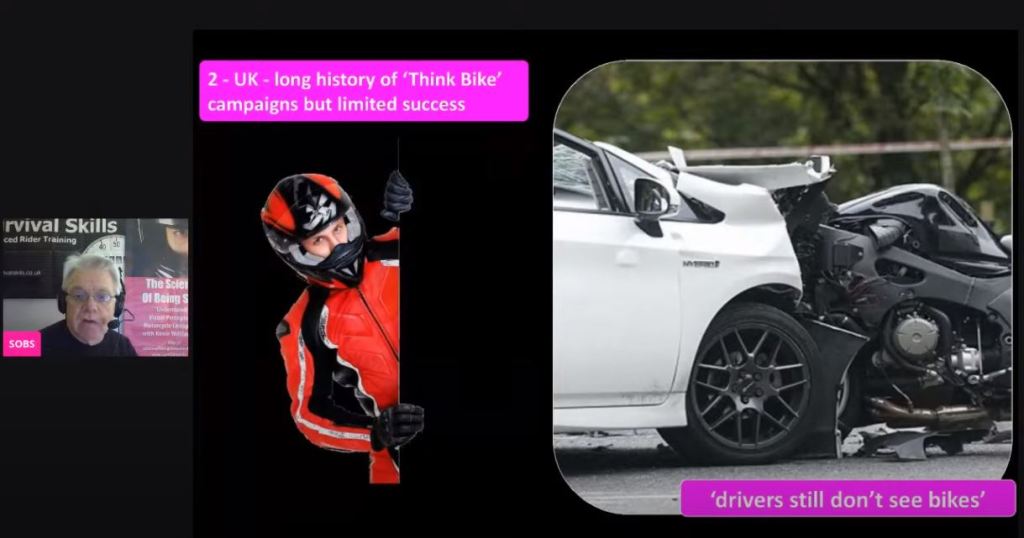
Screenshot of live online presentation of Science Of Being Seen SOBS

But frankly, whilst much of that information has been out there for many years it’s often in fields unconnected with motorcycling. That’s where my research-based Masters degree in the sciences came in handy.

And my research background helped with the deeper investigative work which become possible once scientific papers became more widely available on the internet. Nevertheless, it needed quite a bit of personal enthusiasm to dig it out and pull it together.

So as far as I know, the original SOBS presentation was the first attempt to put conspicuity issues together into one coherent explanation which covered:

  • the reasons drivers fail to spot bikes
  • the reasons that hi-vis and DRLs are not a complete solution
  • the need for riders to think about whether or not their clothing and lighting creates a colour contrast with the background
  • the need for a pro-active response to the SMIDSY threat including slowing down and lateral movement

Having said all that, the whole point of SOBS is educational. I provided it to KFRS, and by the end of 2013, a version of my presentation was already being offered freely to other FRS’s.

——————————–
NOW AVAILABLE – LIVE SOBS PRESENTATIONS
CHECK OUT SURVIVAL SKILLS ONLINE TALK SERIES – NEW!
https://survivalskills.tidyhq.com/schedule/events
——————————–

I want the messages in the presentation to be spread as far and wide as possible to benefit riders, and I have absolutely no interest in locking it down for my own gain. The charge for presentations and the price of my published book of the presentation are to help fund my time involved in research and writing, plus hosting the Science Of Being Seen website. You can make a small donation using the button below if you wish – it all helps.

Buy Me a Coffee at ko-fi.com

So the information is out there for everyone, for free. Nevertheless, if SOBS really WAS the inspiration for the presentation, a ‘based on…’ credit would have been nice.

=================================
SURVIVAL SKILLS ONLINE COACHING
Want to ride better? Then start with a
CRASH COURSE – choose from THREE
one-hour sessions looking at the most
common bike crashes:

* collisions at junctions
* cornering spills
* overtaking incidents

Learn what goes wrong, how to stay out
of trouble where you can and how to get
out of trouble when you can’t.

CRASH COURSE from SURVIVAL SKILLS
– the ONLY way to be a SAFER BIKER!

=================================

PTW crashes – round and round we go…

Yesterday on my Elevenses webcast (https://youtu.be/j8Hk_quPL4Q) I talked about the newest tag-team on the block. MAG and Transport for London (TfL) will be working together to identify – and hopefully improve – accident black spots for powered two wheelers, and I commented how the press release announcing this partnership is almost exactly four years to the day that I wrote a Facebook article on a then-new study into bike crashes commissioned by TfL.

This study concluded – not very shockingly – that bike crashes were most likely to happen at junctions. The good news was that based on their research, the TfL were producing an action plan to improve junctions for bikers, which were set duly forth in an ‘Urban Motorcycle Design Handbook’, which was published early in 2017, if I remember right.

Rather bizarrely, the alternative riders’ rights organisation, the BMF, reviewed the then-new TfL action plan into bike crashes in their online blog and said:

“We don’t understand motorcycle accidents.”

It was a puzzling statement four years ago, because – as I pointed out in Elevenses yesterday – I think it’s clear we have a pretty good handle on motorcycle crashes thanks to 50+ years of research!

Certainly, that research has steadily IMPROVED.

The research has improved in quality- some early studies were particularly simplistic, and there was also an element of ‘cart-before-horse’ detectable in some studies, where facts were bent to fit the theory – that’s evident in some of the studies supporting the use of hi-vis clothing and day-riding lights.

The research has improved in technique – with new developments like immersive simulators and sophisticated eye-tracking equipment, it’s possible to really pinpoint exactly where and at what drivers are looking. There are also sophisticated new tools for analysis of real-life data too.

And the research has certainly improved in quantity – whilst every now and again new papers appear with fresh ideas, there are plenty of other works which confirm and improve on earlier studies.

The most recent paper I’ve read – “Why are powered two wheeler riders still fatally injured in road junction crashes? – A causation analysis” – starts by stating the issue of concern:

“Powered Two Wheeler (PTW) crashes continue to be a road safety concern with a plateauing of the number of associated fatalities.”

=========================
NEW FROM SURVIVAL SKILLS
Fed up with trawling Facebook?
Subscribe to the new Survival Skills NEWSLETTER
Delivered direct to your INBOX

COMING ON JANUARY 1 2020!
=========================

They then looked at two groups of crashes:

“Group A, where the other vehicle was travelling in the opposite direction to the PTW and commenced a right turn across the PTW’s path; and Group B where the other vehicle turned right out of a side road (or entrance) across the PTW’s path.”

This is important.

Group B – the collision with the vehicle that emerges into the bike’s path is the collision that most riders are familiar with – either because they’ve picked themselves off the deck after the event, or because they survived via some rapid evasive action.

But Group A is less familiar to riders. There’s good reason for that. Not only is it far less common, but it accounts for a significant number of the fatalities. Crudely put, many of the riders who DO have this crash don’t come back to warn the rest of us about it.

Now, here’s the first interesting comment:

“…the other vehicle drivers in Group A [were] more likely to have ‘attention allocation’ as a causation factor.”

What’s attention?

We tend to use it incorrectly when we’re talking about road safety. We tend to assume it’s a state in which we’re capable of responding to ANY stimulus. We talk about attentive riders and drivers being aware of their environment.

The fact is we’re misusing the term. ‘Attention’ is not some kind of Zen-like state where we are capable of absorbing everything happening around us. Instead, it’s the behavioural and cognitive process of SELECTIVELY focusing on a specific pieces of information, whilst IGNORING other information which would – if we changed the focus of our attention – be perceivable.

“PAY ATTENTION!”

Why do people say that? Because there’s something specific they want our focus on. Do you see the difference?

This is vitally important, because it explains one of the mechanisms by which a ‘perfectly attentive’ driver can ‘look but fail to see’ a motorcycle. Something ELSE in the driving task became the focus of attention. And so the motorcycle went unseen.

This piece of understanding has been a key piece of my ‘Science Of Being Seen’ presentation since 2012. In the presentation I refer to it under the term ‘workload’, because it better explains that there is simply too much happening around us as we drive (or ride) to be able to absorb ‘everything’ – our attention is therefore selective, focusing on a subset of the environment that experience has taught us is crucial to the task. And I explain that ‘prevalence’ and the relative rareness of PTWs within the traffic stream leads drivers to overlook them.

And here’s the second interesting comment:

“the PTW riders in Group B more likely to have ‘insufficient skills’”

Specifically, they found that riders who had suffered the more common SMIDSY collision with the emerging driver demonstrated “too high speed” and “too late action”.

‘Too high speed’ is somewhat subjective, because to some extent whether a speed is too high in the moments before a potential collision depends on whether or not the rider is capable of shedding that speed in an emergency.

But we know from other research that the danger zone for riders is around three seconds out from a junction.

If the vehicle turns into the rider’s path when the bike is more than three seconds from impact, the rider is usually able to stop.

If the manoeuvre happens when the bike is less than three seconds away, then frequently the rider is unable to stop.

Here’s my point – the fact that the RIDER turned out to be unable to stop doesn’t mean that the MACHINE wasn’t capable of stopping. Some riders lose control of the machine – that’s why we now have mandatory ABS. Many others never get close to full power on the brakes – studies routinely show that riders generate 60-70% of braking force when they believe they are braking hard. And many simply freeze and either react too late or never react at all.

We’ve known for a long time that had the rider been able to bring the bike to a controlled halt by braking to the fullest extent, many junction collisions would be avoided.

The authors concluded… “that drivers failing to give way to PTW riders at junctions is still a problem.”

Why?

Back in 2002, in the VERY FIRST COLUMN that I wrote for the MAG magazine – called Slipstream back then – I said:

“It’s easy to point the finger of blame at car drivers but it’s worth remembering “it takes two to tangle” – one vehicle operator to make the initial mistake, but the second (all too often a rider) to sail blindly into the trap.”

18 years on, a new generation of riders are clearly making the same mistakes.

It’s great to see MAG involved with TfL in a constructive way – by all means address the roads and re-engineer junctions. And it’s equally important we continue to campaign to raise driver awareness of the vulnerability of riders…

…but riders MUST develop decent avoidance and evasion skills as part of the package. As I said yesterday at the end of Elevenses:

“For heavens sake, never forget that it’s ME, it’s YOU that holds the final trump card. We just have to remember a) we’re holding it and b) know how to play it.”

——————————–
NOW AVAILABLE – LIVE SOBS PRESENTATIONS
CHECK OUT SURVIVAL SKILLS ONLINE TALK SERIES – NEW!
https://survivalskills.tidyhq.com/schedule/events
——————————–


Why are powered two wheeler riders still fatally injured in road junction crashes? – A causation analysis
Rachel Talbot, Laurie Brown & Andrew Morris
Journal of Safety Research
Volume 75, December 2020, Pages 196-204

And for drivers

SUMMARY – if you’re a driver, you need to understand how you’re likely to make the ‘looked but failed to see’ error before it happens… far from being ‘dangerous’ or ‘badly-behaved’ road users, both the driver and the rider in a SMIDSY are likely to be riding and driving as they usually do… turn your head more slowly and remember that bikes can be harder to spot… on busy roads take a moment longer to give bikes chance to appear from where they might be hidden… on faster roads take a moment longer to see how quickly bikes are moving… move your head from side to side to check behind the car’s blind spots…


THIS PAGE HAS MOVED

IMPORTANT:

The material is free to all to access and use under a Creative Commons Attribution-NonCommercial-ShareAlike 4.0 International License. That means you can share it with your family and friends, and re-use it for club magazines and websites, so long as you acknowledge the source and author and include the same Creative Commons license in the derived works.

Please note, this Creative Commons license excludes commercial use. If you wish to use any of my work for commercial purposes, including (but not limited to) articles in pay-for magazines or commercial websites, please contact me.

Creative Commons statement

Kevin Williams has asserted his right under the Copyright, Designs and Patents Act, 1988, to be identified as the author of this work.

Photo credit Paul Townsend
https://www.flickr.com/photos/brizzlebornandbred/20001313491

Conclusion – what might work?

SUMMARY – solving the SMIDSY collision may sound simply but it’s not… whilst there is limited evidence that conspicuity aids reduce the collision rate, their use is far from a guarantee the rider will be seen… even when seen, drivers may still misjudge speed and distance… pink hi-vis, the night-time ‘ghost jacket’ and yellow lights would seem to be more effective than conventional hi-vis and DRLs…. but whatever strategy we do adopt, there’s no guarantee we will be seen…


THIS PAGE HAS MOVED

IMPORTANT:

The material is free to all to access and use under a Creative Commons Attribution-NonCommercial-ShareAlike 4.0 International License. That means you can share it with your family and friends, and re-use it for club magazines and websites, so long as you acknowledge the source and author and include the same Creative Commons license in the derived works.

Please note, this Creative Commons license excludes commercial use. If you wish to use any of my work for commercial purposes, including (but not limited to) articles in pay-for magazines or commercial websites, please contact me.

Creative Commons statement

Kevin Williams has asserted his right under the Copyright, Designs and Patents Act, 1988, to be identified as the author of this work.

Photo credit Paul Townsend
https://www.flickr.com/photos/brizzlebornandbred/20001313491

18 Strategies – night-time conspicuity

SUMMARY – collisions between cars and motorcycles increase when it’s dark… drivers misjudge ‘time to collision’ more often when motorcycles have single headlights… retro-reflective material is often too high up or the approaching bike is at the wrong angle for the car’s lights to illuminate it… garments used at night feature blocks, stripes or even random patches of retro-reflective material and fail to create a recognisable shape…


THIS PAGE HAS MOVED

IMPORTANT:

The material is free to all to access and use under a Creative Commons Attribution-NonCommercial-ShareAlike 4.0 International License. That means you can share it with your family and friends, and re-use it for club magazines and websites, so long as you acknowledge the source and author and include the same Creative Commons license in the derived works.

Please note, this Creative Commons license excludes commercial use. If you wish to use any of my work for commercial purposes, including (but not limited to) articles in pay-for magazines or commercial websites, please contact me.

Creative Commons statement

Kevin Williams has asserted his right under the Copyright, Designs and Patents Act, 1988, to be identified as the author of this work.

Photo credit Paul Townsend
https://www.flickr.com/photos/brizzlebornandbred/20001313491

17 Strategies – alternative DRLs

SUMMARY – it’s long been recognised that a dipped headlight is not the most effective day-riding light… making the bike stand out has become a more difficult problem now cars also have day running lights… an effective DRL has to work under multiple conditions… DRLs are most effective at dawn and dusk but less effective in daytime conditions of bright sun… single headlights offer poor help to drivers in judging speed and distance… but DRLs also have to provide a ‘visual signature’ so drivers realise they are seeing a motorcycle and drivers are quick to recognise single headlights as belonging to a bike… twin lights may be mistaken for a car… the ‘triangle of lights’ is ineffective in terms of daytime conspicuity but help drivers judge speed and distance more accurately… unusual lights risk not being recognised as being fitted to a PTW… like hi-vis clothing DRLs are not ‘fit and forget’…


THIS PAGE HAS MOVED

IMPORTANT:

The material is free to all to access and use under a Creative Commons Attribution-NonCommercial-ShareAlike 4.0 International License. That means you can share it with your family and friends, and re-use it for club magazines and websites, so long as you acknowledge the source and author and include the same Creative Commons license in the derived works.

Please note, this Creative Commons license excludes commercial use. If you wish to use any of my work for commercial purposes, including (but not limited to) articles in pay-for magazines or commercial websites, please contact me.

Creative Commons statement

Kevin Williams has asserted his right under the Copyright, Designs and Patents Act, 1988, to be identified as the author of this work.

Photo credit Paul Townsend
https://www.flickr.com/photos/brizzlebornandbred/20001313491

16 Strategies – are dipped headlights effective DRLs?

SUMMARY – the 1975 Ride Bright campaign in London encouraged riders to ride lights-on in daytime… studies proposing safety interventions nearly all state that dipped headlights are effective in reducing collisions… but the claim is often based on laboratory studies or poor quality evidence from the roads… when legislation forced riders to switch on headlights in daytime in Malaysia, 80% complied but the overall reduction in collisions was only around 7%… the pan-European MAIDS study found that in collisions with drivers who did not see the motorcycle, 69% of riders were using their lights… we cannot rely on day riding lights to be seen…


THIS PAGE HAS MOVED

IMPORTANT:

The material is free to all to access and use under a Creative Commons Attribution-NonCommercial-ShareAlike 4.0 International License. That means you can share it with your family and friends, and re-use it for club magazines and websites, so long as you acknowledge the source and author and include the same Creative Commons license in the derived works.

Please note, this Creative Commons license excludes commercial use. If you wish to use any of my work for commercial purposes, including (but not limited to) articles in pay-for magazines or commercial websites, please contact me.

Creative Commons statement

Kevin Williams has asserted his right under the Copyright, Designs and Patents Act, 1988, to be identified as the author of this work.

Photo credit Paul Townsend
https://www.flickr.com/photos/brizzlebornandbred/20001313491

15 Strategies – create a shape

SUMMARY – to be conspicuous, we need to present a recognisable shape… although motion draws attention, we still need to recognise what moved… disruptive camouflage breaks down shapes to hinder recognition… clothing and bikes with multiple colours create a form of disruptive camouflage… many garments sold as ‘hi-vis’ are disruptive patterning… single colours produce a strong silhouette and are likely to be more rapidly recognised by drivers…


THIS PAGE HAS MOVED

IMPORTANT:

The material is free to all to access and use under a Creative Commons Attribution-NonCommercial-ShareAlike 4.0 International License. That means you can share it with your family and friends, and re-use it for club magazines and websites, so long as you acknowledge the source and author and include the same Creative Commons license in the derived works.

Please note, this Creative Commons license excludes commercial use. If you wish to use any of my work for commercial purposes, including (but not limited to) articles in pay-for magazines or commercial websites, please contact me.

Creative Commons statement

Kevin Williams has asserted his right under the Copyright, Designs and Patents Act, 1988, to be identified as the author of this work.

Photo credit Paul Townsend
https://www.flickr.com/photos/brizzlebornandbred/20001313491

14 Strategies – create a contrast

SUMMARY – colour has been exploited for conspicuity for thousands of years… the first bike safety campaign was ‘Ride Bright’ in London in the mid-70s… conspicuity clothing must generate a contrast to be effective… hi-vis is only effective when it is a DIFFERENT colour or shade to the riding environment… counter-intuitively, dark colours show up against light backgrounds… for an effective colour contrast use the colour wheel… if using hi-vis choose a colour appropriate to the riding environment… pink is a good all-round choice for daytime use… but there is not likely to be a one-size-fits-all solution… don’t expect to be seen even when using hi-vis clothing…


THIS PAGE HAS MOVED

IMPORTANT:

The material is free to all to access and use under a Creative Commons Attribution-NonCommercial-ShareAlike 4.0 International License. That means you can share it with your family and friends, and re-use it for club magazines and websites, so long as you acknowledge the source and author and include the same Creative Commons license in the derived works.

Please note, this Creative Commons license excludes commercial use. If you wish to use any of my work for commercial purposes, including (but not limited to) articles in pay-for magazines or commercial websites, please contact me.

Creative Commons statement

Kevin Williams has asserted his right under the Copyright, Designs and Patents Act, 1988, to be identified as the author of this work.

Photo credit Paul Townsend https://www.flickr.com/photos/brizzlebornandbred/20001313491