Moving beyond ‘Think Bike’ – evidence of change?

It’s almost thirty years since I trained up as a CBT instructor. As part of the second ‘classroom’ session – officially known as ‘Element D: on-road preparation’ – we had to attempt to prepare our novice riders to cope with the on-road element…

…all in about 30 to 40 minutes.

One issue we had to cover was to explain that motorcyclists run a significant risk of not being seen by other road users. The ‘looked but failed to see’ error is so common it has its own abbreviation in research literature (LBFTS). I’m sure it’s old hat to regular readers of my pages, but for a new riders it can be hard to comprehend.
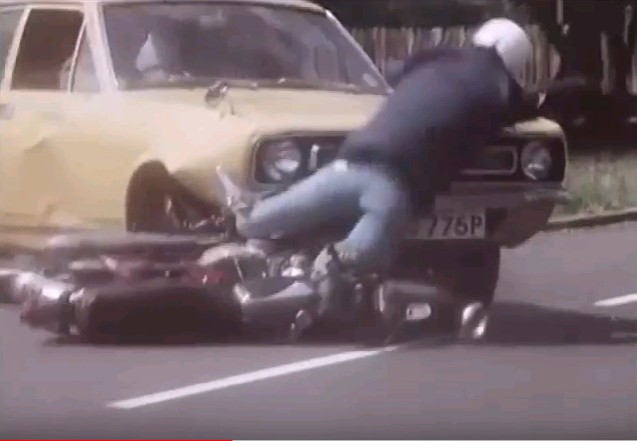
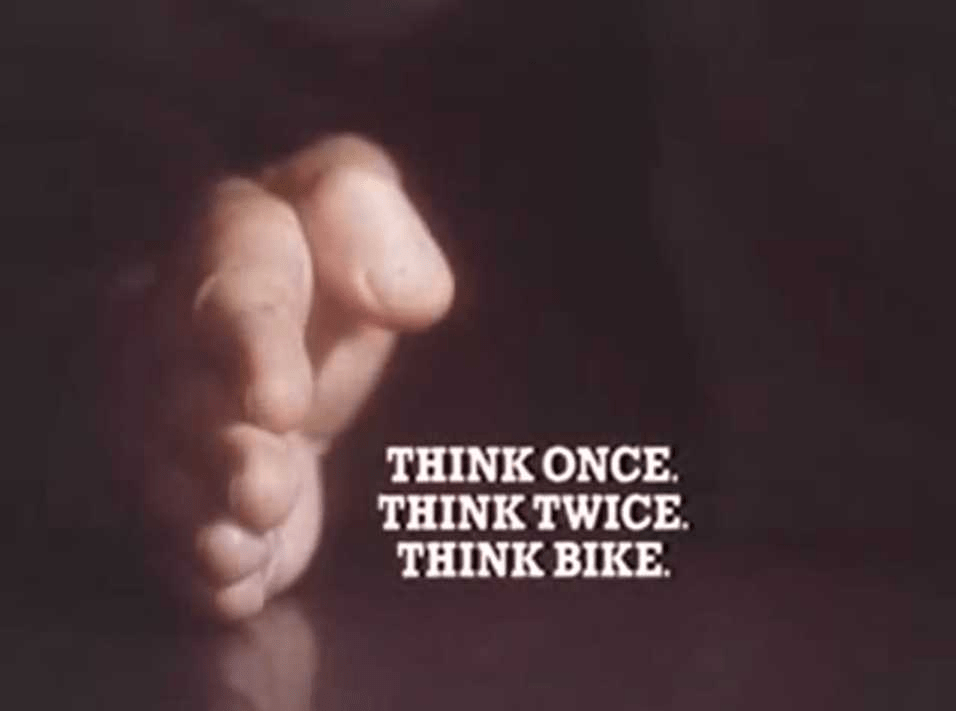
The original ‘Think Bike’ film

So what was the DVSA’s guidance to us instructors? ? Essentially, we were supposed to tell trainees that they were to make themselves easier to be seen; we had to explain the use of conspicuity aids, the differences between daytime fluorescent clothing and night-time reflective kit, and why they should use dipped (low beam) headlights in day time (day-riding lights).

It all began with the first ‘Ride Bright’ campaigns in London in the mid-70s. Many riders voluntarily adopted hi-vis clothing – I was one. Most turned their lights on too – me included when I graduated to a bike with a decent alternator. In fact, motorcycles have had their headlights wired permanently on for over fifteen years.

Just one problem. There is no evidence of positive results.

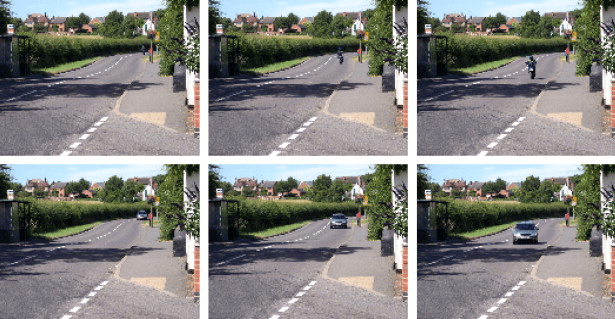
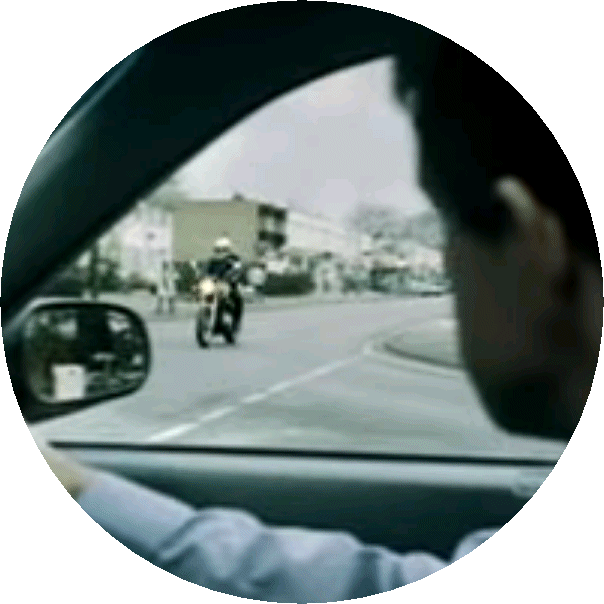
Drivers turning at junctions still look, then fail to spot an approaching motorcycle. And the ‘Sorry Mate I Didn’t See You’ collision with another vehicle at an intersection remains the most common crash involving a motorcyclist. The photo is clipped from the mid-70s ‘Think Once, Think Twice, Think BIKE!’ public information film, incidentally.
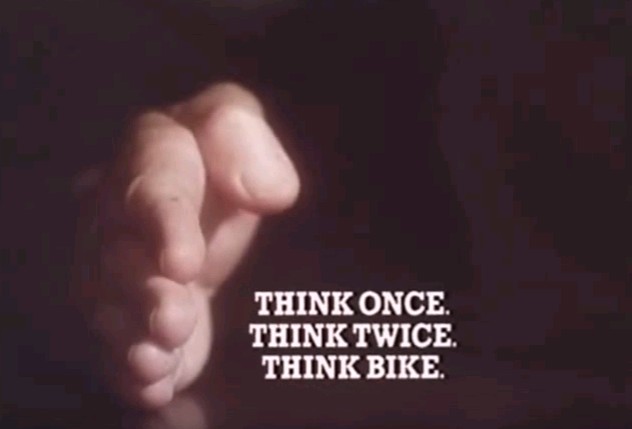
Why?

Here’s my guess. There’s an unintentional subtext to all the ‘Think Bike’ campaigns that we have been having since the mid 1970s. In telling new riders to “make yourself easier to see”, the subtext is this – when we encounter another vehicle at a junction ‘the other fellow’ is RESPONSIBLE for LOOKING FOR US.

And if they don’t see us and a collision occurs?

Then they ARE NOT DOING THEIR job – they must be incompetent or inattentive.

Worse, thanks to the ‘make yourself conspicuous’ messaging, riders come to believe that if they use conspicuity aids, they WILL be seen. Believing that, they don’t pay attention to the potential crash that’s being set up for them. Then when a driver commits the ‘looked but failed to see’ error and turns into the path of the approaching motorcycle, the rider sees what’s happening too late and is caught by SURPRISE! And thus riders fail to get out of collisions that could have been avoidable if only the rider had sounded the horn, then braked or swerved, promptly.

“The driver should have seen me” is all too common as a post-crash refrain.

As I’ve been saying for more than two decades – based on my own decade and a half of dodging vans and taxis in London – telling the driver to look out for bikers is only one-half of the story; far more often than not, the rider sees the turning vehicle – or at least the point at which it will appear – well BEFORE the collision becomes inevitable.

It’s this awareness of the need to search out the potential for a SMIDSY collision before it happens, and to understand what to do to stay out of trouble is what underpins the ‘No Surprise? No Accident!’ concept.

That’s why back in 2012 I delivered the very first Science Of Being Seen (SOBS) presentation at the pilot Biker Down course in Kent. Rather than say “wear hi-vis and ride with your lights on so drivers see you”, SOBS took a rather different look at conspicuity aids – explaining why sometimes they DON’T work:

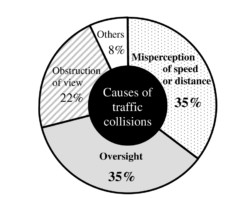
:: looked but COULD NOT see – the bike wasn’t where the driver was able to see it (accounts for around 1 in 5 collisions)
:: looked but FAILED TO see – the bike was visible but due to issues such as motion camouflage, saccadic masking and ineffective conspicuity strategies, the driver failed to detect it (the cause of around 1 in 3 collisions)
:: looked, SAW AND MISJUDGED – the bike was visible but drivers find it hard to accurately calculate ‘time to collision’ particularly on quicker roads (setting up another 1 in 3 collisions)

When we know WHY the collisions happen (and incidentally, distracted driving accounts for less than one in ten of the total, using a mobile at the wheel is about as likely to cause a SMIDSY as a medical emergency at the wheel), we can suggest some defensive measures.
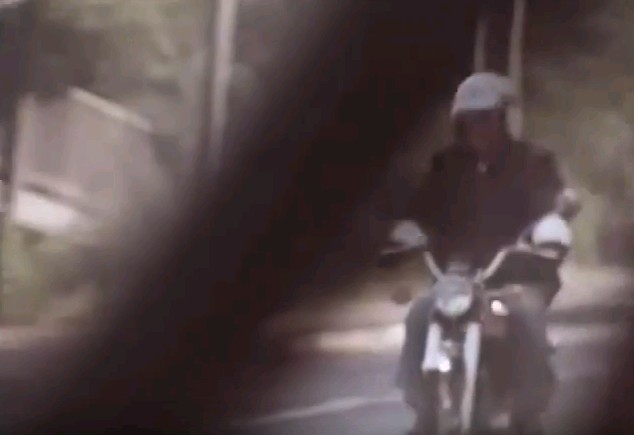
The first is simple enough – ride where we can be seen, and be alert to moments we CANNOT be seen. We need to be aware of the effect of ‘Vision Blockers’ between our position and someone looking for us and to understand the driver blind spot issues caused by the vehicle structure itself. If we can’t be seen, no conspicuity aid will work.

Then and only then should we consider improved conspicuity strategies – I have suggested swapping Saturn yellow (the most common shade of hi-vis but a colour that’s a poor contrast with foliage in rural areas) with Pink for rural daytime use.

And finally I promote the use of proactive responses to a POTENTIAL threat from a vehicle that COULD be about to turn across the rider’s path including sounding the horn, slowing down, changing position and setting up the brakes. It’s not difficult – after all, there are only two things that a vehicle intending to turn into our path can do – wait till we’ve passed by. Or pull out.

So has this ‘protect yourself’ approach filtered down to other road safety campaigns?

Well, there are finally signs that just possibly it has. Back at the beginning of the month, Warwickshire Police announced their usual enforcement campaign, but also mention a new ‘Ride Craft Hub’ which:

“…will help riders identify a SMIDSY situation and protect themselves”.

And last week whilst searching for something else, I found that a couple of years back I’d reported on a story from Tasmania that shows another small but significant indication that the official attitude to rider training is slowly beginning to change.

Stating that the rate of motorcycle accidents in Tasmania had become too high, Infrastructure minister Rene Hidding said that initially the state rolled out more mandatory training “just as had been done in so many other places”.

But Ms Hidding continued:

”It became obvious that people in the industry knew [the process] was wrong.”

A Victoria-based trainer, Duncan McRae, was called in to create a new curriculum which he said was “built around educating riders about those five common crash types that we see most often”.

Does that sound like something you might have heard here?

So, small beginnings, but I believe we’re seeing indications of a shift towards the ‘No Surprise’ approach to riding.

I’m not saying we should stop telling drivers to ‘Think Bike’ as some seem to have assumed, but we should certainly start encouraging a ‘Biker THINK!’ mindset.

I do apologise if I seem to be banging the same drum, but until riders really do accept that SMIDSYs aren’t an automatic consequence of riding a bike, someone has to. And I’ll see what I can dig up on the background to the Tasmanian curriculum change. Watch out for that soon.

http://www.ridecrafthub.org/
http://www.scienceofbeingseen.org
http://www.nosurprise.org
Motorcycle Safety: Moving Beyond ‘Think Bike’

*** SCIENCE OF BEING SEEN *** Moving from ‘Think Bike’ to ‘Biker THINK!’
Ten days ago on my Facebook page http://www.facebook.com/survivalskills, I posted an article about the lack of imagination in Police Scotland’s response to motorcycle crashes – basically, it was more enforcement. At the same time, what caught my eye was the goal that the Scottish ‘Road Safety Framework’ is aiming for is a 30% reduction in motorcyclist KSIs by 2030.

Suggesting that some new ideas were needed, I promptly got a response from an accident claims firm in Scotland telling me about their campaign aimed at drivers called ‘Take Another Look’:

“We are calling for a new campaign to ‘#takeanotherlook’ at junctions…”

On the face of it, that seems like a good idea. Nationwide data from the Department for Transport shows that in 2021, intersections – whether they are T, Y or staggered junctions – are the most common locations of motorcyclist casualties. Collisions at junctions represent no less than 34.7% of combined fatalities and injuries – one-in-three.

The ‘Take Another Look’ people offer an answer as they say their ‘new’ campaign is “…echoing the ‘Think Bike’ initiative of the 1970s that was aimed at increasing motorists’ awareness of motorcycles and reducing accidents caused by failure to spot them in time.”

Just one problem. Whilst calling for a 30% drop in motorcycle casualties by 2030, that same Scottish Road Safety Framework document made this telling statement:

“With regards to longer-term trend of motorcycle fatalities since 1994, there have been many peaks and troughs, and we are still in the same position we were in thirty years ago.”

On the one hand, we have a freshly-minted safety campaign simply repeating what we have been trying for the last fifty.

On the other, we have a statement of fact telling us that thirty years of Scottish motorcycle safety campaigns haven’t changed anything in thirty years.

Shouldn’t that be telling us something? Why are we expecting something that hasn’t worked for half a century to suddenly start working now?

Even if the people putting these campaigns together can’t see it, can’t we motorcyclists see that it’s time to move on from expecting drivers to keep us safe by ‘Thinking Bike’? Isn’t it time to adopt a fresh approach where we learn more about just why drivers don’t see motorcycles, to adopt a proactive approach where we stop relying on others, and crucially to learn to look for ways to avoid being caught up in what needn’t actually be a collision?

Biker, THINK!

=================================
WHAT IS SCIENCE OF BEING SEEN? (SOBS)
SOBS is my in-depth investigation into the
‘Sorry Mate, I Didn’t See You (SMIDSY) collision
between motorcycles and other vehicles.
Created for the fire services ‘Biker Down’
course, it’s based on science, not speculation.
I aim to quash some persistent myths about
how and why junction collisions happen, and
show how motorcyclists can employ simple
techniques to stay out of trouble!
FIND OUT MORE – http://www.scienceofbeingseen.org
BUY THE SOBS e-book – https://ko-fi.com/s/88fbc15a82
WATCH OUT FOR LIVE ONLINE TALKS

SUPPORT SOBS at http://www.ko-fi.com/survivalskills

Is the retinal blind spot a problem?

*** SCIENCE OF BEING SEEN *** Is the retinal blind spot a problem?
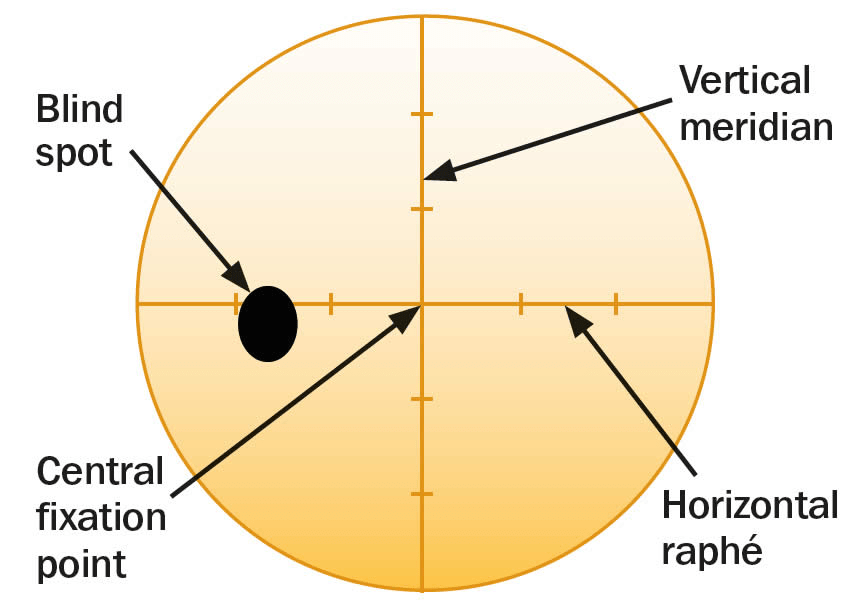
Each of our eyes has a blind spot. This is where, as I’m sure most of you will know, visual information is not detected. These blind areas are due to lack of the specialised photoreceptor rods and cones responsible for capturing light and transmitting visual signals to the brain. The optic nerve carries visual information from the eye to the brain, and the blind spot is caused by the optic nerve’s attachment to the retina where it exits the eye.

The retinal blind spot is a natural feature of the human visual system and covers somewhere between 15 and 20 degrees of our vision in each eye. The diagram shows the approximate location of the blind spot in a healthy left eye. The right eye would be a mirror image.

Recently, I’ve seen a number of articles suggesting that the blind spot is a factor in ‘looked but failed to see’ crashes – or at least, one of the reasons.

One article claimed that cars could go missing in the driver’s retinal blind spot, another suggested that drivers would fail to spot cycles as they approach a junction where the driver is about to turn:

“This blind spot can automatically create problems when driving. If you are not looking and actually moving your head when at junctions for example, you stand the risk of not seeing a narrow object such as a cyclist, because they could be in your blind spot, or even something larger at times.”

The article went on to suggest that “the brain makes up, or fills in what it believes to be there!”

And of course, motorcyclists have read these articles and started reporting on the internet that the retinal blind spots is to blame for collisions where drivers don’t spot motorcycles.

So is the retinal blind spot really a problem?

Almost certainly not. It’s pretty obvious that we don’t have a pair of gaping holes in our visual field, and until we actually try to find them we’re not actually conscious of the presence of the retinal blind spots.

That’s because unless we have lost the sight in one eye, we have binocular vision. That is, the field of vision of each eye overlaps. That means anything in the blind spot of one eye is always going to be within the visual field of the other eye.

As part of the normal processing of visual data, the brain takes the detail and information from both eyes and interpolates – fuses – the images from both eyes into one coherent view.

This means the missing visual data created by the retinal blind spot in one eye is filled in by the brain by using visual data from the other. It’s the same reason we don’t have ‘pigeon vision’ as claimed in a recent FortNine video, and this is why we don’t see our own nose.

Similarly the retinal blind spot is simply not perceived under normal circumstances. In fact, to find the blind spot in one eye, we usually have to cover up the other.

=================================
WHAT IS SCIENCE OF BEING SEEN? (SOBS)
SOBS is my in-depth investigation into the
‘Sorry Mate, I Didn’t See You (SMIDSY) collision
between motorcycles and other vehicles.
It’s based firmly on science, not speculation
and aims to quash some persistent myths
about just why junction collisions happen, and
show motorcyclists there are straightforward
techniques we can employ to stay out of trouble!
FIND OUT MORE – http://www.scienceofbeingseen.org
WATCH OUT FOR LIVE ONLINE TALKS

SUPPORT SOBS at http://www.ko-fi.com/survivalskills

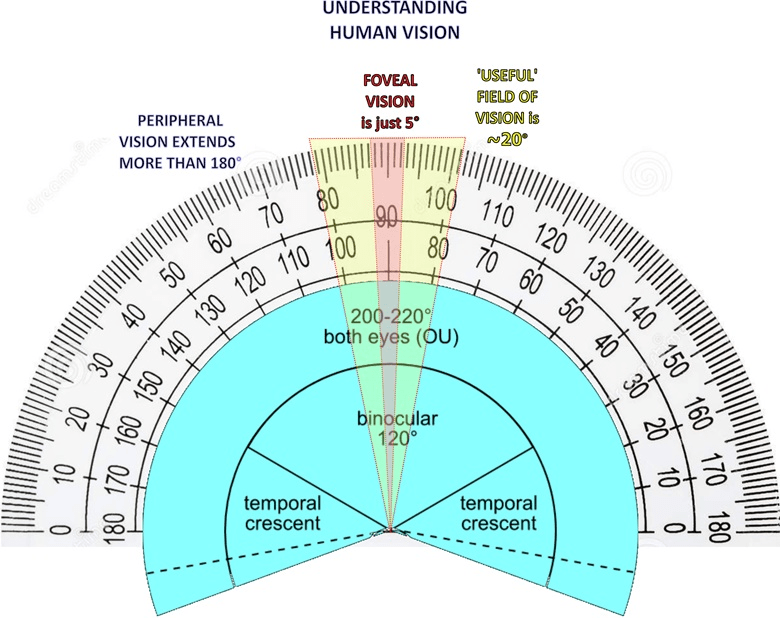
The second point to make is that to make a detail scan of any particular area, we have to look directly at it, to bring it into the narrow cone of clearly focused, colour vision which is right in the centre of the visual field, and just 5 degrees across.

If we look along a road towards oncoming traffic, we examine the scene with our foveal vision. Even if our brain failed to perceive a motorcycle that was in the blind spot of one eye, it would be visible in the other eye since the two retinal blind spots are offset to opposite side.

And it’s even unlikely that the approaching motorcycle would be in the blind spot since, it’s offset to one side and mostly below the ‘horizon’ created by our foveal zone.

So, I’d suggest that for normally sighted people with binocular vision, the retinal blind spot is not a problem.

However, there are a number of diseases and conditions that can cause blind spots or scotomas in the eyes. These blind spots can be temporary or permanent, and they may affect a small portion of the visual field or a larger area, depending on the underlying cause. Some common conditions that can lead to blind spots include:

Glaucoma

Macular degeneration

Optic neuritis

Retinal detachment

In short, regular eye tests are essential for detecting eye problems early, even if you don’t currently have any noticeable symptoms. And should you experience any sudden or persistent vision changes, including the appearance of blind spots, you should seek immediate medical attention.

That’s far better advice than telling motorcyclists drivers don’t see them because of retinal blind spots.


IF YOU THINK THIS POST HIT THE SPOT
please pay it forward to other bikers!

Like ✔ Comment ✔ Share ✔ Follow ✔

ANSWERING QUESTIONS NO-ONE ELSE ASKS
FIND OUT how you can get Survival Skills!
visit us at http://www.survivalskillsridertraining.co.uk

NEW! Link-in-bio page
https://campsite.bio/survivalskills
get all the links here…

survivalskills #advancedriding #skillsonsaturday #tipsontuesday #focusonfriday #nosurprise #scienceofbeingseen #SOBS #CrashCourse #shinysideup2021 #RideForever #ACC

What’s wrong with this hi-vis colour scheme?

Answer – it’s ‘disruptive camouflage’


I’ve commented often enough on how the emergency services have done a lot of research into what’s best at transforming a visible vehicle (ie, one that is in your line of sight and capable of being seen) into a conspicuous vehicle (ie, one that stands out against the background). And if you’ve taken a ‘Biker Down’ course you may well have heard my ‘Science of Being Seen’ presentation delivered to you.

So what you’re looking at are two machines from Ambulance Victoria’s paramedic motorcycle unit in Australia. After a three year trial found motorcycle paramedics have a better response time than traditional ambulances, they’ve been added permanently to the strength.

The BMW F700GS motorcycles are specifically designed for emergency services, and come factory fitted with warning devices, better braking systems, satellite navigation, upgraded suspension, dual batteries, and wiring already in place for all communications equipment. They carry a smaller version of defibrillators, trauma kits and medications used by other paramedics.

The bikes responded to almost 3000 cases last and move through “…heavy traffic… through traffic jams to get to accident scenes quickly… and access Melbourne’s bike paths and walking tracks”.

So that’s their function and given what they do, it’s a bit of a puzzle the way these bikes are dressed up.

The multiple colours and broken patterns are a pretty good imitation of a disruptive camouflage pattern – specifically designed to make objects harder to see!

What about headlight modulators

(Originally published on FB 25 March 2019, mildly edited)

What about headlight modulators?

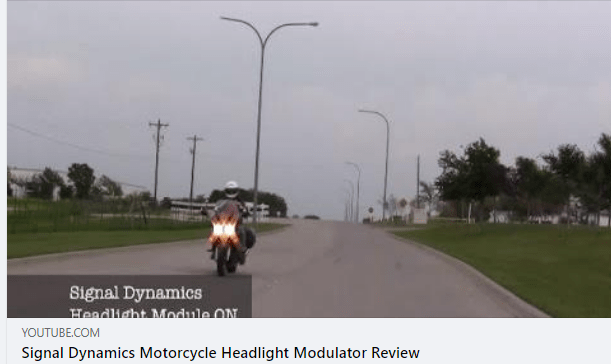
Headlight modulators have been the subject of investigations on a number of occasions, and some US-based riders swear by them. So I was interested to be sent the link to this particular promotional video.

The video starts with a demo of the rear modulator…

…unfortunately, I didn’t even SEE it first time the video ran, which should tell you something.

I know the bike’s not going very fast, but arguably, by the time it comes on it’s too late – the bike’s already slowing. Given that the usual cause of a rear-ender is being tailgated by a vehicle that’s too close to slow down when the bike ahead decelerates, what’s needed is a ‘pre-braking’ warning, not something that comes on at the exact same moment. How you achieve that, I’m not sure.

And there’s a more serious issue. The flashing light around the index plate is actually pulling your eyes AWAY from the important signal, which is the brake light. I can conceive of a situation where the driver’s eyes are pulled down to the flashing lights and fails to react to the brake light. After all, flashing lights around the index plate are usually there for decorative purposes rather than any function.

So what about the front modulator?

You can certainly see it but it’s a bit irritating, to say the least. Can you imagine driving against a long line of bikes, all flickering away on high beam?

In any case, the result of US research seems to be that it enhances DETECTION at long distances – we’re talking hundreds of metres away. So maybe a less irritating modulator may have some benefit on the kind of fast, flat and straight roads they have in parts of the US or perhaps Australia. I can see one use being to alert drivers who might consider overtaking towards the motorcycle.

However, as an anti-SMIDSY device in urban areas, my impression is that modulators appear ineffective, and as far as I can tell from research, the modulator doesn’t appear to have any significant conspicuity benefit when the range is twenty metres or less.

Why is this distance important?

Because in an urban context it’s the crucial distance at which you MUST be seen. Collision dynamics in slower-moving, denser in-town traffic – the circumstances in which most SMIDSY-style crashes occur – clearly indicate that at the moment the the driver makes the final and crucial ‘looked but failed to see’ (LBFTS) error, the bike must be with twenty metres, and probably within a dozen metres or so.

It doesn’t actually matter if we’re spotted 500 metres away or fifty metres away – the ‘Last Chance Saloon’ for the rider is the last check the driver makes before turning into the bike’s path. Why? Two reasons. If the bike is further off when the error happens, either the emerging car will clear the bike’s path and it will be a near-miss, or the rider has sufficient space to hit the brakes hard and stop which means it’s another near-miss.

So the implication is that the bike actually has to be much closer than most riders realise before the LBFTS error will inevitably result in a collision.

What’s clear from looking at the crash stats is that neither hi-vis nor DRLs seem to have made any difference to the overall pattern of crashes, and so the ‘Sorry Mate’ collisions at junctions remain as frequent as ever, despite significant numbers of riders in hi-vis riding kit and virtually every bike in the UK now using lights in daytime.

I doubt we’d see any difference if modulators were legalised for use in the UK either.

Of course, the counter-argument is that modulators will help drivers see you further off, then they will remember you’re there, but I’m not convinced. There’s no evidence that it works for ordinary lights despite trials suggesting bikes with lights are seen at greater distances than bikes with no lights.

So, from a personal perspective, just as I don’t rely on DRLs or hi-vis clothing, I’d rather back my ability to see the driver and anticipate the error than put my faith in a modulator.

In any case, they are illegal in many countries.

Thanks to ‘Paul’ for alerting me to the link.

The five flavours of conspicuity

Once again, I’ve had to respond to a comment on an article about why drivers fail to detect motorcycles in traffic. I was flagging up the difficulties of seeing bikes that are hidden by other vehicles – and thus “not visible” – when the ‘drivers don’t pay enough attention’ comment surfaced.

Not paying attention? Well, a little logical thinking should tell us it’s hard to ‘pay attention to something we can’t see. But is it true that drivers wander round in some kind of daze? Have a think about this.

There are 40 million drivers in the UK, but there are only around 100 fatal collisions at junctions, and maybe 10x that result in serious injuries. That’s 1100.

What about the minor bumps that don’t result in anything serious? Even if we multiplied by another factor of ten, and assumed that there are around 10,000 actual crashes involving bikes and cars at junctions each year, that means that 39,990,000 drivers DON’T crash into a bike each year.

There are around 1.3 million riders, who cover around 3 billion miles on the roads and during that time they have innumerable opportunities to encounter a car at a junction. So far as I know no-one has ever counted the number of junctions, nor calculated the number of interactions that there must be between riders and drivers.

The inference is obvious. The overwhelming majority of drivers DO see the overwhelming majority of powered two wheelers.

And that means those drivers clearly DO pay enough attention to avoid us as well as all the other vehicles they encounter. Even if ‘not paying attention’ were the ONLY reason that cars and motorcycles come to grief at junctions, the fact is that a lack of attention is NOT a driver’s default behaviour, despite what far too many riders believe and repeat.

The fact is, we never even notice the hundreds of drivers who get it right ahead of us, we only ever remember the occasional negative outcomes when someone gets it wrong.

Anyway, moving on…

…once we know that the vast majority of drivers DO look for motorcycles and see them, it’s necessary to look for explanations other than ‘not paying attention’.

If the rider is VISIBLE – that is, where the driver CAN see the bike – one explanation that goes back to the earliest days of research into these crashes is low CONSPICUITY.

Conspicuity can be defined as the properties of an object that cause it to attract attention or to be readily located by an active search. As I mentioned on Tuesday, visibility and conspicuity are NOT interchangeable terms. If a bike’s not visible to the driver, how conspicuous is it matters not a jot.

As Malc reminded me recently, conspicuity can be further broken down:

:: sensory conspicuity
:: attentional conspicuity
:: search conspicuity
:: behavioural conspicuity

Let’s have a look at what these terms mean.

SENSORY CONSPICUITY – this refers to the motorcycle’s ability to attract visual attention, which in determines the ease with which the motorcycle can be detected within the environment during an active search. Size, movement, brightness and contrast against the background all play a part.

ATTENTIONAL CONSPICUITY – this differs from sensory conspicuity as it refers to the degree to which the motorcycle will attract the observer’s attention when they are not actively searching the environment and the bike is unexpected.

SEARCH CONSPICUITY – of course, when we’re at a junction, we’re looking around for other vehicles. And search conspicuity is a measure of just how easy it is for the observer to locate a motorcycle quickly, reliably and accurately when actively scanning the environment.

It should be fairly obvious that attentional conspicuity and search conspicuity are linked. When given an instruction to search specific objects, it seems performance of the detection task improves, even when the target objects are harder to see because they have low sensory conspicuity. Not too surprising, really.

This is the basis of the ‘Think Bike’ campaigns – when drivers are reminded to actively search for motorcycles, the theory is that they will see more of them.

Unfortunately, the theory doesn’t seem to be born out by the results – we’ve been running ‘Think Bike’ campaigns since the mid-70s, yet there doesn’t seem to be any significant’ reduction in the number of collisions that occur at intersections. It may well be that the reminders are forgotten rapidly. Or there may be an element of ‘saturation’ with these campaigns, accompanied by a belief that the crashes only happen “to others”. Of course, statistically – as we’ve just seen – that’s actually correct. The vast majority of drivers will never have a collision with a motorcycle in the whole of their driving career.

BEHAVIOURAL CONSPICUITY – this concerns the the ability of an object or organism to attract attention through its behaviour. For a motorcyclist, this could include actions such as lateral change of position within the lane to generate a movement against the background, the use of brightly-coloured clothing (hi-vis) or day riding lights, including the headlight modulators popular in the US, and the use of sound.

This is the basis of the ‘Ride Bright’ campaigns, which also began in the mid-70s – in fact, I was one of the very first riders to start using my headlight in daytime, and to wear a hi-vis Sam Browne belt.

Has it made any difference? Having looked, I can’t see any obvious difference in the crash rates at junctions between countries which have a lights-on rule (such as France) and those which don’t. Bikes in the UK have come with a hard-wired low beam as a day riding light for quite a few years now, yet once again, it doesn’t seem to have had any effect on collisions.

I’ll add a fifth form of conspicuity:

COGNITIVE CONSPICUITY – research studies have suggested that so-called ‘dual drivers’ who are both cyclists and motorists had fewer collisions with cyclists and detected them at a greater distance in all situations, irrespective of cyclist visibility. Similar results suggest similar outcomes for motorcyclist drivers too. The conclusion was that having experience of either of the vulnerable forms of transport offers those road users an advantage when behind the wheel of a car in terms of processing the visual field and detecting the two-wheelers.

This is why some people advocate that all drivers should be given some training on powered two-wheelers. Unfortunately, as far as I know, a short course of bike training has very little effect long-term. It looks like you need to be a life-long cyclist or motorcyclist for the the awareness of cycles and motorcycles to filter through into driving.

CONCLUSION – my reading of the research, and my investigations into actual crash data tells me that as motorcyclists, we really should not be placing too much faith in any kind of conspicuity.

The biggest problem is that hi-vis clothing and day riding lights are, by their very nature, passive protection; that is, we rely on others seeing us and taking the appropriate action to keep us out of trouble.

As I said at the end of my response to the person saying the issue is ‘lack of attention’, the fact is that COLLISIONS by their very nature are ‘two to tangle’ incidents – one road user sets it up, the other rides into it. Accident studies the world over show that very significant numbers of junction collisions could have been avoided BY THE RIDER if that rider had:

a) seen the crash coming
b) known what to do to STAY out of trouble (evasion)
c) known what to do to GET out of trouble (avoidance)
d) reacted to the threat in time!

I’m still absolutely convinced our safety lies in our own hands. Be pro-active and take responsibility, don’t rely on others to get it right. Do that, and it doesn’t matter whether it’s ‘not paying attention’ or conspicuity issues that cause us not to be detected. It won’t matter because we’ve already the potential problem and dealing with it.

http://www.scienceofbeingseen.org

‘Pigeon vision’ – why it’s not a thing

Does the way pigeons see the world explain some motorcycle crashes?

Ryan over at FortNine recently put up a video entitled ‘how pigeons explain a common motorcycle crash. The presentation says that pigeons “suck at assessing how fast a particular vehicle is closing on them”. And he points to some research that shows that in a particular speed zone, they take off at the same distance from a car no matter what the speed the car approaches at. He says that the pigeons learn the typical speed of cars in their zone. Ryan then says this is because pigeons lack ‘binocular disparity’ and the ability to judge approach speed.

What’s binocular disparity? Because we have two eyes which both offer a view of a particular object, each eye gets a slightly different flat 2-D image from the light that falls on to each retina.

Imagine a tree behind a car. The view of eye is at a slightly different angle, which means each eye will show the tree at a slightly different position relative to the car. The brain can uses these different images to extract depth information. This is binocular disparity.

Ryan then says that we can use binocular disparity “to judge how fast an object is closing on us”, and explains that this is known as ‘stereopsis’ and that “within thirty metres it’s the main method of gauging the speed of other vehicles”.

“Unless” he adds…

…”you’re a pigeon” because pigeons have their eyes on either side of their head.

And he then explains that as we’re sitting at a junction, we only have one eye turned towards the junction:

“Same handicap, see? Only one eye is looking because the other is blocked by my nose”.

He then says that this isn’t so much of a problem when tracking cars because “one eye can still track using the apparent change in size to gauge closing speed”. The problem with motorcycles is that because they are “skinny”, they “don’t show much enlargement” until the bike’s on top of the observer.

Same angle, same distances… the car appears to ‘grow’ more than the bike

This is actually the phenomenon known as looming, and it’s well-known that it is easier to judge speed and distance for cars than bikes – for some reason, our brain measures the lateral growth of a car better than the vertical growth of a bike.

OK, so that’s the basis for the video. It’s plausible-sounding, particularly as it’s well-known that the brain ‘edits out’ the fact that our nose is actually visible in both eyes but I’d say there are significant flaws in the reasoning.

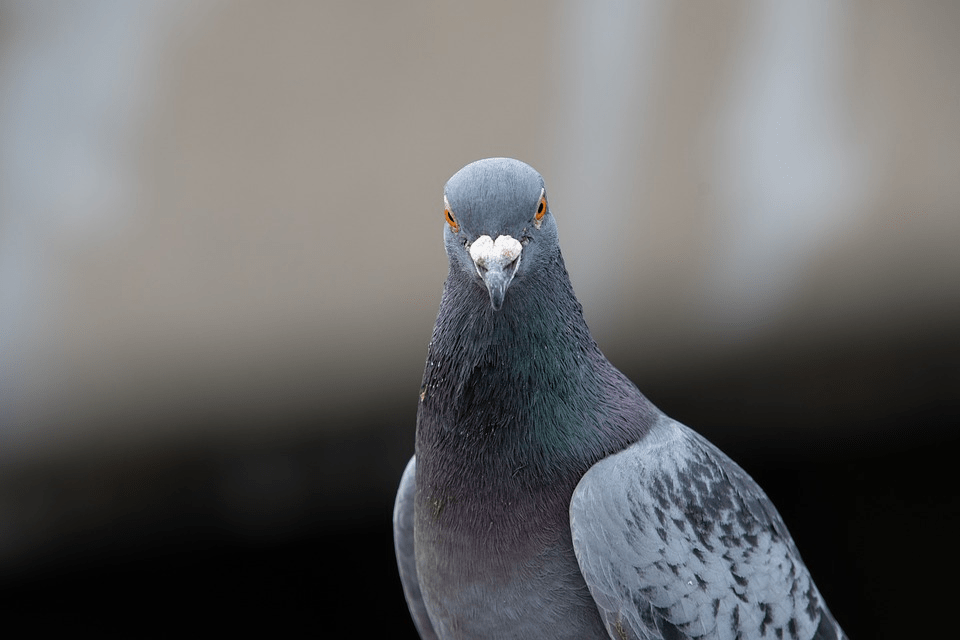
PIGEONS DO HAVE BINOCULAR VISION – Despite having eyes on either side of their head, and though they may turn their heads to scan you with one eye, even for pigeons the fields of view of their two eyes do overlap. Not by much, but pigeons WILL look straight at you and when they do that they are seeing you with both eyes. See the photo.

And although I have no proof, I’d suggest they DO need good depth perception – if they didn’t, they’d never manage to land on a narrow branch. They look directly ahead of them when landing.

HUMANS HAVE A WIDE FIELD OF BINOCULAR VISION – For human vision, the overlap is around 120° – that means we have monocular vision ONLY for around 40° at each side of our field of view. Yes, the bridge of the nose occludes part of each eye’s visual field, but nothing like the extent of a pigeon.

PERIPHERAL VISION DETECTS MOVEMENT AND LIGHT – The pigeon’s eyes are on either side of its head because it’s a prey animal. The eyes give a ‘wrap-around’ field of view with only a very small blind spot directly behind its head. Humans do have a bigger blind spot, but even staring directly ahead, our eyes are sensitive to movement and lights at 90 degrees since that angle falls within our peripheral vision. And once something is detected, our instinct is to turn our head to look straight at it.

The nose restricts around 40° of our total vision either side, but when we want to ‘look’ at something
we turn our heads to focus both eyes…

‘USEFUL’ AND FOCUSED VISION IS MORE RESTRICTED – Within that binocular field, the so-called ‘useful’ field of vision – the visual area from which information can be extracted in a single glance without eye or head movements – is restricted to around 10° either side of our line of sight.

Even more crucially, if we want to extract detail information, then we have to aim our gaze and use ‘foveal’ vision. This is where we get the clear, colour and focused image of the world. The bad news is that it’s a tiny cone, just 5° across at the point our gaze is focused. This is down to the construction of the human eye.

TO SEE DETAIL WE TURN OUR HEADS – It’s simply not possible to gain full situational awareness by relying entirely on the peripheral vision. If we want to look at something in detail, we have to bring it into the centre of our visual field, into our gaze. Mostly, this is a function of the anatomy of the eye; the fovea, the central portion of the retina, has the highest density of photo receptors. It’s also connected to a much larger part of the visual cortex in the brain, where the visual data is processed.

Whilst peripheral vision can provide useful information to fill out situation awareness, for a detailed study of a particular object we need to turn our eyes onto it.

So when we want to see something in detail – including the involuntary response that happens when we detect movement or light in peripheral vision – we do the same ‘eyes front’ thing that the pigeon does when it needs to land. At junctions we don’t stare straight out of the windscreen, trying to work out what’s coming from each direction via peripheral vision from both eyes simultaneously; we turn our heads to search in each direction in turn, in order to point these foveal cones of vision towards the specific area we’re searching.

Tracking, we’re keeping the bike firmly in the middle of our visual field…
Image taken from ‘Look harder for bikes’ road safety video

Ryan talks about the issue of ‘tracking’ vehicles. The fact is we achieve this by looking directly at them. That implies we’ve already seen them and we’re not attempting to detect them. The difficulty of judging speed and distance occurs when we’re already looking at them.

DRIVERS TURNING INTO SIDE ROADS MISS BIKES TOO – If the pigeon vision issue really was a thing, how can we explain the fact that there are TWO collision types at junctions?

Whilst the collision with the driver who emerges from the turning on the nearside is the more common, a significant number of crashes involve an oncoming driver turning INTO the side road and across the driver’s path.

If the ‘looked but failed to see’ issue was really down to a chunk of the visual field being viewed only through one eye, these collisions shouldn’t happen – they’d be ideal circumstances for full binocular vision to detect the bike, then judge its speed to a nicety.

FAILED TO SEE ERRORS HAPPEN CLOSE UP – Ryan says that stereopsis is “the main method of gauging the speed of other vehicles… within thirty metres. I’ve no reason to argue with that, but let’s actually think about the collision dynamics.

30 mph is 13.4 metres per second. So thirty metres is something over two seconds away. Research into collisions suggests that the safe ‘cut-off’ when a rider is almost certain to avoid a collision is three seconds out from the crash – so something under fifty metres away at 30 mph. But at 60 mph, it’s getting on for one hundred metres away.

If Ryan’s figures are right, at rural road speeds the error happens well outside the limits of stereopsis. Even at urban speeds, the error in spotting the bike could happen right at the limits.

But even if the error did happen within the zone covered by stereopsis, there’s a second consideration. Even a rider who’s taken by SURPRISE! should be able to stop fairly comfortably within twenty five metres. I can – and have – stopped in about ten metres from 30 mph.

The three main reasons for collisions and junctions; the driver looked but COULD NOT see… the driver looked but FAILED to see… the driver looked, saw but MISJUDGED speed or distance…

So if the bike actually HITS the car, the error MUST have happened closer. A LOT closer. If a driver somehow fails to detect a motorcycle less than twenty five metres away, I don’t think it’s a speed / distance misjudgement (with one exception – see below). It’s far more likely the driver simply didn’t SEE the bike.

And that can happen because either the bike wasn’t VISIBLE when the driver looked (one in five of collisions) or the perception error was caused by one of the many PERCEPTUAL issues that fall under the ‘looked but failed to see’ umbrella (one in three collisions).

The bulk of ‘looked, saw but misjudged speed and distance’ errors (one in three collisions) seem to happen on faster roads where the bike is beyond the range of stereopsis, and we use the rate of change in size to judge approach speed – and now the difficulty in judging the lateral growth of a motorcycle most likely becomes crucial. The size of the machine only grows by a quarter, despite the distance halving.

(And dismiss the ‘driver didn’t look’ theory too – the proportion of collisions where the driver was distracted is tiny. If drivers genuinely ‘didn’t look’, they’d be bouncing off pedestrians, bikes, and buses – as well as other cars – every few seconds.)

OR THE RIDER WAS SPEEDING – Oddly enough, that researcher who found the pigeons scattered at the same distance from the car no matter what speed he approached at found something in common with drivers. We too gain a sense of how much time we have to turn at junctions based on the TYPICAL speed of vehicles.

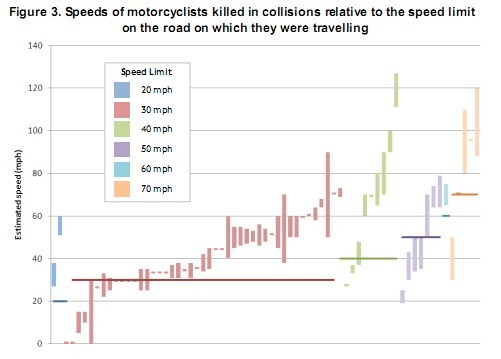
So if ANY vehicle – not just a motorcycle – is travelling significantly quicker than average, that vehicle is far more likely to have a collision. It’s not the speed that caused it per se, although more speed means more difficulty stopping and a bigger impact if the rider hits something, other road users simply aren’t expecting the vehicle to be travelling at the excess speed, so don’t detect the anomaly easily and thus are more likely to turn across the rider’s path.

The horizontal line represents the speed limit, the vertical bars of the same colour
represents the speed of the rider estimated by police

I don’t think it’s any coincidence that in a study of fatal bike crashes in the London area a few years ago, the majority of the deaths in the lower speed limits involved riders who were exceeding the limit. The horizontal lines in the chart represent the speed limit. The vertical bars are the estimated speeds of the riders who died.

AND DRIVERS COLLIDE WITH CARS TOO – Research from the Netherlands a few years ago looked at car-motorcycle and car-car detection errors, and adjusted the rates for EXPOSURE – that it, how many bikes and how many cars a driver would encounter in the same time frame. And what they found was that far from picking out bikes to collide with, drivers actually made the ‘looked but failed to see’ error in front of another car just as often as they made the error in front of a two-wheeler.

We always have to be a little careful about taking data from one country and exporting it to ‘fit’ our own roads and in this case the Netherlands has many more mopeds on the roads than the UK so there’s the possibility that drivers were more ‘bike-aware’. But there’s other evidence that hints that in countries where most vehicles are two-wheelers, bikers crash into bikers at much the same rate as car drivers.

We also have to remember that our own PERSONAL stories are looking through the opposite end of the lens. We may think that drivers are more likely to make a mistake in front of us on our bike than other riders, but the fact is we’ll encounter many more cars than bikes on a ride.

AND A FINAL NAIL – I didn’t even mention the fact that a substantial minority of the population have various eye issues which makes stereopsis impossible, yet manage to drive successfully.

CONCLUSION – The FortNine videos that Ryan fronts are often informative as well as entertaining to watch. But in this particular instance, I think the reasoning he uses is flawed. And hopefully I’ve explained this clearly enough that you can follow my own arguments. I’d be interested in your comments too, of course.

BUT HERE’S WHERE I DO AGREE – If there’s one bit of the video that I absolutely concur with, it’s Ryan’s comment after showing the old mid-70s ‘Think ONCE, think TWICE, think BIKE’ TV advert. I wonder where he found that?

Made in the mid-1970s, it’s still one of the best ‘think bike’ ads

He says about ‘think bike’, “he’s not wrong, but it’s not useful either. If we’re dealing with a sensory problem then imploring drivers to see better is like imploring a deaf person to listen up. I’d rather take my own responsibility…”

Spot on. Be proactive. Don’t wait to be seen. Assume you won’t be detected and ride with that in mind.

You can watch the FortNine video here:

You can find out more about the Science Of Being Seen project here:

www.scienceofbeingseen.org.uk

BOOK YOUR OWN PRESENTATION

I’m available to deliver the Science Of Being Seen (SOBS) presentation to clubs and groups around the UK IN PERSON, or anywhere in the WORLD via a WEBCAST, and at reasonable cost too.

SEND ME A MESSAGE AND I’LL GET BACK TO YOU.

Eye contact – an entirely faulty concept

and why we should forget it

Here’s a snippet from an article on an online motorcycle magazine site, in a series about how to avoid common crashes. Not surprisingly it’s starts with the SMIDSY collision with a vehicle turning at a junction.

This particular statement leapt out at me:

“The number of drivers who have pulled out on while I’ve been maintaining eye contact with them while wearing a clear visor is very worrying. The shock in the face of the driver is the scariest thing to me, it means that person looked to the right, made full eye contact me and still pulled out while I was sounding my horn and taking evasive action! Frightening stuff.”

Now, just think about that for a moment.

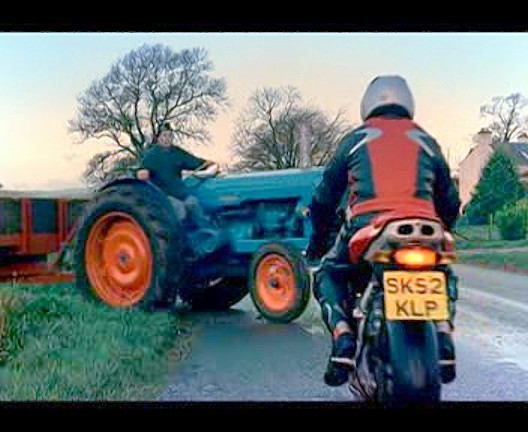
tractor and motorcycle SMIDSY
Looking our way? The best we can say is “they MIGHT see us”

The writer says that enough drivers have pulled out whilst he’s been maintaining eye contact for it to be ‘very worrying’.

Does that suggest anything to you?

Might it be that if drivers continue to pull out whilst ‘making eye contact’ than in fact they AREN’T actually seeing the bike? 

And the writer has actually spotted this, but hasn’t actually realised that the ‘shock in the face of the driver’ is a big clue.

That ‘shock’ is the moment the driver actually SPOTS the bike. The shock is the result of the SURPRISE! at seeing it.

Take a bit of time to watch drivers at junctions. Watch HOW they look in our direction. You’ll often see a snap of the head . That’s the moment we’re detected. You’ll often see the driver then track us by moving his or her head. 

That’s when the driver really does look at us, rather than in our direction. 

I say ‘really does look at us’ because eye contact is an entirely faulty concept.

The eye’s foveal zone – the part of the visual field that gives us clear and sharply focused colour vision – is just a few degrees across. Anything out of this zone is fuzzy. 


WANT TO KNOW MORE ABOUT SCIENCE OF BEING SEEN?
catch the regular LIVE ONLINE TALK SERIES events – next dates:

AUGUST’S LIVE EVENT – ‘SOBS – the full presentation’
WEDNESDAY 3 AUGUST 2022 at 20:00. Tickets cost £5

SEPTEMBER’S LIVE EVENT – ‘Riding Systems – what they
are, and why we need to apply them systematically’

WEDNESDAY 7 SEPTEMBER 2022 at 20:00. Tickets cost £5

BOOK the ONLINE TALK SERIES events at:

https://survivalskills.tidyhq.com/public/schedule/events


You can test this easily by holding your arm out, sticking your thumb up in the air then looking at the thumb nail. Now look at the top knuckle on your thumb. Even though it’s just a centimetre or so below your nail you MUST move your eyes and refocus.

And remember too, that the eye has a depth of field just like a camera. Think how hard it is to focus on an object if there are other things in the same direction but at a different distance. We can have the same problem with a camera, trying to focus on a small object when there are other things in front of it and behind it. 

In the case of a bike, it’s entirely possible that the driver we were so busily trying to make eye contact with was actually looking at and focused on the car ten metres behind us.

So that’s another reason why trying to make eye contact is pretty much a waste of time – the driver can appear to be looking straight at us whilst focused on a car behind us. The motorcycle ahead of it never registers in the driver’s consciousness. It’s not ‘carelessness’ or ‘not looking properly’, it’s just how our eyes work.

So here’s a question for you. If the writer keeps ‘making eye contact’ yet it clearly doesn’t work, why keep trying to make something of it? 

My advice? Forget it and assume we’ve not been seen. We’ll be far better prepared when the driver does make the ‘looked but failed to see’ error and pulls into our path!

WANT TO IMPROVE YOUR PRACTICAL RIDING SKILLS?
Head to www.survivalskillsridertraining.co.uk to find out how I can help you develop a genuinely defensive mindset when riding!

Will you make waves in a sea of lights?

As you will undoubtedly have noticed, the long nights are here again and that means many of us will be riding in twilight or even full night conditions, either out on unlit roads or under street lighting. And equally predictably, the annual forum conversations have struck up:

“The lights on my new bike aren’t as good as my old one. What do you recommend to make them brighter?”

And equally inevitably, talk turns to up-rating the main light or adding auxiliary lights.

But for some, the lights aren’t to see where we’re going rather more effectively; “I want brighter lights to be seen better”.

And that’s risky thinking.

Many years ago, I attended an early Met Police Bikesafe day. As well as the observed rides, there was some useful classroom content, including an extremely insightful and brutally no-nonsense analysis of three fatal motorcycle crashes, a part of the course they have now dropped.

Three crashes were explained to us. One involved a relatively inexperienced rider who simply tried to take a corner too fast and struck a lamp post. The second happened to a rider cautiously filtering down the outside of a queue, who was nudged off-balanced by an unexpected movement of the car he was passing – he went under the wheels of an oncoming car.

The third was the most complex and involved lights, lighting and the background.

At first sight, it was a classic ‘SMIDSY’; the bike on a priority road, a driver who didn’t see the bike pulling out from a junction to the rider’s nearside. The car stopped blocking the lane, the rider was unable to take evasive action and was killed.

What was unusual about the crash was that it was at night, and the bike was a Triumph Speed Triple, with big twin headlights. It’s the sort of bike that gut instinct would tell us should be easy to spot after dark and the idea that driver could fail to spot such a bike on a brightly lit road is totally counterintuitive to a lot of riders. Many would jump to the conclusion that: “the driver didn’t look”, or “wasn’t paying attention”, or “needs an eye-test”.

Both lights were still working after the collision so there were no faults with the lights themselves, and the street was well-lit. Too well lit, it turned out.

It was the photo taken from the driver’s perspective that suggested the likely explanation.

As the driver looked to her right, the bike was approaching against a backdrop of bright lights; other vehicles behind the bike, yes. But also illuminated shop windows and signs, illuminated bollards in the centre of the road and even the street lighting, all thanks to that curve and slope.

The police investigation appeared to suggest that either the bright twin lights on the bike appeared to belong to a car further off, or they simply blended in with the brightly lit background.

In either case, the driver never realised she was looking towards a motorcycle until it was too late, hitting the brakes and blocking the road.

So are there any answers?

The first is simple enough. Assume we WON’T be seen by each and every driver rather than the other way round. Expect to have to take evasive action and we’ll be on the alert to do just that with the absolute minimum delay. It may not prevent a collision – but at least we won’t ride into it without reacting.

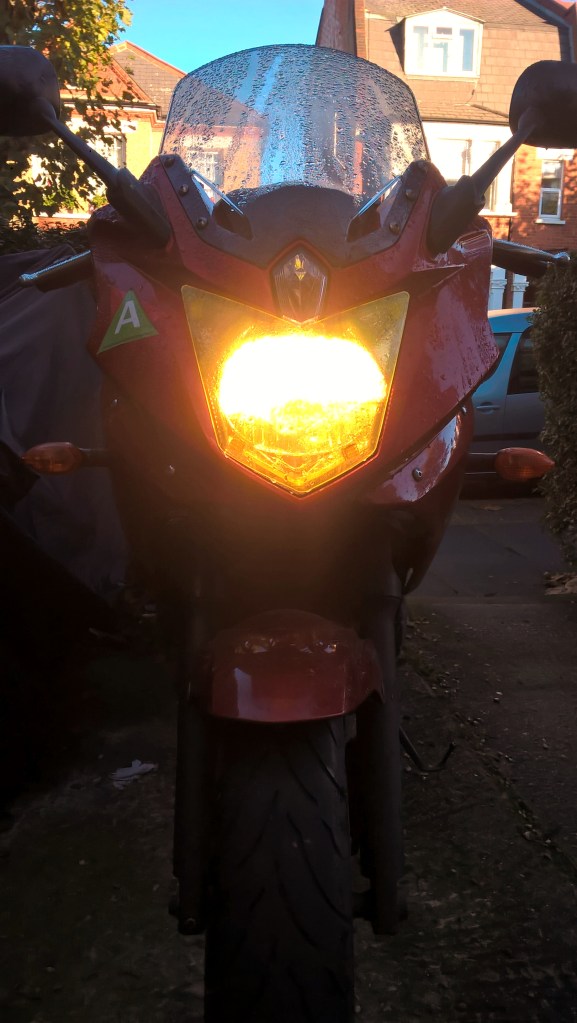
Yellow headlight illuminated on motorcycle

The second is a little more complex. We need to make ourselves stand out. And in a sea of white lights including increasingly bright CAR lights, we need to understand that adding MORE and BRIGHTER white lights isn’t the answer. With the wrong background, it’s simply more camouflage!

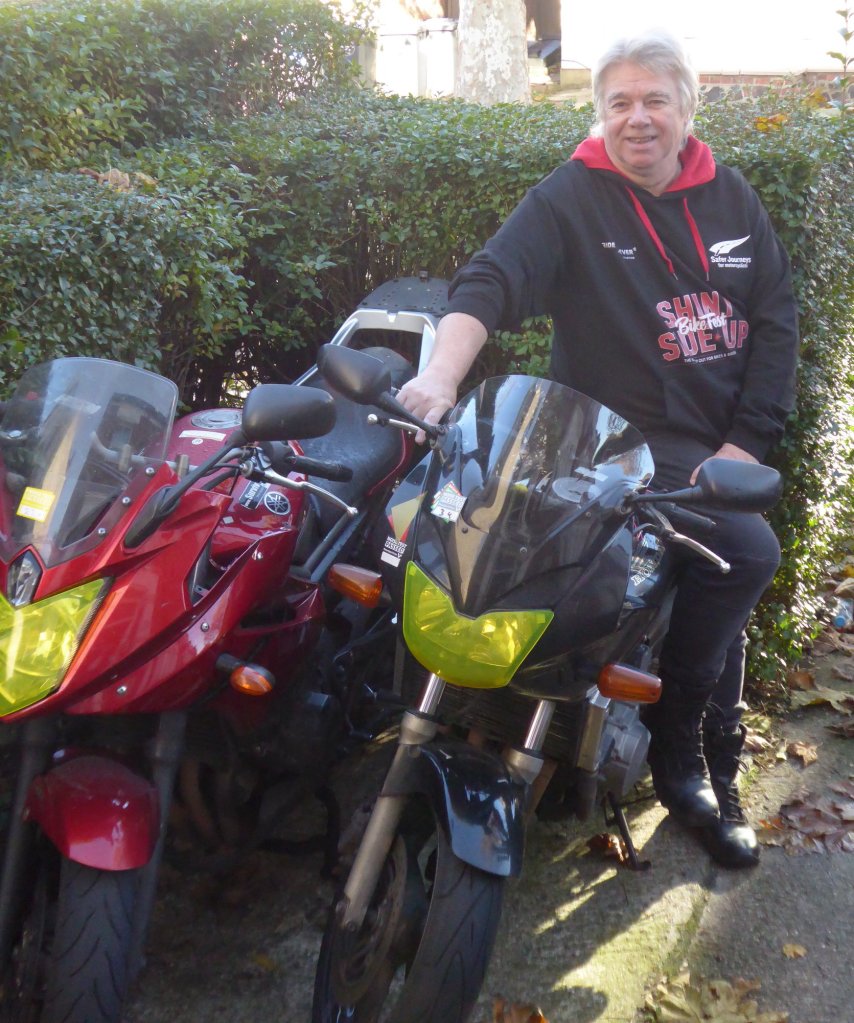
My suggestion? Fit a yellow headlamp cover for night time use in a built-up area. Held on by Velcro, it’s simple enough to remove once out of town. Does it work? Well, hard to say from crash stats as so few riders use yellow lights. But there IS research evidence out there to suggest drivers find bikes sporting coloured lights easier to see.


=================================
WHAT IS THE SCIENCE OF BEING SEEN? (SOBS)
SOBS is an in-depth look at the ‘Sorry Mate, I
Didn’t See You (SMIDSY) collision. Originally
created in early 2012 for Kent Fire & Rescue as
Module 3 of the pilot Biker Down course. Until
2020, most Biker Down courses across the UK
used a ‘slimmed down’ version of SOBS.

SOBS has been recognised internationally. Our
KFRS team was awarded a Prince Michael of Kent
International Road Safety Award in 2012 and an
insurance industry award in 2013. In 2018 & 2019
I took SOBS to New Zealand for the Shiny Side Up
roadshow. SOBS featured on the US REVVTalks
in 2020, on the RoadSafetyGB PTW safety event
in 2021 and was delivered to NZ again via Zoom.
SOBS has featured on the Devitt Bike Blog here:

https://www.devittinsurance.com/guides/motorcycle-features/the-science-of-being-seen/

SEE THE ORIGINAL PRESENTATION LIVE ONLINE

I’m delivering the FULL 40 minute presentation
updated with the LATEST research every two months.

NEXT DATE: Wednesday TICKETS: £5
SIGN UP: at http://thq.fyi/se/012097de78a5

=================================

Kevin Williams with two motorcycles with yellow headlight covers

———————————
IF YOU THINK THIS POST HIT THE SPOT
Like ✔ Comment ✔ Share ✔ Follow ✔
ANSWERING THE QUESTIONS NO-ONE ELSE ASKS
FIND OUT how you can get Survival Skills!
visit the website at www.survivalskills.co.uk
———————————

#survivalskills #advancedriding #skillsonsaturday #tipsontuesday #focusonfriday #nosurprise #scienceofbeingseen #SOBS #CrashCourse #shinysideup2021 #RideForever #ACC

Latest updates… and still to come…

LATEST UPDATES

30 April 2021 – New information on day-riding lights – originally called for by a conference on road safety in Vienna in 1968, adopted by the European Motorcycle Manufacturers Association ACEM in 2001.

1 May 2021 – UK’s 2021 ‘Think Bike’ week still claiming that wearing hi-vis clothing and using day-riding lights will mean “drivers will see bikers”.

LATEST NEWS

28 April 2021 – Science Of Being Seen delivered to 150 member of Thames Valley Advanced Motorcyclists

————————-

LIVE ZOOM PRESENTATIONS of the Science Of Being Seen

I created the Science Of Being Seen presentation in 2011/12 for Kent Fire and Rescue Service to be delivered as part of the free ‘Biker Down’ accident management and first aid course, and after Biker Down went national, many of the teams opted to use a version of SOBS with their course.

I personally delivered SOBS once a month for KFRS  from early 2012 until February 2020, when COVID-19 prevented us running the courses. KFRS have since decided as part of their COVID safety policy that all content shall be delivered in-house by their own staff for the foreseeable future.

But you can now book a seat for my new regular LIVE SOBS PRESENTATION to be delivered online!

——————————–
NOW AVAILABLE – LIVE SOBS PRESENTATIONS
CHECK OUT SURVIVAL SKILLS ONLINE TALK SERIES – NEW!
https://survivalskills.tidyhq.com/schedule/events
——————————–

And if you would like to organise a closed-to-club Zoom presentation for YOUR OWN RIDING CLUB OR GROUP, drop me a line and I’ll put wheels in motion.  

PREVIOUS UPDATES on Ko-Fi

‘Looked Saw & Forgot’ 27 September 2019 – Crucial new understanding – ‘Micro-memory lapses’

The authors of a paper entitled: “The ‘Saw but Forgot’ error: A role for short-term memory failures in understanding junction crashes?” have proposed a mechanism by which some motorcycle collisions which are current classified as ‘looked but failed to see’ crashes are actually the result of a memory issue – the motorcycle is actually seen and brought to conscious attention – but is then somehow forgotten again in what I suggested might be termed a ‘micro-memory lapse’.

In computer terms, this is ‘FIFO’ memory – first in, first out – and the buffer size is small.

What this means from a practical point of view is that in an environment where there are few vehicles, and assuming that the bike is seen in the first place, drivers (and other bikers incidentally) WILL remember the PTW as they plan their manoeuvre, so factoring in the motorcycle.

But in a crowded environment, where there are many things to keep track of, there is a risk that a motorcycle, although it HAS been seen, is then forgotten as other vehicles and maybe cycles and pedestrians catch the driver’s attention. With many vehicles to keep track of, there is a risk that the motorcycle’s presence slips from this short term ‘micro-memory’ as it’s filled with newer data.

Although the paper went on to give the suggestion that drivers should ‘see bike, SAY “BIKE”‘ to engage a different pathway in the brain to prevent these memory issues, my own conclusion (once again) is that it is just another reason why motorcyclists should assume first and foremost that they have not been seen, and be ready to take evasive action.

I will be incorporating this new theory into SOBS at the earliest opportunity. In the meantime, there is a fuller explanation here

————————-

*** SOBS *** Crucial new understanding – ‘Micro-memory lapses’
read it here…

*** SCIENCE OF BEING SEEN *** Danny John-Jules reports
read it here…

————————-

PAST PRESENTATIONS:

————————-
11AM Sunday 6th October 2019

RoSPA ADVANCED DRIVERS and RIDERS CAMBRIDGESHIRE

7PM Wednesday 25th September 2019
WEST LONDON RIDERS UXBRIDGE

————————-

JUST ADDED / coming soon

Just added 17 April 2019 – each page now has a short summary at the top, which covers the main points set out in the rest of the text.

Coming soon – a brief explanation of what ‘science’ is, how it works, and whether we can trust the results.

Coming soon – some positive conclusions about how motorcyclists can prevent themselves being caught up in a ‘Two to Tangle’ collision with a driver at a junction.

————————-

Don’t forget – start from the bottom!

Since you’re here, I’ve a small favour to ask. If you feel able to make a small donation to the upkeep and continued development of SOBS, why not buy me a coffee? Each contribution is much appreciated. Each cuppa keeps me awake and writing! Thank you.

Ko-fi_Red

IMPORTANT:

The material is free to all to access and use under a Creative Commons Attribution-NonCommercial-ShareAlike 4.0 International License. That means you can share it with your family and friends, and re-use it for club magazines and websites, so long as you acknowledge the source and author and include the same Creative Commons license in the derived works.

Please note, this Creative Commons license excludes commercial use. If you wish to use any of my work for commercial purposes, including (but not limited to) articles in pay-for magazines or commercial websites, please contact me.

Creative Commons statement

Kevin Williams has asserted his right under the Copyright, Designs and Patents Act, 1988, to be identified as the author of this work.

Photo credit Paul Townsend https://www.flickr.com/photos/brizzlebornandbred/20001313491