Moving beyond ‘Think Bike’ – evidence of change?

It’s almost thirty years since I trained up as a CBT instructor. As part of the second ‘classroom’ session – officially known as ‘Element D: on-road preparation’ – we had to attempt to prepare our novice riders to cope with the on-road element…

…all in about 30 to 40 minutes.

One issue we had to cover was to explain that motorcyclists run a significant risk of not being seen by other road users. The ‘looked but failed to see’ error is so common it has its own abbreviation in research literature (LBFTS). I’m sure it’s old hat to regular readers of my pages, but for a new riders it can be hard to comprehend.
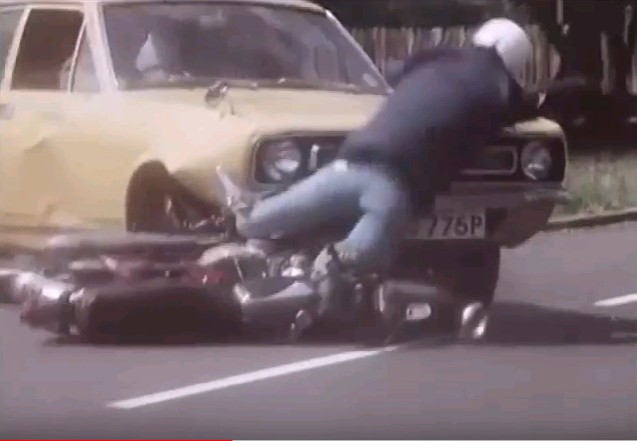
The original ‘Think Bike’ film

So what was the DVSA’s guidance to us instructors? ? Essentially, we were supposed to tell trainees that they were to make themselves easier to be seen; we had to explain the use of conspicuity aids, the differences between daytime fluorescent clothing and night-time reflective kit, and why they should use dipped (low beam) headlights in day time (day-riding lights).

It all began with the first ‘Ride Bright’ campaigns in London in the mid-70s. Many riders voluntarily adopted hi-vis clothing – I was one. Most turned their lights on too – me included when I graduated to a bike with a decent alternator. In fact, motorcycles have had their headlights wired permanently on for over fifteen years.

Just one problem. There is no evidence of positive results.

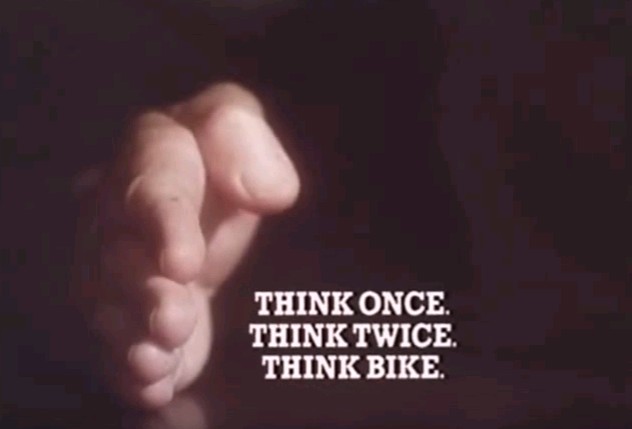
Drivers turning at junctions still look, then fail to spot an approaching motorcycle. And the ‘Sorry Mate I Didn’t See You’ collision with another vehicle at an intersection remains the most common crash involving a motorcyclist. The photo is clipped from the mid-70s ‘Think Once, Think Twice, Think BIKE!’ public information film, incidentally.
Why?

Here’s my guess. There’s an unintentional subtext to all the ‘Think Bike’ campaigns that we have been having since the mid 1970s. In telling new riders to “make yourself easier to see”, the subtext is this – when we encounter another vehicle at a junction ‘the other fellow’ is RESPONSIBLE for LOOKING FOR US.

And if they don’t see us and a collision occurs?

Then they ARE NOT DOING THEIR job – they must be incompetent or inattentive.

Worse, thanks to the ‘make yourself conspicuous’ messaging, riders come to believe that if they use conspicuity aids, they WILL be seen. Believing that, they don’t pay attention to the potential crash that’s being set up for them. Then when a driver commits the ‘looked but failed to see’ error and turns into the path of the approaching motorcycle, the rider sees what’s happening too late and is caught by SURPRISE! And thus riders fail to get out of collisions that could have been avoidable if only the rider had sounded the horn, then braked or swerved, promptly.

“The driver should have seen me” is all too common as a post-crash refrain.

As I’ve been saying for more than two decades – based on my own decade and a half of dodging vans and taxis in London – telling the driver to look out for bikers is only one-half of the story; far more often than not, the rider sees the turning vehicle – or at least the point at which it will appear – well BEFORE the collision becomes inevitable.

It’s this awareness of the need to search out the potential for a SMIDSY collision before it happens, and to understand what to do to stay out of trouble is what underpins the ‘No Surprise? No Accident!’ concept.

That’s why back in 2012 I delivered the very first Science Of Being Seen (SOBS) presentation at the pilot Biker Down course in Kent. Rather than say “wear hi-vis and ride with your lights on so drivers see you”, SOBS took a rather different look at conspicuity aids – explaining why sometimes they DON’T work:

:: looked but COULD NOT see – the bike wasn’t where the driver was able to see it (accounts for around 1 in 5 collisions)
:: looked but FAILED TO see – the bike was visible but due to issues such as motion camouflage, saccadic masking and ineffective conspicuity strategies, the driver failed to detect it (the cause of around 1 in 3 collisions)
:: looked, SAW AND MISJUDGED – the bike was visible but drivers find it hard to accurately calculate ‘time to collision’ particularly on quicker roads (setting up another 1 in 3 collisions)

When we know WHY the collisions happen (and incidentally, distracted driving accounts for less than one in ten of the total, using a mobile at the wheel is about as likely to cause a SMIDSY as a medical emergency at the wheel), we can suggest some defensive measures.
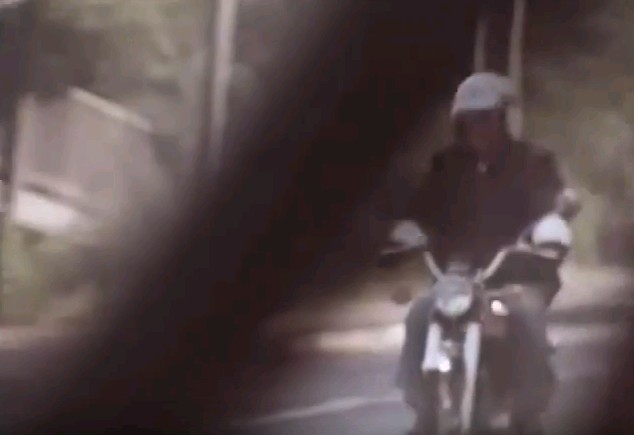
The first is simple enough – ride where we can be seen, and be alert to moments we CANNOT be seen. We need to be aware of the effect of ‘Vision Blockers’ between our position and someone looking for us and to understand the driver blind spot issues caused by the vehicle structure itself. If we can’t be seen, no conspicuity aid will work.

Then and only then should we consider improved conspicuity strategies – I have suggested swapping Saturn yellow (the most common shade of hi-vis but a colour that’s a poor contrast with foliage in rural areas) with Pink for rural daytime use.

And finally I promote the use of proactive responses to a POTENTIAL threat from a vehicle that COULD be about to turn across the rider’s path including sounding the horn, slowing down, changing position and setting up the brakes. It’s not difficult – after all, there are only two things that a vehicle intending to turn into our path can do – wait till we’ve passed by. Or pull out.

So has this ‘protect yourself’ approach filtered down to other road safety campaigns?

Well, there are finally signs that just possibly it has. Back at the beginning of the month, Warwickshire Police announced their usual enforcement campaign, but also mention a new ‘Ride Craft Hub’ which:

“…will help riders identify a SMIDSY situation and protect themselves”.

And last week whilst searching for something else, I found that a couple of years back I’d reported on a story from Tasmania that shows another small but significant indication that the official attitude to rider training is slowly beginning to change.

Stating that the rate of motorcycle accidents in Tasmania had become too high, Infrastructure minister Rene Hidding said that initially the state rolled out more mandatory training “just as had been done in so many other places”.

But Ms Hidding continued:

”It became obvious that people in the industry knew [the process] was wrong.”

A Victoria-based trainer, Duncan McRae, was called in to create a new curriculum which he said was “built around educating riders about those five common crash types that we see most often”.

Does that sound like something you might have heard here?

So, small beginnings, but I believe we’re seeing indications of a shift towards the ‘No Surprise’ approach to riding.

I’m not saying we should stop telling drivers to ‘Think Bike’ as some seem to have assumed, but we should certainly start encouraging a ‘Biker THINK!’ mindset.

I do apologise if I seem to be banging the same drum, but until riders really do accept that SMIDSYs aren’t an automatic consequence of riding a bike, someone has to. And I’ll see what I can dig up on the background to the Tasmanian curriculum change. Watch out for that soon.

http://www.ridecrafthub.org/
http://www.scienceofbeingseen.org
http://www.nosurprise.org

*** SCIENCE OF BEING SEEN *** The importance of lateral movement

*** SCIENCE OF BEING SEEN *** The importance of lateral movement
“Where other drivers turn across the path of a motorcyclist, this can be because the motorcyclist…is not seen by the driver…This points to the need to improve driver awareness of motorcycles, as well as raising awareness among motorcyclists of this issue, which is a key factor in many collisions. By running headlights during the daytime and wearing high visibility clothing, motorcyclists can help to improve their visibility to drivers.”

That’s from Transport for London’s ‘Motorcycle Safety Action Plan’ published back in 2016. I don’t know if there’s been an update since, but essentially it ignores one very big problem behind the ‘Sorry Mate I Didn’t See You’ SMIDSY collision.

IF THE DRIVER CAN’T SEE THE BIKE, HOW DOES MAKING IT MORE VISIBLE HELP?

The motorcyclist also has to be aware that they have to position TO BE SEEN. When plans like this ignore this issue, it’s hardly surprising that so many riders still seem completely oblivious to the problem – OUT OF SIGHT, OUT OF MIND.

In researching the Science Of Being Seen #SOBS, I found that there were actually THREE causes of these crashes.

LOOKED BUT FAILED TO SEE: These are the visual perception failures where a bike that is capable of being seen isn’t spotted. These make up around 1 in 3 of all junction collisions, and for a variety of reasons to do with the way the eye ‘sees’ the world and the brain processes the visual feed, these drivers simply didn’t pick out the presence of a motorcycle even though it was there to be seen. These ‘Looked But Failed To See’ crashes are so common they are actually referred to as LBFTS incidents in the research literature.

Causes include ‘saccadic masking’, which happens when our vision shuts down as we turn our head, a narrow field of clear vision which leaves much of our ‘worldview’ dependent on peripheral vision, and ‘motion camouflage’ where the bike simply ‘grows’ against the background and the driver’s brain fails to detect it.

I have a very good clip of a Spitfire simply ‘appearing out of nowhere’ as it flies directly towards the camera. It’s visible if you look in the right place, but with our attention focused on the presenter, it falls outside our narrow cone of clear vision and in peripheral vision, and is effectively invisible. It’s only when it’s scarily close that it simply ‘pops out’ at the viewer.

And I think we’d all agree that a Spitfire is rather bigger than a motorcycle!

The problem is that lack of lateral movement to attract our attention, and there’s a very specific form of motion camouflage that happens when two moving vehicles are on a collision course. This problem has a name – it’s known as the ‘Constant Bearing, Decreasing Range’ issue. It’s a term used in navigation and flying which means that some object, usually another ship viewed from the deck or bridge of one’s own ship or another aircraft viewed from the cockpit, is getting closer but staying at the same angle – or maintaining the same absolute bearing.

If they both continue on the same course at the same speed, they WILL collide. And it CAN happen on the roads. Just ask yourself where; for example, when you’re approaching a roundabout and another vehicle is on an intersecting course and will arrive at the same time, or when approaching a cross-roads and another vehicle is approaching head-on. Since neither vehicle will appear to move relative to the background, it can be difficult for either driver / rider to perceive the other, even when in clear view. I’ll be coming back to this in a moment.

LOOKED, SAW AND MISJUDGED: And then there is a second type of driver perception error where the driver actually sees the bike, but thanks to the tall and narrow shape of a motorcycle, simply misjudges speed and distance and therefore miscalculates the all-important ‘time to collision’. Once again, it’s a well-known phenomenon in the research and accounts for a further 1 in 3 of junction collisions, usually on faster roads. These are ‘looked, saw and misjudged’ errors.

From the point of view of the rider, the result is that the driver begins a dangerous manoeuvre. Unfortunately, the driver often recognises for themselves half-way through that it’s not going to end well. The rider will often see this change-of-mind when a driver starts to turn across the bike’s path then stops again, frequently ending up stranded across the road ahead of the bike.

This happened in front of me years ago when I was couriering. With a car coming the other way, I had no ‘out’ to the right of the emerging car but had just enough room to turn behind it and shoot obliquely between the gate posts from which the vehicle had just emerged, braking safely to a halt on an immaculate grassy lawn.

The ‘looked but failed to see’ and ‘looked, saw and misjudged’ errors are the classic ‘driver fails’. And it’s always been assumed that advice to use improved scanning techniques would reduce the frequency of these errors. But speaking plainly, the crash stats over the last fifty years of ‘Think Bike’ campaigns fails to turn up any significant change to the frequency of car – bike collisions. And that’s because the human eye and brain were never designed to work at the speed of traffic. The crashes happen because the weaknesses are effectively built-in.

LOOKED BUT COULD NOT SEE: But there’s a third category of error. In around one in five collisions, the rider simply wasn’t where the driver was able to see the bike when the driver looked. The driver ‘looked but COULD NOT SEE’ the bike because it was hidden.

And it’s easier for a bike to go missing than you may realise.

Just watch the video.

Watched it? That was an object the thickness of a PEN blocking our view of the approaching bike.

Now, remember the Constant Bearing issue? Think about what’s happening here. The bike’s not only not moving relative to the background, the fact that it’s on a constant bearing means it’s not moving relative to the vision-blocking pen. And it’s scary how close the bike got before it moved out to where you could see it.

The pen is a Vision Blocker. Think about how many objects there are around us that block lines-of-sight – post boxes, telegraph poles and trees, moving and parked cars, hedges and walls, people walking along the pavement…

…even another motorcycle on a group ride!

Now, I want you to watch the video again. This works best full screen on a PC monitor if you stand about five paces away from the screen. This time stretch your arm out, then hold your hand up vertically with the palm facing away from you, so that you’re looking at the back of your hand. Cover up the policeman and his pen. When do you see the bike now?

Now go sit in your car’s driving set and take a look at the A pillars supporting the front windscreen. If you look at the width of the pillar nearest you, you’ll find it’s about the width of your hand, and it’s about the same distance from your eyes as your hand was when you stretched your arm out.

If you’re still not ‘getting it’, get a friend to walk towards your car whilst trying to hide in the blind spot – they’ll know when they’re in it because they won’t be able to see YOUR eyes. It’s scary just how close they’ll get before you spot them. And a bike’s not much wider than a person.

So now… combine the Constant Bearing problem with the blind spots created by the car itself.

As you approach a vehicle, check where the driver’s head is relative to your line of approach. If their eyes are behind one of the pillars (and the B pillar supporting the doors and the C pillar behind the passenger doors are just as big a problem when approaching from the side or behind), then you’re NOT VISIBLE. You CANNOT BE SEEN.

And we can’t rely on drivers predicting that there MIGHT be a bike they can’t see.

So ask yourself: “how can I bring the driver’s eyes into MY own line-of-sight?”

The answers should be fairly obvious. To ‘break’ motion camouflage and the Constant Bearing problem, all we need to do is change position and speed and thus create some LATERAL movement – hopefully the driver will now see us though a wise rider would still be prepared to take evasive action.

And specifically, we want to identify, then move out from behind, any ‘Vision Blocker’ in order to bring our bike into the driver’s own line-of-sight. That way we ‘uncloak’ our bike, and at least give the driver a CHANCE of seeing us.

Sadly, reading the comments on the FB post where I spotted this video, it’s depressing how many simply missed the point.

There were the usual bunch of “car drivers don’t look properly” or “aren’t paying attention” theorists, though a minor logic check would tell them that if they weren’t ‘paying attention’ they’d be bouncing off everything around them and not just bikes.

Then there were the “car drivers are distracted by their phones” comments. Certainly, you’re at far higher risk of a collision if you are a mobile phone fiddler when driving, but relatively few police investigations into crashes in the UK suggest that the collision can be pinned on mobile phone use as a primary cause. That’s all covered in SOBS.

But my ‘favourite’ comment was probably:

“This just shows that we need to make bikes more visible.”

If you’re in a position where you CAN’T ACTUALLY BE SEEN, how on earth does the writer think that ‘making a bike more visible’ is going to work?

In terms of sage advice, it’s right up there with:

“Drivers, check your blind spots.”

How exactly? They are called blind spots for a reason.

If you want to find out more about the problems of being seen on two wheels, why not sign up for the next presentation of ‘Science Of Being Seen’, on Wednesday evening?

https://survivalskills.tidyhq.com/public/schedule/events

===================================
APRIL’S LIVE EVENT – ‘SOBS – the full presentation’
Science Of Being Seen is a 45 minute talk covering
human visual perception and motorcycle conspicuity,
and explains why conventional hi-vis clothing and
day-riding lights have proven less than successful at
preventing junction collisions. Discover how to use
Survival Skills ‘proactive measures’ in your own riding.
WEDNESDAY 6 APRIL 2022 AT 20:00 Tickets cost £5.

https://survivalskills.tidyhq.com/public/schedule/events

The original video was shown here:
https://www.facebook.com/watch/?v=868556573587883

Science Of Being Seen isn’t complicated

As you probably know, I’ve twice been invited out to New Zealand to work with the NZTA and ACC on the Shiny Side Up rider safety initiative. Just before delivering the ‘Science Of Being Seen’ (SOBS) presentation at Kapiti near Wellington in February 2019, I was interviewed for an item on the Newshub TV channel.

The point that I really tried to get across is that though the word ‘science’ scares people into thinking that it’s complicated stuff, it isn’t.

Science is really just about making accurate observations and drawing the correct deductions about why things happen. That’s all it is.

But ONLY when we get the science right, can we derive effective countermeasures.

Here’s the report in full:


The simple science hoping to save motorcyclists’ lives

Hitting eleven locations nationwide, Shiny Side Up is the country’s biggest bike-fest. But it’s not just leather, chrome, and stunts – it’s about saving lives.

The joint initiative between ACC’s Ride Forever programme and the NZTA is far more effective at spreading the word than pamphlets or statistics.

“It’s not them having ACC or the Government saying ‘we know what’s best for you’,” says ACC’s motorcycle programme manager Dave Keilty at the Kapiti Coast event. “This gives the riders an opportunity to learn from other experienced and qualified people.”

The simple science hoping to save motorcyclists’ lives

Hitting eleven locations nationwide, Shiny Side Up is the country’s biggest bike-fest. But it’s not just leather, chrome, and stunts – it’s about saving lives.

The joint initiative between ACC’s Ride Forever programme and the NZTA is far more effective at spreading the word than pamphlets or statistics.

“It’s not them having ACC or the Government saying ‘we know what’s best for you’,” says ACC’s motorcycle programme manager Dave Keilty at the Kapiti Coast event. “This gives the riders an opportunity to learn from other experienced and qualified people.”

Kevin Williams has been teaching safety in the UK for more than twenty years, and has been brought over to teach Kiwi riders the science of being seen. He says it’s more than putting on hi-viz and hoping for the best.

Riders can learn why other road users might not be able to see them, even if they think they might be in plain sight. One example is saccadic masking – which is simpler than the name suggests.

“Turning our heads quickly from side to side actually shuts down part of our vision, so that we only actually take snapshots, and we can miss things that are between those snapshots. And that’s typically where the bikes go AWOL,” Mr Williams says.

“And sometimes people just see bikes and don’t realise quite how quick they’re travelling, so they just get to the driver a lot sooner than the driver was expecting,” he says.

Helping riders understand why they’re not seen means they can find ways to be seen.

“Some lateral movement back and forwards across the lane may help the driver pick you up,” says Mr Williams.

Motorcycles make up around 3 percent of vehicles on the roads in New Zealand – but make up 16 percent of road deaths.

“We don’t have the protection of the shell or the airbags,” says Mr Keilty. “We are the safety belt and the airbag, that’s us. So we’ve got to be aware that we’re doing everything we can in our power not to have that crash in the first place.”

Shiny Side Up attendees are encouraged to sign up to the ACC’s Ride Forever programme. Since launching in 2012, 20,000 riders have taken classes – and they’re 27 percent less likely to crash.

“We want the younger riders to much more aware, much more safety-conscious, and have much better skills by the time they’re 40,” says Mr Keilty. “We want the over-40-year-olds to come in, sample what we’ve got, and work out there’s actually a lot still to learn.”

Learning how to be seen will ensure riders can keep coming back to events like Shiny Side Up for years to come.

Motorcycles make up around 3 percent of vehicles on the roads in New Zealand – but make up 16 percent of road deaths.

“We don’t have the protection of the shell or the airbags,” says Mr Keilty. “We are the safety belt and the airbag, that’s us. So we’ve got to be aware that we’re doing everything we can in our power not to have that crash in the first place.”

Shiny Side Up attendees are encouraged to sign up to the ACC’s Ride Forever programme. Since launching in 2012, 20,000 riders have taken classes – and they’re 27 percent less likely to crash.

“We want the younger riders to much more aware, much more safety-conscious, and have much better skills by the time they’re 40,” says Mr Keilty. “We want the over-40-year-olds to come in, sample what we’ve got, and work out there’s actually a lot still to learn.”

Learning how to be seen will ensure riders can keep coming back to events like Shiny Side Up for years to come.


http://www.newshub.co.nz/the-simple-science-hoping-to-save-motorcyclists-lives.html