*** SCIENCE OF BEING SEEN *** The importance of lateral movement

*** SCIENCE OF BEING SEEN *** The importance of lateral movement
“Where other drivers turn across the path of a motorcyclist, this can be because the motorcyclist…is not seen by the driver…This points to the need to improve driver awareness of motorcycles, as well as raising awareness among motorcyclists of this issue, which is a key factor in many collisions. By running headlights during the daytime and wearing high visibility clothing, motorcyclists can help to improve their visibility to drivers.”

That’s from Transport for London’s ‘Motorcycle Safety Action Plan’ published back in 2016. I don’t know if there’s been an update since, but essentially it ignores one very big problem behind the ‘Sorry Mate I Didn’t See You’ SMIDSY collision.

IF THE DRIVER CAN’T SEE THE BIKE, HOW DOES MAKING IT MORE VISIBLE HELP?

The motorcyclist also has to be aware that they have to position TO BE SEEN. When plans like this ignore this issue, it’s hardly surprising that so many riders still seem completely oblivious to the problem – OUT OF SIGHT, OUT OF MIND.

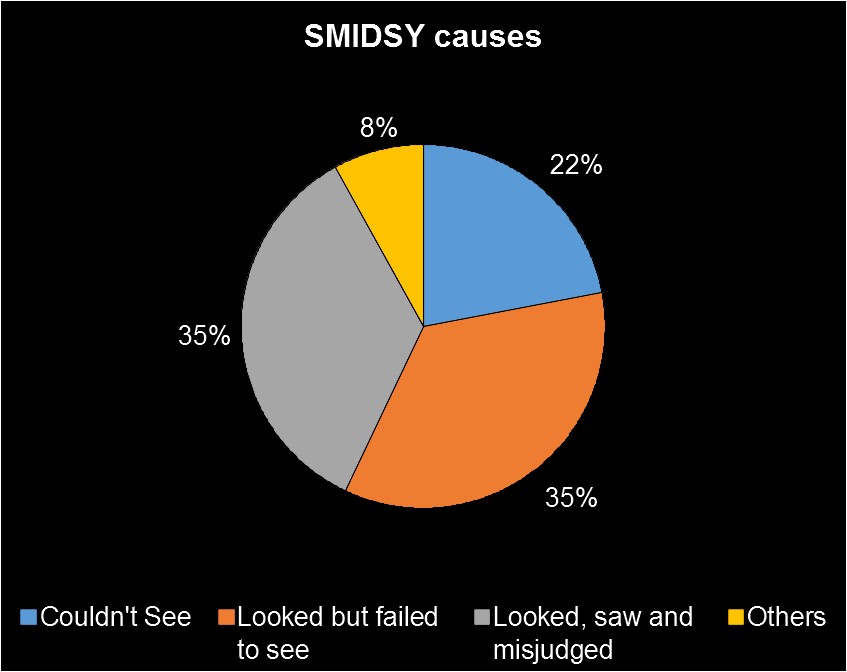
In researching the Science Of Being Seen #SOBS, I found that there were actually THREE causes of these crashes.

LOOKED BUT FAILED TO SEE: These are the visual perception failures where a bike that is capable of being seen isn’t spotted. These make up around 1 in 3 of all junction collisions, and for a variety of reasons to do with the way the eye ‘sees’ the world and the brain processes the visual feed, these drivers simply didn’t pick out the presence of a motorcycle even though it was there to be seen. These ‘Looked But Failed To See’ crashes are so common they are actually referred to as LBFTS incidents in the research literature.

Causes include ‘saccadic masking’, which happens when our vision shuts down as we turn our head, a narrow field of clear vision which leaves much of our ‘worldview’ dependent on peripheral vision, and ‘motion camouflage’ where the bike simply ‘grows’ against the background and the driver’s brain fails to detect it.

I have a very good clip of a Spitfire simply ‘appearing out of nowhere’ as it flies directly towards the camera. It’s visible if you look in the right place, but with our attention focused on the presenter, it falls outside our narrow cone of clear vision and in peripheral vision, and is effectively invisible. It’s only when it’s scarily close that it simply ‘pops out’ at the viewer.

And I think we’d all agree that a Spitfire is rather bigger than a motorcycle!

The problem is that lack of lateral movement to attract our attention, and there’s a very specific form of motion camouflage that happens when two moving vehicles are on a collision course. This problem has a name – it’s known as the ‘Constant Bearing, Decreasing Range’ issue. It’s a term used in navigation and flying which means that some object, usually another ship viewed from the deck or bridge of one’s own ship or another aircraft viewed from the cockpit, is getting closer but staying at the same angle – or maintaining the same absolute bearing.

If they both continue on the same course at the same speed, they WILL collide. And it CAN happen on the roads. Just ask yourself where; for example, when you’re approaching a roundabout and another vehicle is on an intersecting course and will arrive at the same time, or when approaching a cross-roads and another vehicle is approaching head-on. Since neither vehicle will appear to move relative to the background, it can be difficult for either driver / rider to perceive the other, even when in clear view. I’ll be coming back to this in a moment.

LOOKED, SAW AND MISJUDGED: And then there is a second type of driver perception error where the driver actually sees the bike, but thanks to the tall and narrow shape of a motorcycle, simply misjudges speed and distance and therefore miscalculates the all-important ‘time to collision’. Once again, it’s a well-known phenomenon in the research and accounts for a further 1 in 3 of junction collisions, usually on faster roads. These are ‘looked, saw and misjudged’ errors.

From the point of view of the rider, the result is that the driver begins a dangerous manoeuvre. Unfortunately, the driver often recognises for themselves half-way through that it’s not going to end well. The rider will often see this change-of-mind when a driver starts to turn across the bike’s path then stops again, frequently ending up stranded across the road ahead of the bike.

This happened in front of me years ago when I was couriering. With a car coming the other way, I had no ‘out’ to the right of the emerging car but had just enough room to turn behind it and shoot obliquely between the gate posts from which the vehicle had just emerged, braking safely to a halt on an immaculate grassy lawn.

The ‘looked but failed to see’ and ‘looked, saw and misjudged’ errors are the classic ‘driver fails’. And it’s always been assumed that advice to use improved scanning techniques would reduce the frequency of these errors. But speaking plainly, the crash stats over the last fifty years of ‘Think Bike’ campaigns fails to turn up any significant change to the frequency of car – bike collisions. And that’s because the human eye and brain were never designed to work at the speed of traffic. The crashes happen because the weaknesses are effectively built-in.

LOOKED BUT COULD NOT SEE: But there’s a third category of error. In around one in five collisions, the rider simply wasn’t where the driver was able to see the bike when the driver looked. The driver ‘looked but COULD NOT SEE’ the bike because it was hidden.

And it’s easier for a bike to go missing than you may realise.

Just watch the video.

Watched it? That was an object the thickness of a PEN blocking our view of the approaching bike.

Now, remember the Constant Bearing issue? Think about what’s happening here. The bike’s not only not moving relative to the background, the fact that it’s on a constant bearing means it’s not moving relative to the vision-blocking pen. And it’s scary how close the bike got before it moved out to where you could see it.

The pen is a Vision Blocker. Think about how many objects there are around us that block lines-of-sight – post boxes, telegraph poles and trees, moving and parked cars, hedges and walls, people walking along the pavement…

…even another motorcycle on a group ride!

Now, I want you to watch the video again. This works best full screen on a PC monitor if you stand about five paces away from the screen. This time stretch your arm out, then hold your hand up vertically with the palm facing away from you, so that you’re looking at the back of your hand. Cover up the policeman and his pen. When do you see the bike now?

Now go sit in your car’s driving set and take a look at the A pillars supporting the front windscreen. If you look at the width of the pillar nearest you, you’ll find it’s about the width of your hand, and it’s about the same distance from your eyes as your hand was when you stretched your arm out.

If you’re still not ‘getting it’, get a friend to walk towards your car whilst trying to hide in the blind spot – they’ll know when they’re in it because they won’t be able to see YOUR eyes. It’s scary just how close they’ll get before you spot them. And a bike’s not much wider than a person.

So now… combine the Constant Bearing problem with the blind spots created by the car itself.

As you approach a vehicle, check where the driver’s head is relative to your line of approach. If their eyes are behind one of the pillars (and the B pillar supporting the doors and the C pillar behind the passenger doors are just as big a problem when approaching from the side or behind), then you’re NOT VISIBLE. You CANNOT BE SEEN.

And we can’t rely on drivers predicting that there MIGHT be a bike they can’t see.

So ask yourself: “how can I bring the driver’s eyes into MY own line-of-sight?”

The answers should be fairly obvious. To ‘break’ motion camouflage and the Constant Bearing problem, all we need to do is change position and speed and thus create some LATERAL movement – hopefully the driver will now see us though a wise rider would still be prepared to take evasive action.

And specifically, we want to identify, then move out from behind, any ‘Vision Blocker’ in order to bring our bike into the driver’s own line-of-sight. That way we ‘uncloak’ our bike, and at least give the driver a CHANCE of seeing us.

Sadly, reading the comments on the FB post where I spotted this video, it’s depressing how many simply missed the point.

There were the usual bunch of “car drivers don’t look properly” or “aren’t paying attention” theorists, though a minor logic check would tell them that if they weren’t ‘paying attention’ they’d be bouncing off everything around them and not just bikes.

Then there were the “car drivers are distracted by their phones” comments. Certainly, you’re at far higher risk of a collision if you are a mobile phone fiddler when driving, but relatively few police investigations into crashes in the UK suggest that the collision can be pinned on mobile phone use as a primary cause. That’s all covered in SOBS.

But my ‘favourite’ comment was probably:

“This just shows that we need to make bikes more visible.”

If you’re in a position where you CAN’T ACTUALLY BE SEEN, how on earth does the writer think that ‘making a bike more visible’ is going to work?

In terms of sage advice, it’s right up there with:

“Drivers, check your blind spots.”

How exactly? They are called blind spots for a reason.

If you want to find out more about the problems of being seen on two wheels, why not sign up for the next presentation of ‘Science Of Being Seen’, on Wednesday evening?

https://survivalskills.tidyhq.com/public/schedule/events

===================================
APRIL’S LIVE EVENT – ‘SOBS – the full presentation’
Science Of Being Seen is a 45 minute talk covering
human visual perception and motorcycle conspicuity,
and explains why conventional hi-vis clothing and
day-riding lights have proven less than successful at
preventing junction collisions. Discover how to use
Survival Skills ‘proactive measures’ in your own riding.
WEDNESDAY 6 APRIL 2022 AT 20:00 Tickets cost £5.

https://survivalskills.tidyhq.com/public/schedule/events

The original video was shown here:
https://www.facebook.com/watch/?v=868556573587883

Last call for Science Of Being Seen Wed 1 Dec

Wednesday 1 December @ 8 PM

A few years back, Howard Askew attended one of our ‘Biker Down’ courses in Kent – where Biker Down originated as you probably know – and where I was delivering the original ‘SOBS’ presentation.

WEDNESDAY, 1 DECEMBER 2021 AT 20:00
Tickets cost £5.
BOOK AT: http://thq.fyi/se/012097de78a5

Some time later later he sent me this comment on the course and SOBS in particular:

“For sure the course was very good about what to do in the event of an accident, but you were the only person who was giving strategic advice on avoiding becoming a casualty and made a Despatch Rider from 1978 to 1985 think outside of the box. It’s all about avoiding those nasty accidents.”

And that absolutely nails the function of SOBS as part of Biker Down.

When Jim Sanderson and I first got involved in discussions about the pilot course of what would become the national Biker Down campaign, we both agreed that there was a need for a pro-active, crash prevention module.

Managing the accident scene and treating casualties are both vital skills.

But it would be better if the rider attending BD didn’t end up needing someone else delivering those skills to the rider.

And so SOBS was born. And as Biker Down was picked up by fire services across the UK, so the majority of those courses delivered a version of SOBS as the third, proactive module.

SOBS was created over the winter of 2011 – 12. I delivered my final presentation for KFRS at Rochester in February 2020, just before we went into lockdown.

For many years individual fire services were pretty much left to run Biker Down in their own time, but it’s finally been acknowledged as a ‘national initiative. And so the fire services have now decided to bring all the modules ‘in-house’.

And that means they have decided to move on from SOBS.

On the one hand, a fresh look can be a good thing.

On the other I’m disappointed because SOBS is a unique safety intervention in that it seeks to give genuinely science-based information to riders and help them make better-informed choices and I think it’s a shame it will no longer be delivered to UK riders.

But with all the work I’ve put into the SOBS project I certainly don’t want to leave it sitting on the shelf, and that’s why I’m running an online webcast every two months, as well as making myself available to clubs and groups for presentations either in person or online.

Make a date here online, or book me for a talk for your group – it’s your choice. But you’ll be giving yourself or your riding buddies a chance to see the presentation which has gone international, being showcased by RoadSafetyGB here in the UK, on the REVVtalks series in the USA and not least as part of the Shiny Side Up rider road shows in New Zealand.

JANUARY’S LIVE EVENT – ‘FILTERING – what’s legal,
what’s illegal and what’s plain common sense’
Get tips that work from a sixteen year courier veteran.

WEDNESDAY, 5 JANUARY 2022 AT 20:00
BOOK AT: http://thq.fyi/se/Z3fblAQ

LEDs and Conspicuity

[This post was originally written on October 11 2012 – which gives you an indication of just how long I’ve been talking about the problems of visual perception, motorcycle conspicuity in general and lighting issues more specifically. At the time of writing LED headlights were almost unheard of. So the article is about the use of LEDs for add-on auxiliary lighting which was becoming increasingly common at that time, rather than LEDs fitted as main riding lights. It’s been updated a little for clarity.]

At the end of my ‘Science of Being Seen’ conspicuity and collision avoidance presentation last night for ‘Biker Down’, a chap called Nick Ingram approached me to ask my views on LED light bars and how they might help, and he’s just sent me an online discussion, which I duly read.

The short version is that a lot of riders were positive about the current trend for fitting light bars, subscribing to the belief that “if one light is good, more must be better”.

But is that actually true?

As I said on Biker Down, anything that breaks up or distorts the silhouette of a motorcycle / rider means it takes observers longer to recognise that they are looking at a motorcycle, and in some circumstances they may not even recognise that what they are seeing actually IS a bike!

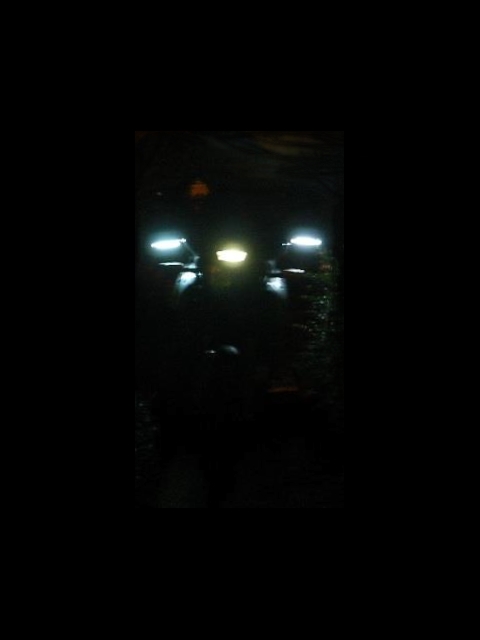
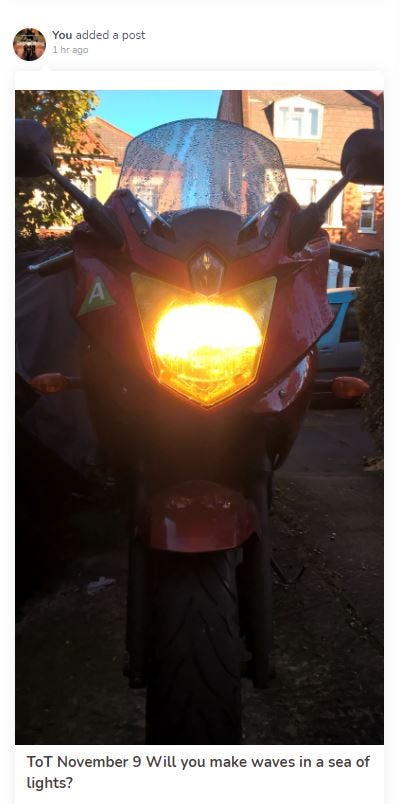
Have a look at the attached photo. Imagine we’re sitting in a side road looking at those lights coming towards us in the midst of a row of cars with headlights on.

We can see the lights, no problem. But WHAT exactly is it? WHERE exactly is it? How FAR away is it – if we don’t know what we’re looking at, we can’t judge distance. How LONG has we got before it gets here – if we can’t judge distance, we can’t make a judgement about speed either. Can we PULL OUT – without accurate speed / distance information, trying to work out ‘time to collision’ and whether we’ve a safe gap to pull out into becomes tricky.

What happens when the bike’s lights confuse the driver’s ‘recognition and range-finding’ system. Is he or she more or less likely to pull out?

The fact is we don’t simply know the answer to that question – it will depend on several issues such as whether the lights actually make us look further away, or whether the confusion delays – but does not CHANGE – the driver’s decision to go. This is the problem with any conspicuity aid – since they rely on the other road user detecting them, they MAY work….

…or they MAY NOT. And you and I will never know whether the driver who just waited for us as we rode by waited because he saw our extra lights… or whether spotted the bike regardless of the lights.

The bad news that we don’t know the effect on an approaching driver, the extra lights will change OUR behaviour. Behind the lights, we’re clearly hoping we reduce the chance of a driver pulling out on us, If we didn’t think that, why would we bother fitting them?

So the moment we fit extra lights “to be seen” – whether that’s for daytime riding or night riding – then we create a risk for ourselves; the BELIEF that the lights make it less likely that a driver will pull out in front of us.

Once we believe we’re easier to see, it’s likely we’ll start relying on those lights to keep us out of trouble. And then we’re more likely to be caught totally cold when the driver DOES pull out, all our lights notwithstanding.

So it would be really useful to know if additional lights worked.

Anecdotally, many riders report that fewer drivers pull out in front of them when using lights or wearing hi-vis. Unfortunately, it’s likely our perceptions are skewed because we’re no objective observers – when we want to see if the lights make a difference we’ll actually pay far more attention to what drivers do than we previously did. In the past, the incidents we’ll have noticed will have been the drivers who DIDN’T see us and pulled out, and not the far more numerous drivers who DID see us. So once we start looking to count ‘drivers who don’t pull out’, we’ll start noticing this far more numerous group than we had done previously.

What about safety studies? Some early studies purport to show riders using lights or hi-vis are involved in fewer accidents, but they are not ‘blind’ studies. They don’t send out random groups of riders who either have or don’t have lights fitted and switched on, but simply look at crashes. If riders who ride with lights on have fewer crashes, it’s entirely likely that the riders using day riding lights were aware of the conspicuity problem and thus more likely to have changed their riding style subtly and unconsciously to compensate for the risk.

So let me go back to a classic piece of work in the USA years ago in 1974 by a chap called Leonard. It was at the time that the debate on daytime lights was just starting. He created three different colour and lighting schemes, then compared the number of drivers who violated his right-of-way on a regular daily journey in which he alternated the use of a ‘control’ motorcycle and two ‘test’ motorcycles as follows:

• ‘Control’ – standard motorcycle with the headlight off
• ‘Lights only’ – standard motorcycle with the headlight turned on
• ‘Spectacular’ – motorcycle with extensive use of reflective materials, bright colours, lights

In 30 test days each riding the control motorcycle and the motorcycle with the headlight on he experienced respectively 1.9 and 1.8 violations per day, or when riding the control motorcycle and the ‘spectacular’ motorcycle 1.8 and 2.0 violations per day. In other words, the lights and the ‘spectacular’ colours made no difference.

He also tried riding a fake ‘police’ motorcycle to see what would happen. In 15 test days riding the ‘police’ motorcycle, Leonard experienced just one right-of-way violation. Make of that what you will!

[Edit – at time of writing, motorcycles in the UK had only just started to have permanently-on headlights, but it’s become more and more common. Has it made any difference to rider conspicuity? If it had, you’d expect that the proportion of junction collisions – compared with the total number of crashes – would have fallen. Updating this post at the end of 2021, I can’t see any such change in the crash stats.]

My conclusions? Our best defence is not to try to stand out from the crowd, but to ride in a way that not only accepts that drivers WILL make mistakes but to be able to DEAL with the situation WHEN, not if, it happens.

*** SOBS *** Why I recommend yellow lights!

…white lights can be camouflage when everyone around is also using white lights!


I know I keep telling you about Science Of Being Seen (SOBS), and I keep mentioning my live webcasts, but there’s a reason – so many riders seem unaware just how invisible they are on the road.

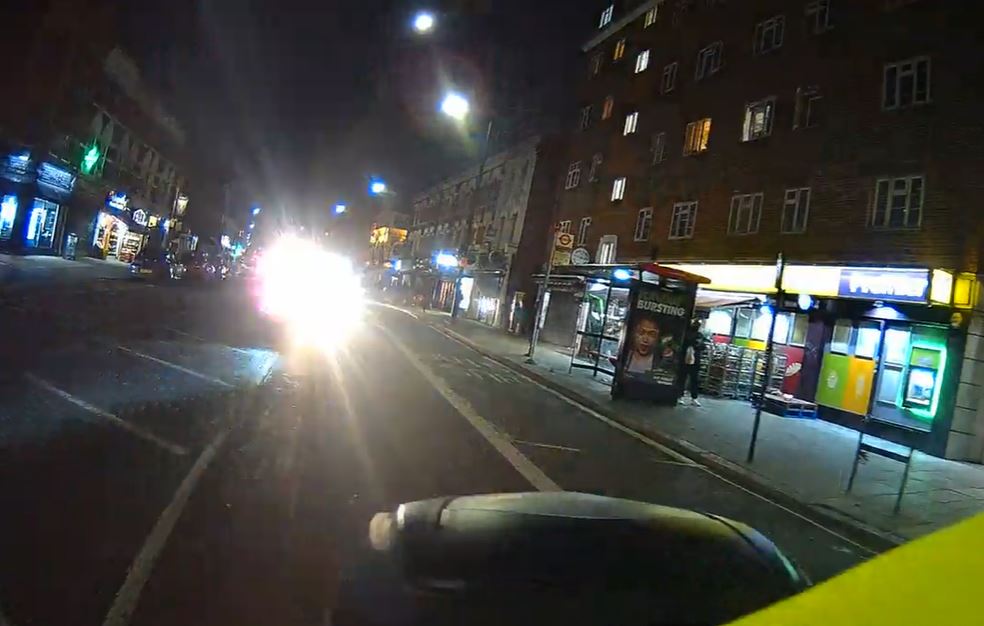
Bill Robinson – who took one of my ONLINE COACHING courses earlier this month – sent me a short video clip of an incident he’d had when riding his bike. I’ve asked for permission to re-use the clip because I think it’s incredibly informative.

Pending that permission, I’ve snipped a couple of stills and I’ll be talking about the issues of night time visibility later this morning in ELEVENSES – which is, oddly enough, going out LIVE at 11am at http://www.facebook.com/survivalskills.

If you can’t catch it then, I do suggest you find a few minutes to view the section of the show either on FB or over at YouTube:

There’s a scooter in there somewhere… can you see it?

The still photos from the video will help me explain why adding more or brighter WHITE lights isn’t the answer to improving nighttime conspicuity, and why I recommend YELLOW lights not just to differentiate ourselves from other vehicles in daytime against white day running lights but also why they have been shown to be effective at night in built-up areas.

Dare to be different!
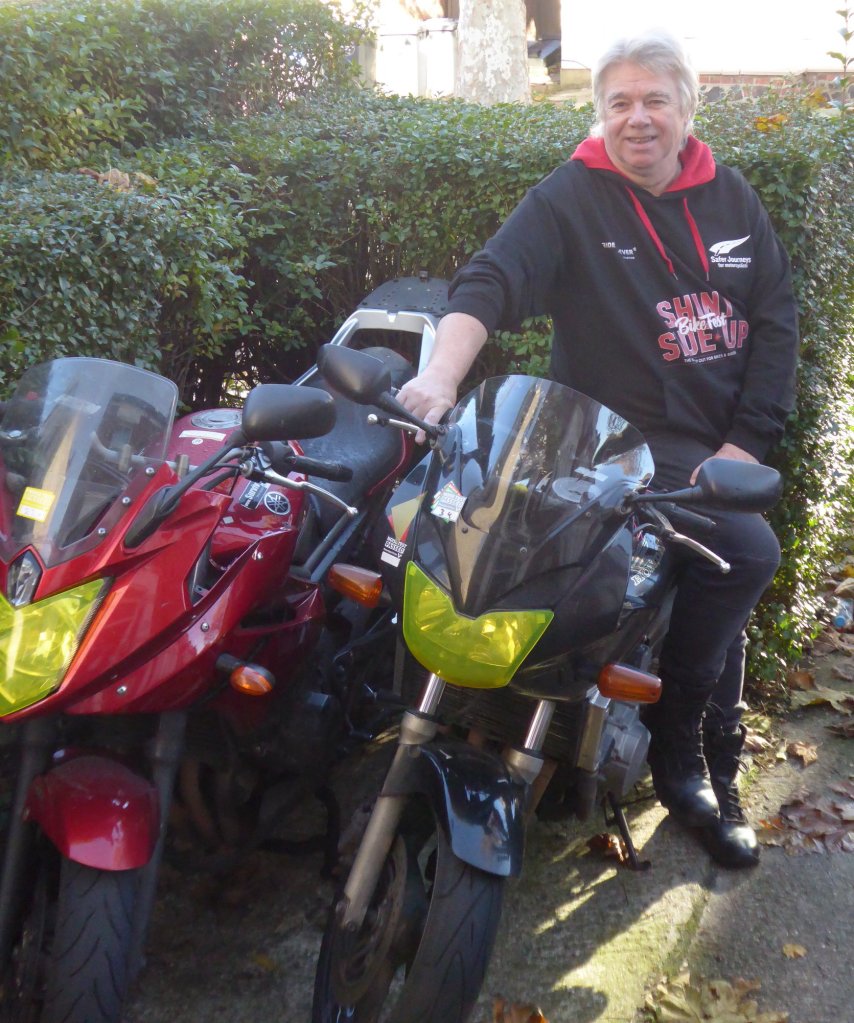
Yellow headlight covers are an inexpensive way of making a motorcycle stand out in a sea of lights.

So watch ELEVENSES this morning, and then sign up for:

DECEMBER LIVE ONLINE – ‘SCIENCE OF BEING SEEN’
SOBS is a 40 minute talk about the twin issues of
human visual perception and motorcycle conspicuity,
why conventional hi-vis clothing and day-riding lights
have proven less than successful at preventing
junction collisions. Discover how to use Survival Skills
‘proactive measures’ into your own riding.
WEDNESDAY, 1 DECEMBER 2021 AT 20:00
Tickets cost £5.
Book at: http://thq.fyi/se/012097de78a5

NOT JOINED Ko-Fi YET?


It’s easy!

YOUR INVITATION TO JOIN ME ON KO-FI…
…is waiting!

Simply head over to www.ko-fi.com/survivalskills and sign up TODAY

This image has an empty alt attribute; its file name is https%3A%2F%2Fbucketeer-e05bbc84-baa3-437e-9518-adb32be77984.s3.amazonaws.com%2Fpublic%2Fimages%2F3fd9f239-3655-44c1-ad8f-76ee220ec9b9_1299x248.jpeg


And access to all the top content you’ve come to expect from Survival Skills!

Here’s what you’re missing from the last few days

This image has an empty alt attribute; its file name is https%3A%2F%2Fbucketeer-e05bbc84-baa3-437e-9518-adb32be77984.s3.amazonaws.com%2Fpublic%2Fimages%2Fe9e98b74-df00-408d-a1f5-950abf7b9c32_424x749.jpeg

This morning’s TIPS on TUESDAY item:

This image has an empty alt attribute; its file name is https%3A%2F%2Fbucketeer-e05bbc84-baa3-437e-9518-adb32be77984.s3.amazonaws.com%2Fpublic%2Fimages%2Fdcd356c2-72c0-4630-8cc1-6ffc50835373_399x804.jpeg

When it comes to being seen at night, is brighter always better?

Find out with Survival Skills and the Science Of Being Seen project!

This image has an empty alt attribute; its file name is https%3A%2F%2Fbucketeer-e05bbc84-baa3-437e-9518-adb32be77984.s3.amazonaws.com%2Fpublic%2Fimages%2F2ec99a1a-599f-450c-91a7-820c83b7e478_1867x939.jpeg

TO FIND OUT JUST HOW EASY IT IS TO JOIN ME, WATCH THIS SHORT VIDEO
– and join me for Ko-Fi

Looking forward to seeing you for Ko-Fi…

Kevin Williams
Survival Skills Rider Training

Invisible motorcycles – it’s magic!

Back in March 2018, I wrote a post on my www.facebook.com/survivalskills site entitled:

“On a bike you’re a magician”

I went on to explain that “the world we see ‘out there’… has been built entirely ‘in here’ inside our brains, and that even when we attend a stage magic show and KNOW we are going to be fooled, we still can’t spot the tricks… when it comes to riding… we have two additional problems:

  • the motorcyclist’s audience isn’t expecting to be tricked by the biker
  • the motorcyclist isn’t aware that he / she is a magician and about to fool the audience!

Ever since I started work on the Science Of Being Seen (SOBS) project, I’ve done my best to get over the various issues – the visual perception problems that all road users have when it comes to spotting motorcycles and other two-wheelers in a traffic stream, the reasons why we shouldn’t be relying on hi-vis clothing and day-riding lights, and why we must work on pro-active responses to threats near junctions.

I’ve done my best with limited resources. But here is what can be done when you want to explain those concepts and have a small but professional production facility behind you.

I can’t help but wonder whether my March post inspired this video. I’ve no complaints if it did because I have to admit that the end result is highly impressive as Ryan, the FortNine ‘Science Guy’ presents a quickfire, light-hearted and slightly-offbeat presentation which covers, in short order:

Saccades and saccadic masking – the visual ‘shutdown’ that happens when we turn our heads too quickly. We think we see a smooth-scanning colour video as we look from side to side, but in fact the brain cannot cope with the blurring images. It masks most of the visual feed takes a series of snap-shots called ‘fixations’. Small objects like motorcycles caught in the saccades are left out – masked – when the brain reassembles the snapshots into what we perceive as video. He also makes the same point I do – “the solution is simple. Slow your scan”. The saccades are smaller and we are less likely to miss a motorcycle.
selective attention – “just as the brain blocks data it considers blurry, it also blocks what it considers irrelevant.”

He illustrates this by playing a couple of clever visual tricks that show how when we’re focused on one task, we miss other events happening around us. I cover the same ground when I talk about ‘inattentional blindness’ and ‘semantic meaning’.

He explains that danger or sexual signals are picked up very quickly, and that two tonnes of car is far more likely to be detected as a threat than a motorcycle. Using the horn to create a ‘threat’ that attracts attention is something I constantly recommend. About the only point on which I’m not convinced is the suggestion that wearing red creates a more threatening image and acts as an attractant. It will depend on whether that red colour actually creates a contrast against the background and is capable of being detected first of all.

Peripheral blindness“in just 20% off the line of sight, humans lose 90% of their vision – bad news, you’re legally blind in your periphery”. Once again, it’s a point I make on SOBS and we both explain how the brain plays us a trick. It uses ‘historical information’ from snapshots – remember those fixations – grabbed as our eyes move around the scene to paint what appears to be a current, wide angle colour picture. It’s not, and vital data – like a motorcycle – can be missing.

From there he draws a rather more tenuous – but still relevant link – to collisions that happen on our own doorstep. Close to home, we all mentally switch-off and expect what usually happens – no motorcycle. He argues that in residential areas we riders have to be doubly-alert for the driver who’s relaxed because he’s nearly home.

More importantly, like SOBS, he emphasises the need for movement at intersections to attract attention when we’re likely to be in the driver’s peripheral vision. The use of our arms to creating movement may seem unconventional, but think of it in context of the rider slowing or turning – I often use arm signals to emphasise a signal when I’m about to manoeuvre in an unexpected place.

Motion camouflage and the constant bearing problem – although he doesn’t use those terms, he covers the twin phenomena of ‘motion camouflage’ and what’s known in aviation and boating circles as ‘the constant bearing problem’. “As two vehicles approach the same spot at the same speed before a collision they occupy a constant place in each other’s field of view. There’s no relative movement so YOU need to move.” That’s exactly the point I’ve made on SOBS – be PROACTIVE. Don’t wait for the driver to see the bike – change that constant bearing by changing speed.

Beam blindness – is an excellent term and better than ‘blind spots’ which we are more likely to be familiar with. It’s pretty obvious that the beams (usually known as the A pillars) either side of the windscreen create physical blind spots for all drivers, but Ryan mentions a much less well-known phenomenon – and one I only discovered whilst researching SOBS: “you know those vertical beams either side of your windshield? You don’t see anything near there. The brain gets bored easily so it eliminates stuff that’s constantly in frame.”

Ryan is making the point that the problem goes deeper that the physical blind spots. We’re not even aware that something COULD be hidden by in a blind spot. He uses our own noses as an example – we don’t see it without consciously looking for it. The brain simply wipes it from our visual image because it’s always there. Similarly, the A, B and C pillars are always there in a car, and we tend to forget them without consciously making ourselves aware of these obstructions. So we suffer ‘beam blindness’ where our brains create these mental blind spots.

And in fact, it’s worse than that – it seems that our brain also blanks out some of the VISIBLE background to either side of the pillars. In consequence, the blind area we don’t ‘see’ that’s reated by the pillars is even wider than we think.

What can we do about it? Understand the problem. “The solution, when you ride towards a vehicle at 10 or 2 [o’clock] is to know that you’re probably invisible.” And to remember that we’re also invisible if we’re approaching a vehicle that’s angled so that the driver is looking back over his / her shoulder – the B pillar between the doors will be an obstruction to vision.

Contrast blindness“the air force has determined that contrast is the greatest factor in the visual acquisition of targets. It turns out they’re primarily concerned with not getting shot but we can take their research and flip it.” First, he makes the excellent point about knowing where your shadow is: “fighter pilots love to attack out of the sun”. That’s a tactic that has been exploited since WW1 and with the sun behind us, we’re harder to spot too. Second Ryan mentions that fighter planes are painted to blend with their background and reduce contrast. He asks – as I have done many times – why is rain gear often black? He recommends – as I do – high contrast gear when it’s raining, not on bright sunny days.

And that’s FortNine’s excellent ‘Invisibility Training for Motorcyclists’ in a nutshell.

Having watched it, doesn’t it make you wonder why it is that MOTORCYCLISTS like Ryan and myself are having to put this kind of primer together for bikers? Why is it that the hugely-funded road safety organisations still seem to be totally oblivious to the need to communicate these issues to motorcyclists? As Ryan and I have both shown in our different ways, the science is out there.

https://youtu.be/x94PGgYKHQ0

Remember, on a bike you’re a magician…

…and your ability is to make yourself invisible!

Three years ago, Duncan McKillop wrote this perceptive statement:

“Human beings refuse to believe that their eyes can be fooled yet stage magicians have been fooling people’s eyes for centuries! This is because we do not understand that the world we see ‘out there’ is in fact a construction that has been built entirely ‘in here’ inside our brain.

“The magician knows this and knows how easy it is for us to construct an incorrect model of the world in response to the way he performs his craft. People know that if they go to a night of magic that the magician is going to fool their eyes, but even with that certain knowledge the magician still manages to pull off their tricks.

“If we know we are going to be fooled and still get fooled what does that say about the link between knowledge and perceptual ability?

“In SMIDSY’s and similar collisions it’s the rider that’s taking the place of the magician and fooling their audience into thinking they are not really there.”

Duncan hits the nail on the head.

Understanding that the world ‘out there’ is a construct of our brain is absolutely essential, as is understanding that we need to KNOW we can be fooled.

Unfortunately, when it comes to riding and to SMIDSY-style collisions between cars and bikes, we have two additional problems:

  • our car-driving audience isn’t aware that they can be tricked by the biker!
  • the motorcyclist isn’t aware that he / she is a magician and about to fool the audience of drivers!

And that’s why I have spent a lot of time working on my Science of Being Seen (SOBS) project here and over on my www.facebook.com/survivalskills page. It’s time for riders across the world to learn how the magic works!

ORIGINALLY POSTED MARCH 2018 on FB

Ko-fi_Red
Help support SOBS – and open up access to HUNDREDS of ‘Better Biking’ articles – just buy me a coffee!
Each cuppa keeps me awake, researching and writing! Thank you.
https://ko-fi.com/survivalskills
COPYRIGHT © 2011 – 2021 Kevin Williams and Survival Skills Rider Training
This work is licenced under a Creative Commons Attribution-NonCommercial-Sharealike 4.0 International License.

Kevin Williams has asserted his right under the Copyright, Designs and Patents Act, 1988, to be identified as the author of this work.

IMPORTANT: The material is free to all to access and use under a Creative Commons Attribution-NonCommercial-ShareAlike 4.0 International License. That means you can share it with your family and friends, and re-use it for club magazines and websites, so long as you acknowledge the source and author and include the same Creative Commons license in the derived works.

This Creative Commons license excludes commercial use. If you wish to use any of my work for commercial purposes, including (but not limited to) articles in pay-for magazines or commercial websites, please contact me.

Photo credit Paul Townsend https://www.flickr.com/photos/brizzlebornandbred/20001313491

Science Of Being Seen isn’t complicated

As you probably know, I’ve twice been invited out to New Zealand to work with the NZTA and ACC on the Shiny Side Up rider safety initiative. Just before delivering the ‘Science Of Being Seen’ (SOBS) presentation at Kapiti near Wellington in February 2019, I was interviewed for an item on the Newshub TV channel.

The point that I really tried to get across is that though the word ‘science’ scares people into thinking that it’s complicated stuff, it isn’t.

Science is really just about making accurate observations and drawing the correct deductions about why things happen. That’s all it is.

But ONLY when we get the science right, can we derive effective countermeasures.

Here’s the report in full:


The simple science hoping to save motorcyclists’ lives

Hitting eleven locations nationwide, Shiny Side Up is the country’s biggest bike-fest. But it’s not just leather, chrome, and stunts – it’s about saving lives.

The joint initiative between ACC’s Ride Forever programme and the NZTA is far more effective at spreading the word than pamphlets or statistics.

“It’s not them having ACC or the Government saying ‘we know what’s best for you’,” says ACC’s motorcycle programme manager Dave Keilty at the Kapiti Coast event. “This gives the riders an opportunity to learn from other experienced and qualified people.”

The simple science hoping to save motorcyclists’ lives

Hitting eleven locations nationwide, Shiny Side Up is the country’s biggest bike-fest. But it’s not just leather, chrome, and stunts – it’s about saving lives.

The joint initiative between ACC’s Ride Forever programme and the NZTA is far more effective at spreading the word than pamphlets or statistics.

“It’s not them having ACC or the Government saying ‘we know what’s best for you’,” says ACC’s motorcycle programme manager Dave Keilty at the Kapiti Coast event. “This gives the riders an opportunity to learn from other experienced and qualified people.”

Kevin Williams has been teaching safety in the UK for more than twenty years, and has been brought over to teach Kiwi riders the science of being seen. He says it’s more than putting on hi-viz and hoping for the best.

Riders can learn why other road users might not be able to see them, even if they think they might be in plain sight. One example is saccadic masking – which is simpler than the name suggests.

“Turning our heads quickly from side to side actually shuts down part of our vision, so that we only actually take snapshots, and we can miss things that are between those snapshots. And that’s typically where the bikes go AWOL,” Mr Williams says.

“And sometimes people just see bikes and don’t realise quite how quick they’re travelling, so they just get to the driver a lot sooner than the driver was expecting,” he says.

Helping riders understand why they’re not seen means they can find ways to be seen.

“Some lateral movement back and forwards across the lane may help the driver pick you up,” says Mr Williams.

Motorcycles make up around 3 percent of vehicles on the roads in New Zealand – but make up 16 percent of road deaths.

“We don’t have the protection of the shell or the airbags,” says Mr Keilty. “We are the safety belt and the airbag, that’s us. So we’ve got to be aware that we’re doing everything we can in our power not to have that crash in the first place.”

Shiny Side Up attendees are encouraged to sign up to the ACC’s Ride Forever programme. Since launching in 2012, 20,000 riders have taken classes – and they’re 27 percent less likely to crash.

“We want the younger riders to much more aware, much more safety-conscious, and have much better skills by the time they’re 40,” says Mr Keilty. “We want the over-40-year-olds to come in, sample what we’ve got, and work out there’s actually a lot still to learn.”

Learning how to be seen will ensure riders can keep coming back to events like Shiny Side Up for years to come.

Motorcycles make up around 3 percent of vehicles on the roads in New Zealand – but make up 16 percent of road deaths.

“We don’t have the protection of the shell or the airbags,” says Mr Keilty. “We are the safety belt and the airbag, that’s us. So we’ve got to be aware that we’re doing everything we can in our power not to have that crash in the first place.”

Shiny Side Up attendees are encouraged to sign up to the ACC’s Ride Forever programme. Since launching in 2012, 20,000 riders have taken classes – and they’re 27 percent less likely to crash.

“We want the younger riders to much more aware, much more safety-conscious, and have much better skills by the time they’re 40,” says Mr Keilty. “We want the over-40-year-olds to come in, sample what we’ve got, and work out there’s actually a lot still to learn.”

Learning how to be seen will ensure riders can keep coming back to events like Shiny Side Up for years to come.


http://www.newshub.co.nz/the-simple-science-hoping-to-save-motorcyclists-lives.html

SCIENCE OF BEING SEEN gets a write-up for Devitt

SOBS featured by Devitt Insurance

The ‘Science Of Being Seen’ (SOBS) has just got a comprehensive write-up on the Devitt motorcycling pages:

www.devittinsurance.com/guides/motorcycle-features/the-science-of-being-seen/

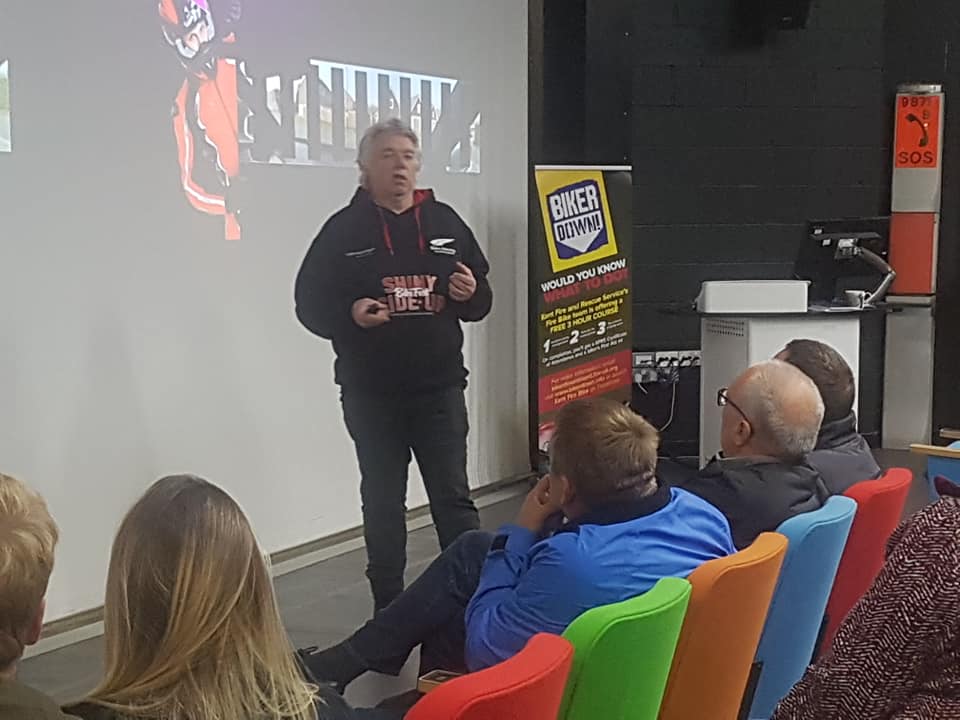
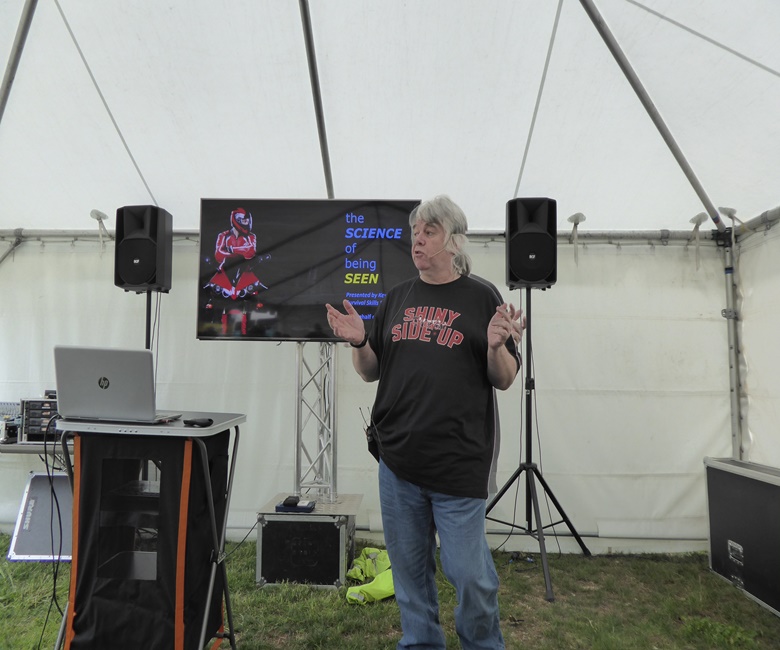
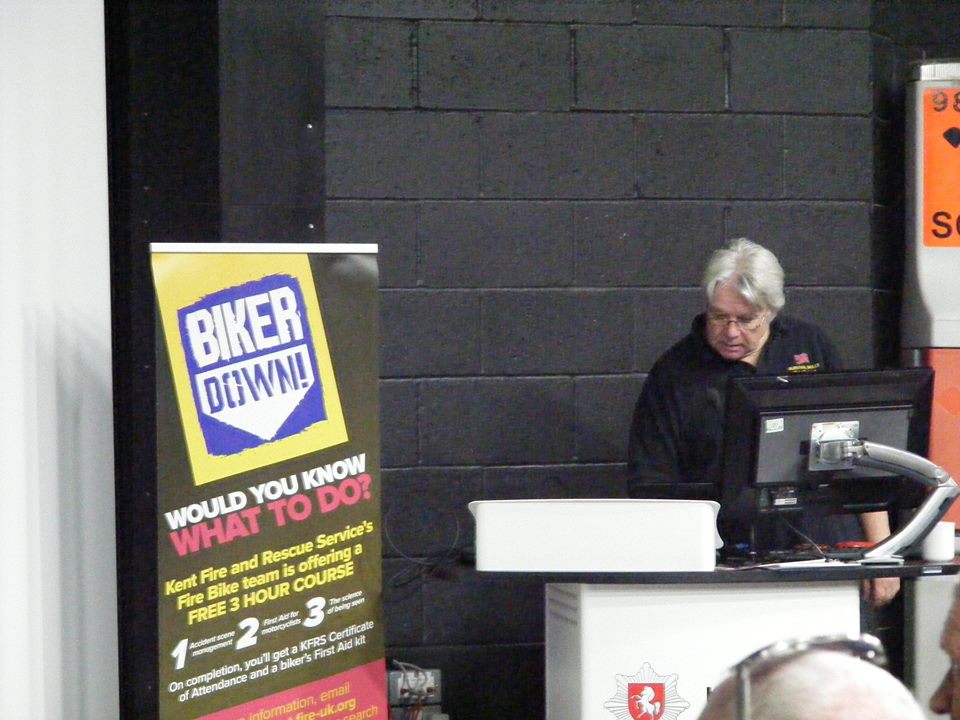
The Science Of Being Seen was part of the ‘Biker Down’ course in Kent since a pilot course run in early 2012. Here I am mid-presentation at Kent Fire & Rescue’s ‘Road Safety Experience’ facility in Rochester in 2019, explaining the phenomenon of ‘saccadic masking’

.  

A little history…

After we won a Prince Michael of Kent International Road Safety Award at the end of 2012…

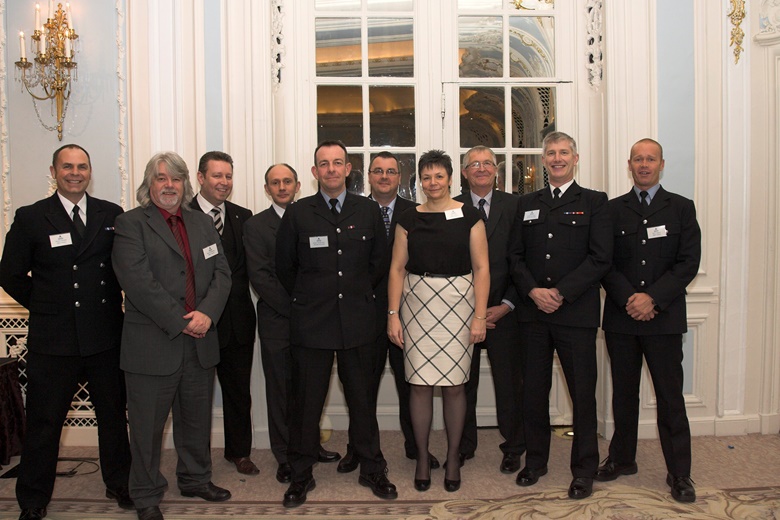
The Biker Down team from Kent Fire & Rescue Service at the Savoy November 2012 
…Biker Down was picked up by many of the other Fire and Rescue Services in the UK, and most of them used a version of SOBS as the Module Three ‘collision prevention’ element. 

  Setting up the laptop to run the presentation in 2019
Until COVID put everything on hold last March, I personally delivered the talk for ‘Biker Down’ in Kent for almost 10 years.


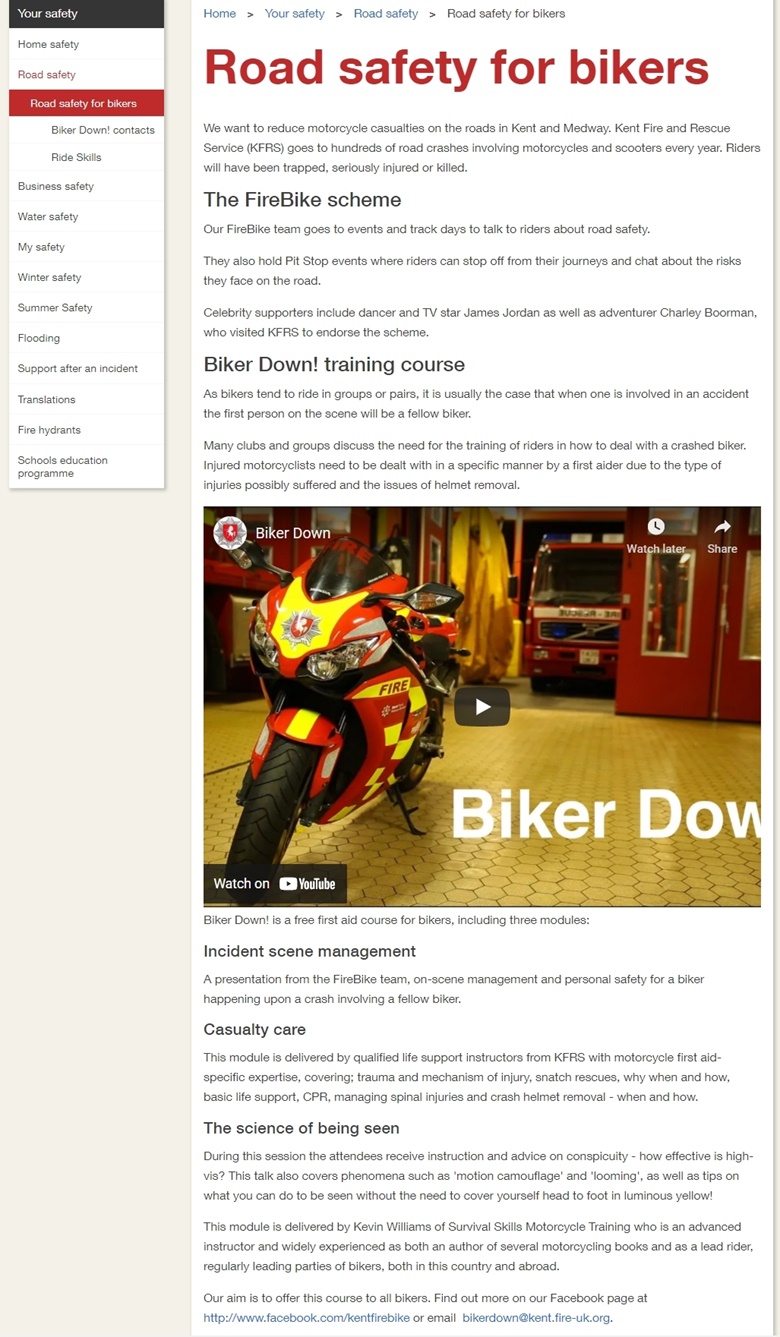
The KFRS website (June 2021) with SOBS as the third ‘pro-active’ module of Biker Down

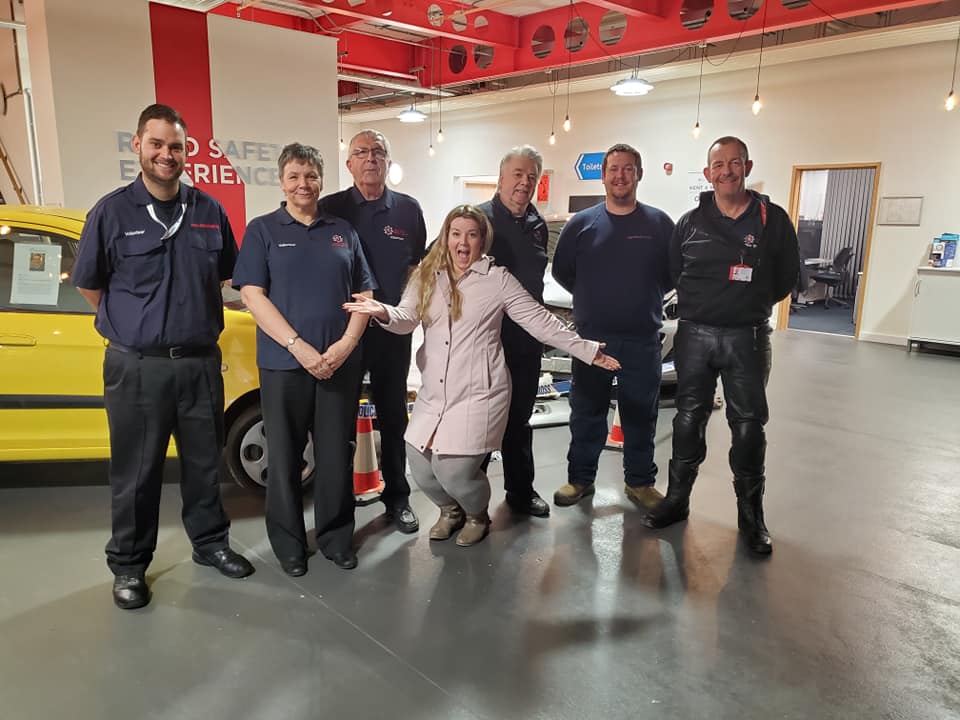
In February in 2020, I was able to invite Brittany Morrow to see our course in action at Rochester in Kent whilst she was in the UK.


Brittany in a typical pose with the Biker Down team
Little did I know that was to be the final SOBS presentation I delivered for Biker Down Kent. 


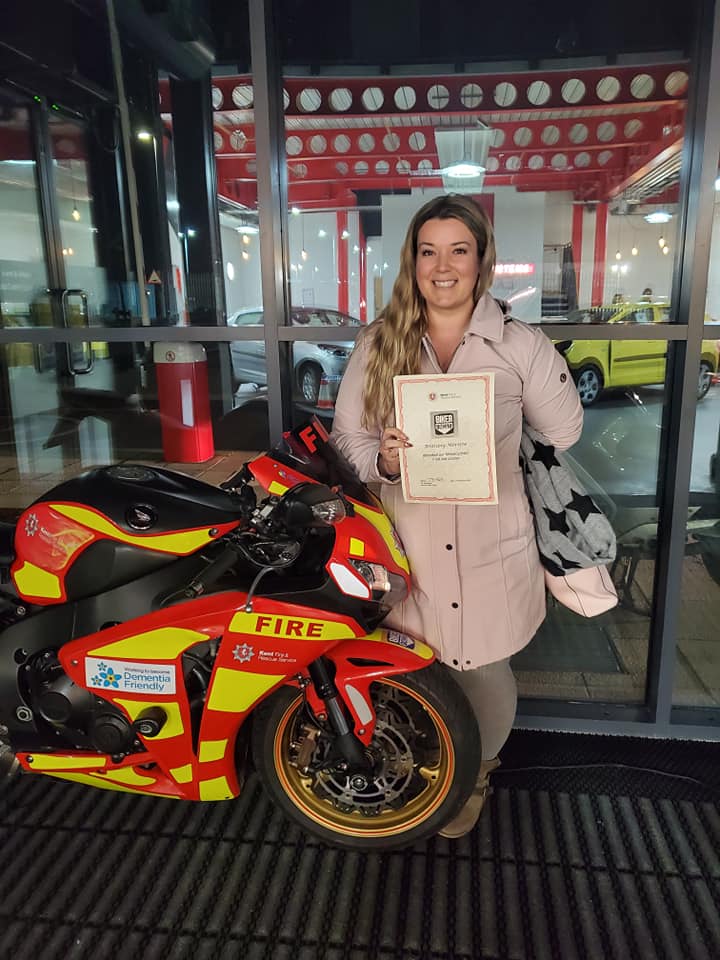
Brittany with her Biker Down certificate of attendance   

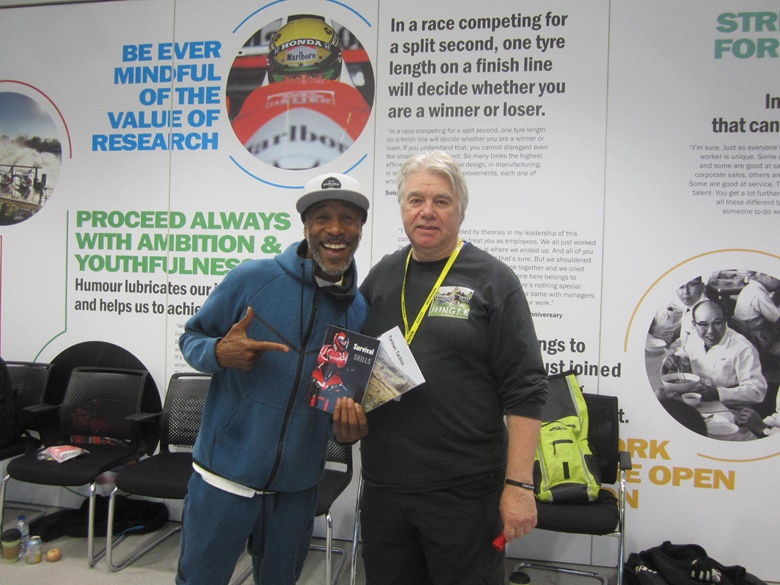
I’ve run some special SOBS presentations as well, including one for MCN staff at Peterborough, and another for Honda UK at Bracknell. 
Danny John-Jules gets two of my books
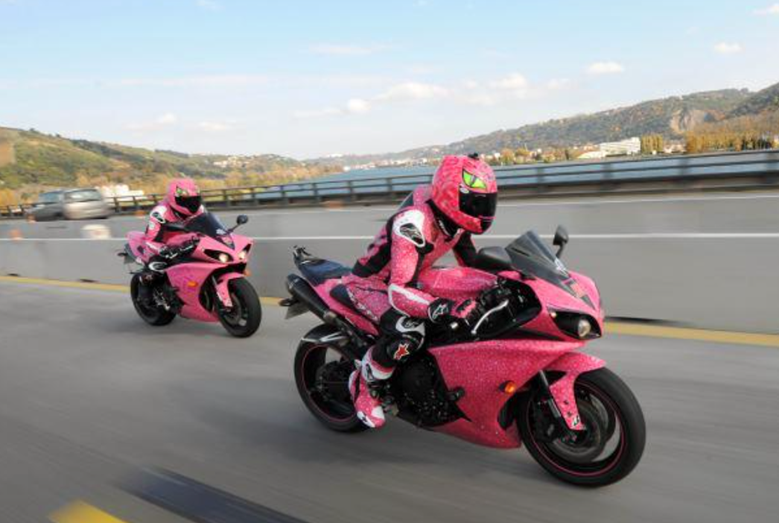
The latter was attended by actor Danny John-Jules who was so impressed with my recommendation of pink as a hi-vis colour, he sent me some photos of him riding his own machine. 

Those bikes are VERY pink!

SOBS has also been recognised internationally. I personally took SOBS to New Zealand for their month-long Shiny Side Up roadshows in 2018 and 2019. 


SOBS in the tent at SSU in 2018!

On my second trip in 2019, SOBS was featured in a New Zealand bike magazine, and during the tour I was interviewed for the New Zealand Newshub show.

In 2020, SOBS featured on the US REVVTalks series and it was one of the presentations for the RoadSafetyGB powered two wheeler event earlier this year (2021).

And I made a virtual return for the 2021 Online SSU event after the roadshow was curtailed by a lockdown in New Zealand. 

The present…

Earlier this year I was informed that all elements of Biker Down in Kent would be brought ‘in-house’ and subsequently, the associated fire services decided it was time for a fresh presentation. 

And so, nearly a decade after I first put the pilot presentation together for firefighter Jim Sanderson at Kent, SOBS is no longer a part of Biker Down. 

And next, the future…

And so it’s time to relaunch Science Of Being Seen as a standalone project. 

And the first step along that path is added by this great work by David Williams on the Devitt website.  

I hope even more riders will become aware of the issues because SOBS provides vitally important information to ALL motorcyclists and drivers as it explains why motorcycles aren’t seen at junctions. 

And to ensure that SOBS remains in rider consciousness, I’ll be running a series of Science Of Being Seen LIVE ONLINE webcasts.

It’s YOUR CHANCE to see the ORIGINAL and FULL presentation, but constantly UPDATED with the most recent research.

The presentation explores a range of problems: 

:: ‘looked but COULD NOT see’ collisions, where for various reasons – including ‘beam blindness’ and the ‘constant bearing issue’ – it was physically impossible for the driver to see the motorcycle in the run up to the crash

:: ‘looked but FAILED TO see’ collisions, where the bike was in a place it could be seen but visual perception issues meant that the driver failed to spot the bike

:: ‘looked, SAW AND FORGOT’ collisions where short term visual memory and workload issues meant that the driver was likely to have seen the bike but mentally lost track of it

:: ‘looked, SAW AND MISJUDGED speed and distance’ collisions, which tend to happen on faster roads

We’ll also take an objective look at the effectiveness or otherwise of the usual ‘passive safety’ conspicuity aids – hi-vis clothing and day-riding lights (DRLs), before suggesting some general rules to make them more effective.

And the talk concludes with an explanation of the concept of a ‘Two to Tangle’ collision where someone else makes the initial error but the motorcyclist fails to take evasive action, then offers some simple pro-active measures any rider can take to reduce the risks of being caught up in a SMIDY collision themselves. 

NEXT PRESENTATION: Wednesday 6 October @ 8 PM.  

EVENT LINK

http://thq.fyi/se/3279523bdcc9

TICKETS ARE JUST £5. Attendance is limited to 30 people per event. YOUR ACCESS CODE WILL BE EMAILED TO YOU APPROXIMATELY 24 HOURS BEFORE THE EVENT.

Look out for future webcasts on the first Wednesday of alternate months. 

I hope to see at least a few of you there!

“The Science Of Being Seen – understanding visual perception and motorcycle conspicuity” – a presentation from Kevin Williams of Survival Skills Rider Training.

Find out more about the SOBS project at https://scienceofbeingseen.wordpress.com
Support the SOBS project at www.ko-fi.com/survivalskills
Find out about Survival Skills post-test training courses at www.survivalskills.co.uk
Follow Survival Skills on Facebook at www.facebook.com/survivalskills

What’s easier to see – a bike? Or a bus?

A few years back, I came across an interesting experiment. And the results may well surprise you.

But first, some background. Historically, we’ve been aware that motorcycles are hard to spot – low salience in the jargon – so research has largely focused on enhancing drivers’ ability to detect motorcycles. Hence the focus on conspicuity issues, and interventions such as day riding lights, novel lighting arrangements, brightly coloured or reflective clothing, helmets and fairings.

But although research has shown that these interventions sometimes have positive effects, the fact is that drivers still “look but do not see” motorcycles.

More and more research has focused on just how we see the world around us – the topic of visual perception. As we’ve seen in articles here, we’re all subject to looking at an object in ways that change depending on context.

In one instance, researchers suggested that our prior experience changes the way we search a scene:

“When viewing a photograph or scene observers most commonly fixate on the most physically salient regions first, but if the observers have relevant content expertise (for example, a history student viewing a photograph of artefacts from the US Civil War) then they focus less on physically salient areas and more on semantically meaningful areas.” ((Humphrey & Underwood, 2009)

This aligns with studies that suggest that motorcycle license holders have that ‘relevant content expertise’, and that as a result, ‘dual-drivers’ are better at detecting motorcycles than drivers without experience riding on bikes. We pick out the ‘semantically meaningful areas’ – ie, other motorcycles – more rapidly from the other features.

This same phenomenon is seen when we look at paintings. Eye-tracking shows that rather than study the entire picture for meaning, our brain takes short-cuts to direct our attention to limited parts of a scene. And just WHICH parts we study changes depending on the question asked.

So one team of researchers suggested that an observer’s ability to detect motorcycles could be changed by making that observer more aware of motorcycles, and that they would do this by the simple expedient of showing a group of drivers a traffic scene containing more motorcycles.

Because motorcycles are hard to spot, the researchers deliberately picked two test objects for their experiment; a bike but also a bus, something which certainly isn’t low salience.

This is how the experiment worked.

The simulator was based on a vehicle cab constructed from genuine vehicle parts and standard controls together with an audio feed, to give an accurate ‘look and feel’, whilst the visual environment was provided by three 19″ screens providing a 120 degree view and what the researchers describe as ‘medium fidelity’.

The test drives were set in urban areas, with regular intersections and with a 60 kph / 37 mph speed limit. Apart from the target vehicles, everything else was four-wheeled. Vehicles appeared from right and left, as well as ahead. Traffic was moderate, with the target vehicles appearing at random.

The drivers were split into two groups, placed in the simulator and sent on a 7.5 kilometre ‘exposure’ drive. All they had to do was drive following normal road rules, but the traffic stream was different. One group encountered an unusually high number of motorcycles with no buses appearing. The other drove with an unusually high number of buses but with no motorcycles appearing.

Having completed that, both groups were sent on a second, longer 39 km drive, where they were asked to count the number of motorcycles or buses they saw, and they were told that their reaction time and accuracy were both being measured.

In this longer drive, the ‘high motorcycle prevalence’ drive contained 120 motorcycles and 6 buses. In the ‘high bus prevalence’ drive, the numbers were reversed, with just 6 motorcycles and 120 buses.

Two custom buttons on the steering wheel allowed the subjects to respond by pressing the appropriate button when they detected the targets. At the same time, their driving performance was monitored by a range of sensors including speed, lateral position, braking and acceleration.

The participants were recorded as having missed a target if they failed to respond, or responded after the target had passed them.

You’ll probably not be surprised that the drivers told to look for buses missed seeing some motorcycles. You probably WILL be surprised that when tasked with looking for motorcycles, drivers missed a greater number of buses.

That’s almost certainly not what we’d expect.


NOW AVAILABLE – LIVE SOBS PRESENTATIONS
CHECK OUT SURVIVAL SKILLS ONLINE TALK SERIES – NEW!

https://survivalskills.tidyhq.com/public/schedule/events


Before you panic, most of the drivers successfully detect ALL vehicles. The detection rate was actually over 99%.

But looking at the less than 1% of cases where drivers failed to see one or the other, 68% detected all buses and 78% detected all motorcycles.

What we’re seeing here is research based on on something called the ‘prevalence effect’. The original theory grew out of research into detection issues in medical screening procedures. Highly trained staff looking through microscopes at tissue samples tend to miss the rare anomalies, even though they know what they are looking for.

In effect, motorcycles are just like those medical anomalies because we make up less than 1% of traffic on UK roads. Although drivers know they will encounter motorcycles and should “Think Bike”, the researchers wondered that if they are so rare that drivers subconsciously don’t expect to encounter any and instead focus on other parts of the scene.

Now, I must make clear again that this isn’t ‘carelessness’, it isn’t ‘not looking properly’, it isn’t ‘bad training’ and it isn’t any of the other blame-game explanations we so commonly see. What it is, is yet another example of the hidden power (and weakness) of the brain, working far below the level of our awareness.

Of course, the participants in both groups didn’t realise they hadn’t seen some of the motorcycles or some of the buses. As far as the brain’s concerned, “what we see is all there is”.

The authors’ conclusion was that the detection rates for motorcycles would be improved by the ‘simple’ expedient of putting more motorcycles on the road.

Not too surprisingly the research has been picked up by interested outfits such as FEMA and the MCIA and used as evidence that motorcycles should be promoted as a means of transport to make them safer.

In reality, we’re not about to see floods of powered two-wheelers on the roads, and drivers detection rates are not going to snowball overnight.

But don’t forget the reverse prevalence effect operates. We’re used to seeing plenty of cars – it’s easy enough for us to spot them. All we have to do is understand the Science Of Being Seen to see how drivers make ‘looked but did not see’ mistakes, then take the necessary action to avoid the collision! No Surprise? No Accident!

Reference:

Can Drivers’ Expectations and Behaviour Around Motorcycles Be Influenced by Exposure?
Beanland, Lenne and Underwood