Remember, on a bike you’re a magician…

…and your ability is to make yourself invisible!

Three years ago, Duncan McKillop wrote this perceptive statement:

“Human beings refuse to believe that their eyes can be fooled yet stage magicians have been fooling people’s eyes for centuries! This is because we do not understand that the world we see ‘out there’ is in fact a construction that has been built entirely ‘in here’ inside our brain.

“The magician knows this and knows how easy it is for us to construct an incorrect model of the world in response to the way he performs his craft. People know that if they go to a night of magic that the magician is going to fool their eyes, but even with that certain knowledge the magician still manages to pull off their tricks.

“If we know we are going to be fooled and still get fooled what does that say about the link between knowledge and perceptual ability?

“In SMIDSY’s and similar collisions it’s the rider that’s taking the place of the magician and fooling their audience into thinking they are not really there.”

Duncan hits the nail on the head.

Understanding that the world ‘out there’ is a construct of our brain is absolutely essential, as is understanding that we need to KNOW we can be fooled.

Unfortunately, when it comes to riding and to SMIDSY-style collisions between cars and bikes, we have two additional problems:

  • our car-driving audience isn’t aware that they can be tricked by the biker!
  • the motorcyclist isn’t aware that he / she is a magician and about to fool the audience of drivers!

And that’s why I have spent a lot of time working on my Science of Being Seen (SOBS) project here and over on my www.facebook.com/survivalskills page. It’s time for riders across the world to learn how the magic works!

ORIGINALLY POSTED MARCH 2018 on FB

Ko-fi_Red
Help support SOBS – and open up access to HUNDREDS of ‘Better Biking’ articles – just buy me a coffee!
Each cuppa keeps me awake, researching and writing! Thank you.
https://ko-fi.com/survivalskills
COPYRIGHT © 2011 – 2021 Kevin Williams and Survival Skills Rider Training
This work is licenced under a Creative Commons Attribution-NonCommercial-Sharealike 4.0 International License.

Kevin Williams has asserted his right under the Copyright, Designs and Patents Act, 1988, to be identified as the author of this work.

IMPORTANT: The material is free to all to access and use under a Creative Commons Attribution-NonCommercial-ShareAlike 4.0 International License. That means you can share it with your family and friends, and re-use it for club magazines and websites, so long as you acknowledge the source and author and include the same Creative Commons license in the derived works.

This Creative Commons license excludes commercial use. If you wish to use any of my work for commercial purposes, including (but not limited to) articles in pay-for magazines or commercial websites, please contact me.

Photo credit Paul Townsend https://www.flickr.com/photos/brizzlebornandbred/20001313491
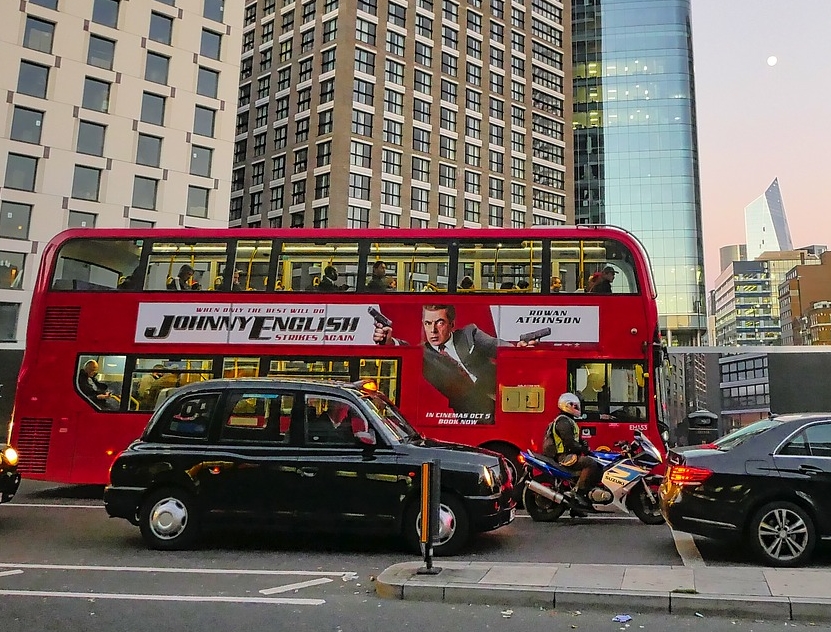
How can you not see… a bus?

One of the factors implicated in car / powered two wheeler collisions is that we see what we’re expecting to see – the less frequently we encounter a particular type of vehicle, the more likely that type is to ‘fall off the search radar’. The mere fact that motorcycles are less common than cars on the roads actually makes it harder for drivers to notice them, according to Vanessa Beanland of The Australian National University.

“I didn’t see it, because I wasn’t expecting it there” is an issue I’ve been aware of for some time. There are the insurance stories of drivers who turned into the wrong driveway and “hit a tree that isn’t there”. They may be anecdotal but they illustrate the point that we all tend to see what we expect to see.

So whether this really is the first research team that has actually “published results on how it influences people’s ability to safely perform dynamic tasks, such as driving” as claimed, I don’t know but it certainly highlights something motorcyclists SHOULD be aware of.

It’s an important piece of work on the topic of motorcycle conspicuity because the interesting thing is that they not only show that a small, hard-to-spot object like a motorcycle can be missed by drivers, the paper shows that it’s not just size that matters – road users also take longer to spot something as big as a bus if it’s not something that they see frequently.

This is called the ‘low-prevalence effect’ and it increases the likelihood of collisions as well as degrading a person’s ability to search through static images, such as workers screening airport luggage or biological samples for cell anomalies.

Beanland’s team used a driving simulator experiment involving 40 adult drivers to investigate whether it is easier for drivers to detect and respond to specific types of vehicles when they occur more frequently in surrounding traffic.

The drivers had to detect two types of vehicles: motorcycles and buses.

The researchers varied how frequently these vehicles appeared. Half of the subjects were subjected to a high prevalence of motorcycles and a low number of buses, with the other half experiencing the reverse.

Although participants were explicitly instructed to search for both buses and motorcycles, the researchers found that the attention of the observers was biased toward whichever vehicle occurred more frequently during the simulated detection drive.

This in turn affected the speed at which drivers were able to detect low-prevalence targets. Even an object the size of a bus took longer to spot when they didn’t appear often.

In the simulated test in which motorcycles occurred more frequently, the car drivers were able to detect them on average from 51 meters farther away than in the tests where they occurred less often. In effect, at a driving speed of 60 km/h, this allowed the drivers an extra 3 seconds to respond.

And here’s the really surprising result. Drivers gained an extra 4.4 seconds to react to buses in the simulations where they occurred more frequently.

This is likely to be linked to what’s known as the ‘priming effect’. A ‘seed’ event or image will trigger associative memories relevant to that event or image, speed up retrieval of appropriate responses from memory, and make the processing of that response quicker. A very simple example is how it takes a moment to react to the first motorcycle when we see a group out riding, but when the second, third and subsequent bikes appear, we’re ready for them.

The results suggest that drivers’ inability to always notice motorcyclists is partially due to the fact that motorcycles occur relatively rarely on our roads, and that drivers are simply not on the look-out for them.

“Drivers have more difficulty detecting vehicles and hazards that are rare, compared to objects that they see frequently”, says Beanland, who believes that the ability to accurately perform visual searches is crucial to ensuring safe driving and avoiding collisions.

Unfortunately, training drivers to look for bikes isn’t the answer – there have been education programmes exhorting drivers to ‘Think Bike’ since the mid-1970s! They have limited effect because most of the time, there isn’t a motorcycle in the driver’s field of view that has the potential to be missed in the first place. So such programmes may have some short term effects, but as drivers continue NOT to encounter bikes, the advice to ‘look twice’ or ‘look harder’ is forgotten…

…right up to the moment that the driver DOES miss spotting a bike in traffic.

That being the case, it’s difficult to see how to get drivers to spot motorcycles more effectively, other than by increasing the numbers of bikes on the road, a proposal that has been eagerly put forward by the Motorcycle Industry Association here in the UK.

More realistically, the solution is – much as motorcyclists hate to admit it – down to us. It takes two to tangle; the driver may create the circumstances in which a collision can happen but we should be able to see it coming and stay out of it too.


Reference: Beanland, V. et al. (2014) Safety in numbers: Target prevalence affects the detection of vehicles during simulated driving, Attention, Perception, & Psychophysics. DOI 10.3758/s13414-013-0603-1

Image by Albrecht Fietz from Pixabay